How AI Governance Tools Are Stopping Costly Data Breaches in 2026
Discover how AI governance tools protect your business from costly data leaks. Learn risks, solutions, and best practices for 2026.
June 30, 2026
Written by

Introduction
As AI becomes deeply embedded across enterprise operations, a critical question is emerging: how secure is the data flowing through your AI systems?
From customer support and software development to analytics and decision-making, AI is transforming the way organizations work. However, this adoption is also creating new vulnerabilities that traditional security frameworks were never designed to address. Without effective data leak prevention measures, even a single AI interaction can expose sensitive business information.
For enterprise leaders, the challenge goes beyond security. Regulatory scrutiny is increasing, customers expect stronger accountability, and trust has become a business asset that is difficult to rebuild once lost.
This is why AI governance tools are rapidly becoming a core component of enterprise AI strategies. They help organizations strengthen AI data security, maintain visibility across AI systems, and establish the controls needed to manage risk at scale.
So, what exactly are AI governance tools, how do they prevent data leaks, and why are they becoming essential for enterprises in 2026? Let's deep dive into it.
The Growing Risk of Data Leaks in AI-Driven Enterprises
As AI adoption accelerates, organizations are discovering that traditional security frameworks were not designed to manage the unique risks introduced by modern AI systems.
How AI Systems Create New Data Exposure Risks
AI systems rely on data to generate value. However, this dependence on data also creates new opportunities for exposure.
Shadow AI Usage
Employees frequently use public AI tools without organizational approval. Often referred to as shadow AI, this practice involves entering sensitive information into external platforms without governance controls. Organizations may have no visibility into what data is being shared, where it is stored, or how it is used.
Prompt Injection and Data Leakage
Attackers can manipulate AI systems through carefully crafted prompts designed to reveal confidential information or bypass safeguards. Prompt injection attacks have become one of the most discussed AI security risks because they exploit the model itself rather than the surrounding infrastructure, especially as AI agent systems become more autonomous and interconnected.
Model Training Risks
Many organizations train or fine-tune AI models using proprietary datasets. Without proper governance, sensitive information may inadvertently become embedded in model outputs or exposed through unintended interactions.
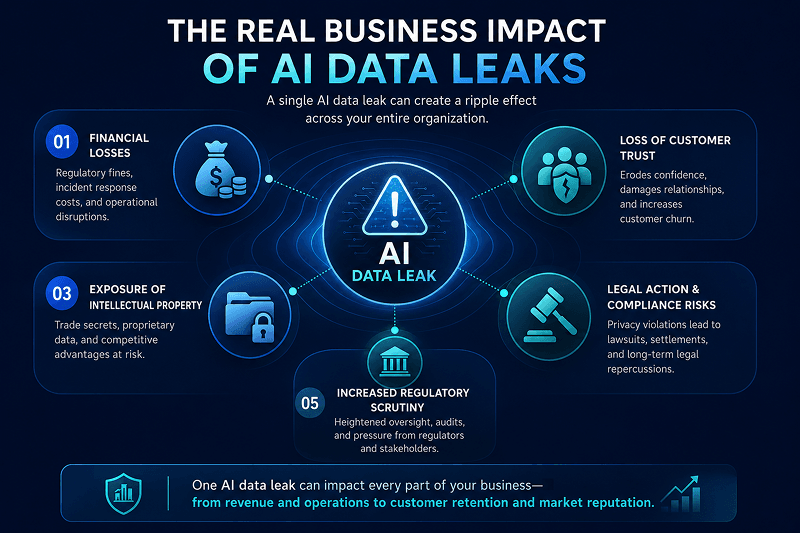
Real Business Impact of AI Data Leaks
What Are AI Governance Tools?
AI governance tools are platforms, frameworks, and technologies designed to manage, monitor, and control AI systems throughout their lifecycle. These capabilities are also central to building an enterprise AI governance framework that can manage risk, compliance, and accountability at scale.
Unlike standalone security solutions, AI governance solutions focus specifically on ensuring that AI systems operate safely, transparently, ethically, and in compliance with organizational policies and regulatory requirements.
Their role spans the entire AI lifecycle:
| AI Lifecycle Stage | Governance Function |
| Development | Establish policies, data controls, and model approval processes |
| Training | Monitor data quality, lineage, and risk exposure |
| Deployment | Enforce access controls and governance policies |
| Operations | Monitor performance, compliance, and security risks |
| Continuous Improvement | Audit outcomes, track changes, and maintain accountability |
A common misconception is that governance and security are the same thing. Security tools primarily focus on protecting systems from external threats. Governance tools focus on ensuring AI systems behave according to organizational rules, compliance requirements, and ethical standards.
In other words, security protects infrastructure. Governance protects how AI operates within that infrastructure.
Why AI Governance Tools Are Critical in 2026
AI is no longer limited to pilot projects or isolated use cases. In 2026, enterprises are integrating AI into customer interactions, software development, business operations, decision-making, and knowledge management at an unprecedented scale.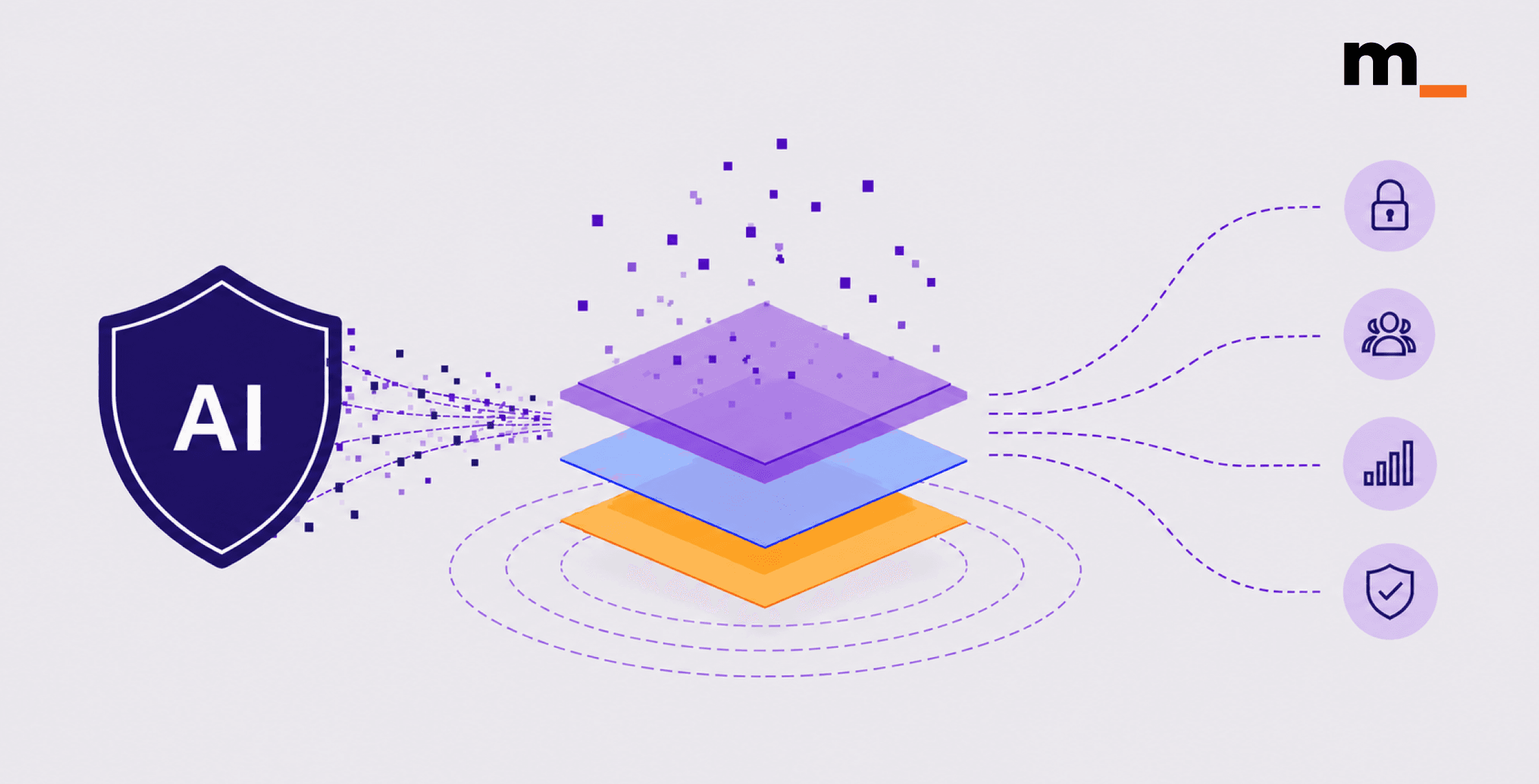
AI Is Expanding Faster Than Traditional Controls
Across industries, employees are using AI-powered copilots, chatbots, analytics platforms, and autonomous agents to automate workflows and improve productivity. Many organizations now manage dozens or even hundreds of AI models across different teams and departments.
Without governance, businesses struggle to answer critical questions:
- Who is using AI across the organization?
- What data is being shared with AI systems?
- Which models are making business decisions?
- Are AI outputs accurate, fair, and compliant?
As AI becomes embedded in core business processes, a single governance failure can create operational, legal, and reputational consequences across the enterprise, particularly as organizations also need to prepare for evolving AI-driven security threats and response mechanisms.
Regulatory Expectations Are Rapidly Increasing
Global regulators are moving beyond broad AI principles and introducing more specific requirements around transparency, accountability, risk management, and data protection.
Organizations are increasingly expected to demonstrate AI compliance:
- Document how AI systems are developed and used
- Monitor AI-related risks continuously
- Demonstrate compliance through audit trails and reporting
- Protect sensitive customer and business data
- Establish clear accountability for AI-driven decisions
The challenge is no longer simply adopting AI. It is proving that AI is being deployed responsibly and in accordance with evolving regulatory expectations.
Trust Has Become a Competitive Advantage
Customers, employees, investors, and regulators are paying closer attention to how organizations use AI. Businesses that cannot explain how their AI systems operate or how risks are managed may face growing skepticism and reduced trust.
Building trustworthy AI requires:
- Transparency into AI decisions and data usage
- Accountability across teams and stakeholders
- Strong data protection controls
- Bias detection and mitigation processes
- Explainability for high-impact decisions
- Continuous monitoring and oversight
AI governance tools provide the structure needed to operationalize these principles at scale.
Ready to Build an AI Governance framework that scales with your Business?
Consult MillipixelsHow AI Governance Tools Prevent Data Leaks
The primary value of AI governance tools lies in their ability to proactively reduce risk while enabling innovation.
Monitoring AI Usage Across Systems
One of the biggest challenges enterprises face is understanding how AI is being used across departments. Employees often interact with multiple AI tools, copilots, and automation platforms, creating potential blind spots for security teams.
- AI governance platforms provide centralized visibility into:
- Which employees and teams are using AI applications?
- What AI models and tools are being accessed?
- Which internal and external data sources are connected?
- How frequently AI systems are being used?
- Where potential policy violations or risky activities occur?
This visibility allows organizations to detect shadow AI usage, uncover unauthorized integrations, and identify behaviors that could expose sensitive business information. Simply put, organizations cannot protect what they cannot see.
Access Control and Data Permissions
Not every employee should have access to every dataset, model, or AI capability.
Without proper controls, users may unintentionally expose confidential information, proprietary data, customer records, or intellectual property through AI interactions. AI governance tools help organizations implement:
- Role-based access controls (RBAC)
- Data classification and sensitivity policies
- Department-specific usage restrictions
- Approval workflows for high-risk AI activities
- Granular permissions for models, datasets, and integrations
For example, a customer support employee may require access to support knowledge bases but should not have access to financial records, legal documents, or proprietary research data.
By enforcing least-privilege access principles, governance platforms significantly reduce the risk of accidental or unauthorized data exposure, a capability that becomes even more critical as enterprises expand into intelligent process automation in large-scale AI-driven environments.
 Real-Time Risk Detection
Modern AI governance platforms continuously monitor AI activity to identify behaviors that may indicate security, compliance, or data protection risks, while AI-driven threat intelligence can help organizations identify emerging threats and prioritize responses.
Potential threats include:
- Unauthorized sharing of confidential information
- Uploading sensitive data into external AI tools
- Violations of internal AI usage policies
- Unusual user behavior or access patterns
- Prompt injection and adversarial attacks
- Attempts to bypass security controls
When suspicious activity is detected, governance tools can trigger real-time alerts, automate responses, or block high-risk actions before sensitive data leaves the organization. These capabilities not only improve AI governance but also support effective remote IT risk management by enabling security teams to monitor and mitigate risks regardless of where employees work. This becomes increasingly critical as AI is now involved in 83% of reported security breaches, according to Gigamon’s 2026 Hybrid Cloud Security Survey, highlighting how quickly AI-driven threats are outpacing traditional detection and response mechanisms
Audit Trails and Transparency
When an AI-related incident occurs, organizations need clear answers about what happened, who was involved, and what data may have been affected. AI governance solutions create comprehensive audit trails that record:
- User interactions with AI systems
- Prompts and AI-generated outputs
- Data access and sharing activities
- Model decisions and recommendations
- Policy modifications and approvals
- Compliance and governance actions
These records provide the transparency needed for investigations, internal reviews, regulatory audits, and compliance reporting.
What Millipixels Is Seeing Across Enterprise AI Adoption
Across multiple enterprise AI implementations, a clear pattern is emerging: AI governance is no longer treated as a compliance layer added after deployment, but as a core enabler of scalable and responsible AI adoption.
In earlier stages of AI adoption, governance was often equated with regulatory checklists and risk mitigation. However, as organizations move from experimentation to production-scale generative AI, this view is shifting rapidly.
At Millipixels, based on our experience working with enterprise teams across AI strategy and implementation, we have consistently seen that organizations move faster when governance is embedded from the start rather than layered on later. Once visibility, accountability, and control mechanisms are in place, internal confidence in deploying AI increases significantly across business functions.
Rather than slowing innovation, governance is increasingly acting as the foundation that enables it—allowing teams to scale AI use cases with greater speed, safety, and trust.
For a deeper look at how enterprises should evaluate their AI ecosystem before scaling, read:
How to choose a generative AI integration partner for enterprise software in 2026 (CTO Checklist)
Key Features of AI Governance Tools
Not all AI governance solutions offer the same capabilities, but several features have become increasingly important. Below are a few of those:

AI Governance vs Traditional Security Tools
Many organizations assume their existing security stack is sufficient. However, AI introduces challenges that traditional security tools were not built to address.
Traditional cybersecurity solutions remain essential, but they cannot provide the specialized oversight required for AI systems.
This is why organizations increasingly view AI governance and cybersecurity as complementary disciplines rather than competing investments.
Use Cases of AI Governance in Enterprises
Enterprise AI governance is relevant across industries and business functions.
SaaS Companies
SaaS providers increasingly embed AI into product experiences, copilots, and software development workflows. Governance helps prevent customer data exposure, monitor model behavior, and ensure AI-powered features comply with security and privacy requirements.
Healthcare
Healthcare organizations use AI for clinical documentation, diagnostics, patient engagement, and operational efficiency. Governance solutions help protect patient data, enforce privacy regulations, and maintain transparency in AI-assisted decisions.
Finance
Banks, insurers, and fintech companies rely on AI for fraud detection, risk assessment, lending, and customer service. AI governance improves model accountability, supports regulatory compliance, and reduces the risk of biased or opaque decision-making.
Customer Support AI
Organizations deploy AI agents to handle customer inquiries, automate responses, and assist support teams. Governance ensures these systems follow company policies, protect sensitive customer information, and deliver accurate, consistent, and auditable responses across all customer interactions.
How to Choose the Right AI Governance Tools
Use this checklist to quickly evaluate any AI governance platform:
Core Capabilities
☐ Real-time AI model monitoring
☐ Data leakage and sensitive information detection
☐ Policy enforcement across AI tools and workflows
☐ Audit logs for all AI interactions
☐ Bias, fairness, and risk monitoring
Compliance & Security
☐ Supports relevant regulations (e.g., GDPR, HIPAA, SOC 2)
☐ Strong data privacy and access controls
☐ Secure handling of prompts, outputs, and training data
☐ Automated compliance reporting
Integration & Scalability
☐ Easy integration with existing AI/ML stack
☐ Works across multiple models (LLMs, APIs, custom models)
☐ Scales across teams, products, and environments
☐ Minimal disruption to current workflows
Visibility & Reporting
☐ Centralized dashboard for AI activity
☐ Customizable reports for stakeholders
☐ Incident tracking and alerting system
☐ Usage analytics and model performance insights
Vendor & Operational Fit
☐ Clear documentation and implementation support
☐ Proven expertise in AI governance or enterprise security
☐ Transparent pricing and predictable total cost
☐ Roadmap aligned with future AI expansion
Future of AI Governance
The next phase of AI governance will be shaped by increasing automation, expanding AI autonomy, and rising regulatory pressure. As AI systems move from assistive tools to autonomous agents, governance will evolve from static oversight to continuous, embedded control mechanisms across the AI lifecycle.
Within this evolving landscape, Millipixels anticipates a few major shifts that will define how enterprises operationalize AI governance:
Agentic AI Governance
As AI agents take on more complex tasks, governance will extend beyond monitoring outputs to tracking decisions, actions, and end-to-end workflows. This shift will require deeper visibility into how AI systems behave in real operational environments, not just how they respond.
Automated Compliance
Governance platforms will increasingly map AI activity directly to regulatory frameworks, automatically generating compliance evidence and documentation. This will reduce reliance on manual audits and make compliance a continuous, system-level function.
Real-Time Monitoring Systems
Instead of periodic reviews, organizations will move toward always-on monitoring that detects anomalies, policy violations, and risk signals as they happen, enabling faster intervention and tighter control.
In fact, studies from IBM’s Cost of a Data Breach Report show that organizations with security AI and automation in place identify and contain breaches 108 days faster on average than those without, significantly reducing the window of exposure for sensitive data and AI-driven systems.
Conclusion: AI Governance Tools for Secure and Responsible Enterprise AI Growth
AI is rapidly reshaping how organizations operate, innovate, and compete. But as adoption accelerates, so do risks around data exposure, compliance gaps, and erosion of stakeholder trust.
This is why AI governance tools have become essential for modern enterprises. They provide the visibility, control, and accountability needed to strengthen AI data security, prevent data leaks, and enable responsible AI adoption at scale.
Organizations that treat governance as an afterthought risk falling behind on regulation, security, and trust expectations. Those that build governance early are better positioned to scale AI safely and sustainably.
At Millipixels, we help enterprises design and implement secure, scalable AI systems—from governance frameworks and risk assessments to end-to-end AI strategy and execution.
Ready to strengthen your AI governance? Connect with Millipixels to build a governance strategy that protects your data and enables responsible AI growth.
Frequently Asked Questions
1.What are AI governance tools used for enterprises?
AI governance tools help enterprises manage, monitor, and control AI systems throughout their lifecycle. They provide visibility into how AI models are developed, trained, deployed, and used across the organization. These tools help enforce policies, manage access permissions, track data usage, and ensure compliance with internal and external regulations.
2.What are the best tools for managing AI risks and preventing data leaks?
The best AI governance tools combine policy enforcement, model monitoring, compliance reporting, and risk detection capabilities within a single platform. Solutions from providers such as IBM, Microsoft, Dataiku, Credo AI, Fiddler, and Holistic AI are commonly used by enterprises looking to strengthen oversight and improve data leak prevention strategies.
The ideal solution depends on organizational requirements. Businesses operating in highly regulated industries often prioritize compliance automation and audit trails, while AI-driven SaaS companies may focus on model monitoring and usage visibility.
3.What is included in an AI governance tools list?
A comprehensive AI governance tools list typically includes platforms that support policy management, model monitoring, bias detection, explainability, compliance reporting, risk assessment, and data lineage tracking. These tools help organizations establish control over AI systems while maintaining transparency and accountability.
4.Are open-source tools effective for AI governance in organizations?
Open-source AI governance tools can be effective for organizations with strong technical teams and specific governance requirements. They often provide flexibility, customization, and cost advantages compared to commercial platforms.
However, enterprises operating at scale frequently require advanced features such as automated compliance reporting, enterprise integrations, vendor support, and continuous monitoring capabilities.
5.What do industry analysts like Gartner say about AI governance and enterprise risk management?
Industry analysts, including Gartner, consistently emphasize that effective AI governance tools are becoming a critical component of enterprise risk management. Their research highlights the importance of establishing governance frameworks that address transparency, accountability, compliance, security, and responsible AI deployment.
6.How do AI governance tools help reduce the risk of data leaks in AI systems?
One of the primary functions of AI governance tools is strengthening data leak prevention across AI environments. These platforms monitor AI usage, enforce access controls, classify sensitive data, and detect potentially risky interactions in real time. By creating visibility into how data flows through AI systems, organizations can identify vulnerabilities before they become serious incidents.
7.Why is AI governance becoming critical for enterprises in 2026?
Enterprise AI governance is becoming critical because AI systems are moving from experimental use cases to mission-critical business operations. Organizations are increasingly relying on AI for customer interactions, analytics, software development, and decision-making, making governance essential for managing associated risks.
At the same time, regulatory scrutiny is increasing worldwide. Enterprises must demonstrate accountability, transparency, and compliance while ensuring AI systems operate securely and responsibly. Governance frameworks provide the structure needed to scale AI adoption while maintaining trust and minimizing operational risk.
8.What are the main goals of AI governance initiatives in organizations?
The primary objective of AI governance initiatives is to ensure that AI systems operate safely, ethically, transparently, and in compliance with business policies and regulatory requirements. Governance initiatives help organizations establish accountability while reducing risks related to security, bias, privacy, and model performance.
9.Which companies are leading in generative AI governance solutions?
Several companies are emerging as leaders in AI governance solutions, including IBM, Microsoft, Credo AI, Dataiku, Fiddler, Holistic AI, and Google Cloud. These providers offer capabilities such as model monitoring, compliance management, explainability, policy enforcement, and AI risk management.
10.What features should organizations look for in AI governance platforms?
When evaluating AI governance solutions, organizations should prioritize features such as policy enforcement, model monitoring, risk detection, audit trails, compliance reporting, data lineage tracking, explainability, and access control management.
Written by

Parthsarathy Sharma
With 4+ years of experience across AI, UX, GCC/outsourcing, enterprise technology, and brand strategy, Parthsarathy brings a research-driven lens to digital experience content. His work focuses on turning emerging technology, customer experience, and business trends into clear, practical perspectives for readers.