The Micro GCC Blueprint: Setting Up Purpose-Built Tech Teams in 2026
Micro GCC 2026 guide for US companies to build purpose-built tech teams in India with the right setup model, cost, timeline, governance, ROI, and partner.
June 23, 2026
Written by

Introduction
The old offshore question was simple: “How do we reduce delivery cost?”
That question is now too small.
In 2026, US companies are not only looking for lower-cost engineering capacity. They are looking for purpose-built tech teams that can own product roadmaps, modernize platforms, build AI capabilities, strengthen DevOps, improve customer experience, and work as an extension of the business.
That is why the Micro GCC 2026 conversation matters.
India’s Global Capability Center ecosystem has moved far beyond back-office delivery. The Zinnov-Nasscom GCC Landscape in India 2026 report counts 2,117 GCCs, $98.4 billion in market revenue, 2.36 million professionals, and more than 506 Forbes Global 2000 companies operating GCCs in India. Reuters also reported that North American companies account for about two-thirds of new GCC setups in India.
But not every company needs a 500-person center. Many mid-market firms, SaaS businesses, AI-native companies, and growth-stage enterprises need something sharper.
They need a compact team with the control of a captive center, the speed of an offshore model, and the governance to protect long-term value.
That is the role of a Micro GCC.
This guide explains what a Micro GCC is, how it differs from outsourcing and traditional GCCs, what it costs, how to set one up, and how US companies can use the model to build purpose-built tech teams in India.
What is a Micro GCC?
A Micro GCC is a smaller, focused Global Capability Center built around a specific business or technology capability.
Unlike a traditional GCC, which may start with a broad operating charter and large-scale hiring, a Micro GCC usually begins with a compact team aligned to a clear mandate. That mandate could be AI engineering, product development, DevOps, data engineering, platform modernization, UX, analytics, QA automation, or customer technology operations.
A simple definition:
A Micro GCC is a lean offshore capability center that gives companies dedicated talent, stronger control, better continuity, and direct ownership without the complexity of setting up a full-scale captive center on day one.
The difference is not just size. It is intent. A Micro GCC is not a vendor bench. It is not a loose AI staff augmentation setup. It is not a traditional offshore development center working through tickets.
It is a designed team that understands the product, the workflows, the systems, the business context, and the outcomes that matter.
For many US companies, that makes the model a useful bridge between outsourcing and a mature captive center.
Why US companies are choosing Micro GCCs in India in 2026
US companies are choosing Micro GCCs because the work they want to move offshore has changed.
A decade ago, offshore teams were often used for execution-heavy work. Today, companies are building India-based teams for product ownership, AI development, data engineering, cloud operations, platform reliability, analytics, and customer experience. Reuters reported that India-based GCCs are now managing higher-value functions such as software development, finance, R&D, product support, analytics, and corporate affairs.
The shift is from cost savings to capability control.
1. Companies want owned capability, not just outsourced output
Outsourcing can work well when the task is clear, and the dependency is limited.
But many technology needs are no longer simple tasks. AI products need feedback loops. SaaS platforms need continuous improvement. Data systems need domain context. DevOps teams need to understand release risk. UX teams need to stay close to user behavior.
That kind of work improves when knowledge compounds inside a dedicated team.
2. AI is increasing the need for specialized teams
AI adoption is not just a tooling decision. It needs data pipelines, model governance, integration, security, testing, monitoring, and product thinking. Companies can also turn to outsourced AI development when they need specialized expertise without building a large internal AI team immediately.
A Micro GCC can give companies a focused AI engineering team offshore without building a large enterprise AI unit immediately.
This is especially useful for companies that need to move from experimentation to production but do not want AI work scattered across disconnected vendors.
3. Traditional GCCs can feel too heavy for mid-sized companies
A full GCC can be powerful, but it can also require legal setup, leadership hiring, finance operations, HR systems, compliance, real estate, local management, and long planning cycles.
For many small and mid-sized US companies, that is too much too early.
A Micro GCC offers a more disciplined starting point. Start with a team of 8, 12, or 20 people. Prove the capability. Build governance. Expand only when the operating model is working.
4. The India talent advantage remains strong, but competition is rising
India remains the world’s largest GCC hub, but rising demand for AI, cloud, cybersecurity, and data skills is creating talent pressure. Reuters reported that demand for AI and machine learning skills is outstripping supply, with some tech roles seeing sharp wage inflation. That makes the setup model more important.
A Micro GCC needs a hiring strategy, not just recruiters. The right partner should know how to attract senior talent, reduce attrition risk, protect continuity, and build a team that stays close to the parent company’s product and culture.
Micro GCC 2026 setup process for purpose-built tech teams
A strong Micro GCC setup does not begin with hiring. It begins with clarity. Before adding people, define the capability you want to build, the ownership you expect, and the business outcome the team must support.
Step 1: Define the business capability
Start with the question most companies skip: What should this team make possible that our current model cannot?
Examples include:
Capability | What the Micro GCC should own |
AI engineering | Model integration, AI workflows, RAG systems, agentic workflows, evaluation, and monitoring |
Product engineering | Feature development, architecture support, API development, QA automation, and release velocity |
DevOps and cloud | CI/CD, cloud cost control, observability, uptime, incident response, and platform reliability |
Data engineering | Pipelines, warehouses, BI layers, governance, reporting, and analytics enablement |
UX and product design | Research, product flows, design systems, usability improvements, and conversion journeys |
Integration engineering | ERP, CRM, commerce, payment, workflow, and third-party system integrations |
The clearer the capability, the better the team design.
Step 2: Choose the right setup model
There are four common ways to build a Micro GCC.
Model | Best for | Watch out for |
GCCaaS or managed Micro GCC | Companies that want speed, governance, and a partner-led setup | The contract must protect IP, talent continuity, and operating transparency |
Build-Operate-Transfer model | Companies that want a partner to build and stabilize the team before transfer | Transfer terms should be defined before hiring begins |
EOR model | Companies testing India hiring without setting up an entity | EOR solves employment admin, not capability design |
Full captive setup | Companies ready for long-term legal, HR, finance, and leadership ownership | Higher setup effort and slower launch |
For most mid-sized US companies, GCCaaS or a BOT model offers the best balance between speed and control.
Step 3: Design the team around outcomes
Do not start with a generic “five developers and one QA” structure. Start with the work.
For example, a product engineering Micro GCC may need:
Role | Why it matters |
Engineering lead | Owns technical direction and team maturity |
Backend engineers | Build APIs, business logic, integrations, and platform services |
Frontend engineers | Own product interfaces and customer-facing features |
QA automation engineer | Improves release confidence and reduces regression risk |
DevOps engineer | Strengthens deployment, cloud, monitoring, and uptime |
Product analyst | Connects delivery to product usage and business signals |
The founding team should be senior enough to build context, not just close tickets.
Step 4: Select the location strategy
India’s major GCC hubs include Bengaluru, Hyderabad, Pune, Chennai, NCR, and Mumbai. Tier-two cities are also gaining attention as companies look beyond crowded metros.
The right location depends on the role mix. Bengaluru and Hyderabad are strong for deep tech, product engineering, AI, cloud, and enterprise technology. Pune and Chennai are strong for engineering, manufacturing technology, automotive, SaaS, and enterprise systems. NCR and Mumbai offer strong access to business, product, finance, and corporate functions.
The key is not only where talent exists. It is where the right talent can be hired, retained, and supported.
Step 5: Build governance before scale
Governance should not arrive after the team grows. It should be part of the first sprint.
Define:
Governance area | What to define early |
Ownership | What the Micro GCC owns, co-owns, and does not own |
Decision rights | What the India team can decide independently |
Product rituals | Sprint cadence, planning, demos, retrospectives, and escalation paths |
Security | Device policies, access controls, code repositories, data access, and compliance |
IP protection | Contract terms, code ownership, documentation, and confidentiality |
Performance metrics | Velocity, quality, uptime, rework, cycle time, and business impact |
Communication | Working hours overlap, documentation standards, stakeholder cadence |
A Micro GCC should feel lean, but never loose.
Step 6: Hire for continuity, not only skill
A Micro GCC succeeds when knowledge compounds. That means hiring people who can stay close to the product, understand the domain, and grow into ownership. The talent acquisition strategy should prioritize senior anchors, stable reporting lines, clear career paths, and retention planning.
EY notes that GCCs are moving from cost-driven delivery units to innovation-led strategic hubs, where talent strategy and employee value proposition become central to long-term relevance.
This is why Micro GCC hiring should not be treated like ordinary staffing.
Step 7: Stabilize, measure, and expand
The first 90 days should prove the model.
Track:
Metric | What it tells you |
Time to capability | How quickly the team starts producing meaningful output |
Sprint predictability | Whether commitments match delivery |
Rework rate | Whether quality and context are improving |
Knowledge continuity | Whether the team is retaining product understanding |
Release contribution | Whether the team is moving production work forward |
Stakeholder confidence | Whether global leaders trust the team with more ownership |
Scale only after the team has demonstrated execution quality and operating rhythm.
Planning a Micro GCC in India?
Millipixels helps companies design, build, and scale compact Global Capability Centers for product engineering, AI, DevOps, data, UX, and digital transformation.
Get in touch
Types of purpose-built tech teams you can build through a Micro GCC
The best Micro GCCs are not generic development shops. They are built around a specific capability.
(1) AI and ML engineering team GCC
An AI engineering team offshore can support applied AI development, workflow automation, AI product features, RAG systems, model integration, data preparation, testing, monitoring, and governance.
This model works best when the business already has AI use cases but lacks a dedicated team to take them from prototype to production.
(2) Product engineering offshore team
A product engineering Micro GCC can support SaaS platforms, mobile applications, enterprise portals, customer-facing products, internal tools, and product modernization.
The team can own feature development, APIs, frontend engineering, QA automation, release support, and technical debt reduction.
(3) DevOps team offshore
A DevOps Micro GCC helps companies improve deployment speed, observability, cloud performance, cost optimization, infrastructure automation, and incident response.
This works especially well for SaaS companies and digital platforms where uptime and release quality directly affect revenue.
(4) Data engineering team
A data engineering Micro GCC can build pipelines, warehouses, dashboards, analytics layers, governance processes, and reporting systems.
This is valuable when leadership needs better decision visibility but data is scattered across tools, teams, and business units.
(5) UX and product design team
A UX-focused Micro GCC can support research, product flows, design systems, prototyping, usability testing, and conversion-focused improvements.
This is useful for companies that need continuous product experience improvement without hiring a large in-house design organization.
(6) Integration and platform engineering team
Many companies do not need more apps. They need their systems to talk to each other.
An integration Micro GCC can support CRM, ERP, commerce, payment, workflow, analytics, and support platform integrations.
How much does a Micro GCC cost?
A Micro GCC costs less than a traditional captive center because it starts with a smaller team, lighter infrastructure, and a more focused operating model.
But the real answer depends on five factors:
Cost driver | What affects the budget |
Team size | A 6-person team and a 25-person team have very different operating costs |
Skill mix | AI, cloud, cybersecurity, and senior product roles cost more than standard delivery roles |
Setup model | GCCaaS, BOT, EOR, and captive models have different cost structures |
Governance depth | Security, compliance, reporting, and documentation add cost, but reduce risk |
Location | Talent costs vary across Bengaluru, Hyderabad, Pune, Chennai, NCR, Mumbai, and tier-two cities |
Public offshore rate guides often place India software development rates below US or nearshore equivalents, but rate cards do not show the full cost of ownership. A Micro GCC cost model should include talent acquisition, payroll, benefits, infrastructure, tools, security, management, compliance, retention, and transition planning.

Cost savings should not be the only ROI metric
Cost reduction matters, but it is not the whole business case. A stronger Micro GCC ROI model includes:
ROI area | What to measure |
Cost efficiency | Lower loaded team cost compared to equivalent US hiring |
Hiring speed | Faster access to specialized talent |
Delivery velocity | More predictable product or platform output |
Capability depth | Growth of internal product, AI, cloud, or data capability |
IP ownership | Less dependency on vendor-owned knowledge |
Continuity | Lower disruption from talent churn and vendor changes |
Business impact | Faster launches, better uptime, improved conversion, lower rework |
Millipixels’ own Global Capability Center service page positions its GCC model around cost efficiency, innovation, scalable talent, and measurable delivery, including proof points such as average cost reduction, multi-country delivery, on-time completion, SLA compliance, and repeat business.
GCC vs outsourcing vs ODC comparison
A Micro GCC sits between outsourcing and a full captive center.
Model | Control | Speed | Ownership | Best fit |
Traditional outsourcing | Low to medium | Fast | Vendor-owned delivery | Defined projects, short-term execution, limited strategic dependency |
Offshore Development Center | Medium | Medium | Shared or vendor-managed | Larger delivery teams with some continuity |
Managed GCC | High | Medium to fast | Company-aligned, partner-operated | Companies that want control without full operating burden |
Micro GCC | High | Fast | Dedicated and capability-led | US companies building focused tech teams in India |
Full captive GCC | Very high | Slower | Fully owned | Large enterprises ready for long-term India operations |
Nearshore model | Medium | Fast | Usually vendor-managed | Communication-heavy work needing timezone proximity |
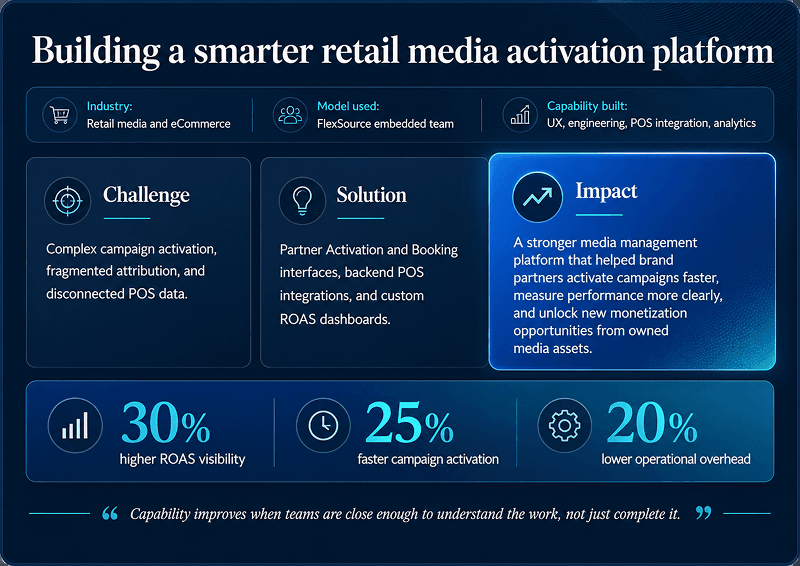
Real-world example: Building a smarter retail media activation platform
Capability improves when teams are close enough to understand the work, not just complete it.
Common Micro GCC challenges and how to solve them
A Micro GCC can reduce operating weight, but it still needs discipline. The most common failures happen when companies treat the model as “outsourcing with a better label.”
Challenge 1 - Hiring before defining the mandate
Many companies start by asking for roles. They should start by defining the capability.
A Micro GCC for AI engineering, for example, should not be designed like a generic software team. It needs data engineers, ML engineers, integration support, product ownership, and governance thinking.
Solution: Write a one-page capability charter before hiring begins.
Challenge 2 - Underestimating talent retention
India has deep technology talent, but high-demand skills are competitive. AI, cloud, cybersecurity, and senior engineering roles require a serious retention strategy.
Solution: Build a differentiated employee proposition, clear growth paths, leadership access, and meaningful product ownership.
Challenge 3 - Weak IP and access controls
A Micro GCC should protect code, data, documentation, product knowledge, and customer information from day one.
Solution: Define repository ownership, device policies, data access, confidentiality terms, security reviews, and audit processes before production work begins.
Challenge 4 - Treating the India team as a support layer
If every decision sits with the US team, the Micro GCC becomes a delivery queue.
Solution: Give the team bounded ownership. Start with defined modules, workflows, or product areas, then expand decision rights as trust builds.
Challenge 5 - Scaling too early
A 10-person team with strong context can outperform a 40-person team with unclear ownership.
Solution: Scale after the first capability is stable. Use metrics like rework rate, release contribution, stakeholder confidence, and sprint predictability.
Challenge 6 - Ignoring governance rituals
Micro does not mean informal. Without governance, even a small team can become noisy.
Solution: Establish operating cadences, dashboards, escalation paths, product rituals, and documentation standards from the beginning.
Top GCC trends shaping tech teams in 2026
1. AI-first GCCs are becoming the new growth engine
Companies are increasingly using GCCs to build AI-enabled products, automation systems, analytics engines, and intelligent workflows. The winners will not simply hire AI talent. They will build the operating model that lets AI work move safely into production.
2. Skills-first hiring is replacing role-first hiring
The old model asked, “How many engineers do we need?”
The better question is, “What capability must this team own?”
GCC talent acquisition strategy in 2026 will focus on skills, learning velocity, business context, and adaptability.
3. Smaller centers are gaining credibility
The next wave of GCC growth will not only come from large enterprise campuses. It will also come from Micro GCCs, managed GCCs, GCCaaS models, and BOT-led capability centers. This matters for small and mid-sized US companies that want the benefits of a captive center without the old entry barrier.
4. Multi-hub strategies are reducing concentration risk
As major Indian hubs become more competitive, companies are exploring multi-city models and “India plus” strategies. Reuters reported that some firms are also diversifying across countries such as Poland, the Philippines, Brazil, and Costa Rica to manage risk.
For Micro GCCs, the practical answer may be a hub-and-spoke model, with leadership in one major city and specialist hiring across other locations.
5. Governance is becoming a buying criterion
US companies are no longer evaluating GCC partners only on recruitment speed.
They are looking at IP protection, security, reporting, attrition control, operating transparency, compliance readiness, and the ability to connect offshore teams to business outcomes.
In short, the best Micro GCC companies will not sell headcount. They will sell capability with accountability.
How to choose the best Micro GCC company
| Question | Why it matters |
| Can they define the capability before hiring? | Prevents generic team design |
| Do they understand your product and business model? | Improves context and ownership |
| Can they support GCCaaS, BOT, EOR, or managed GCC models? | Gives you flexibility as the center matures |
| How do they protect IP? | Critical for product, AI, data, and engineering work |
| What is their talent retention strategy? | Reduces knowledge loss |
| What governance dashboards do they provide? | Keeps performance visible |
| Can the team scale into a larger GCC later? | Protects long-term optionality |
| Do they have relevant delivery proof? | Shows they can execute, not just advise |
A strong partner should help you answer three questions:
What should we build?
How should we operate it?
How do we know it is creating business value?
Frequently Asked Questions
1. What is a purpose-built tech team?
A purpose-built tech team is a dedicated team designed around a specific business or technology capability. Instead of hiring generic resources, the team is structured to own outcomes such as AI engineering, product development, DevOps, data engineering, UX, or platform modernization.
2. What is a Micro GCC and how is it different from a traditional GCC?
A Micro GCC is a smaller Global Capability Center built for focused capability ownership. A traditional GCC may involve large-scale operations, broader functions, and heavier setup requirements, while a Micro GCC starts lean, moves faster, and scales once the model is proven.
3. How much does it cost to set up a Micro GCC in India?
The cost depends on team size, skill mix, location, setup model, governance requirements, and infrastructure. A Micro GCC usually costs less than a traditional captive center because it starts with a smaller team and lighter operating structure, but companies should evaluate total loaded cost rather than hourly rates alone.
4. How long does it take to set up a Micro GCC for a US company?
A focused Micro GCC can often be designed and launched in phases over 6 to 12 weeks, depending on hiring complexity, operating model, compliance needs, and leadership availability. Highly specialized AI, data, cloud, or cybersecurity teams may take longer to hire well.
5. What types of tech teams can be set up as a Micro GCC?
Companies can set up AI engineering teams, DevOps teams, product engineering teams, data engineering teams, UX design teams, QA automation teams, integration teams, cloud operations teams, and customer technology teams as a Micro GCC.
6. How is a GCC different from outsourcing?
Outsourcing usually involves vendor-managed delivery, while a GCC is designed as a dedicated capability center aligned to the parent company. A GCC offers stronger control, better knowledge continuity, deeper IP ownership, and closer integration with business strategy.
7. Is a GCC right for small or mid-sized US companies?
A traditional GCC may be too heavy for many small or mid-sized companies, but a Micro GCC can be a strong fit. It allows them to build dedicated offshore capability in India without taking on the full complexity of a large captive center immediately.
8. What is GCCaaS, or Global Capability Center as a Service?
GCCaaS is a managed model where a partner helps design, build, operate, and sometimes transition a Global Capability Center. It is useful for companies that want the benefits of a GCC, such as dedicated talent and stronger control, without handling every legal, HR, operational, and compliance requirement alone.
9. What are the top locations to set up a Micro GCC in India?
Common Micro GCC locations in India include Bengaluru, Hyderabad, Pune, Chennai, NCR, Mumbai, and select tier-two cities. The best location depends on the roles being hired, compensation expectations, retention strategy, industry context, and leadership availability.
10. What is the Build-Operate-Transfer model in GCC setup?
The Build-Operate-Transfer model allows a partner to build and operate the GCC for an agreed period before transferring ownership to the client. It is useful when a company wants speed at the beginning but long-term control later.
11. What is the difference between an EOR model and a full GCC setup?
An Employer of Record model helps a company hire employees in another country without setting up a local legal entity. A full GCC setup involves deeper ownership, operating structure, governance, leadership, and long-term capability development.
12. How do Micro GCCs support AI and product innovation in 2026?
Micro GCCs support AI and product innovation by creating dedicated teams that can work continuously on data pipelines, model integration, product features, automation, testing, and governance. This helps companies move beyond pilots and build repeatable AI and product capability.
13. Can a US startup build a GCC without setting up a legal entity in India?
Yes, a US startup can begin through models such as GCCaaS, managed GCC, EOR, or BOT before setting up a full Indian entity. The right model depends on hiring plans, IP needs, compliance requirements, budget, and long-term ownership goals.
14. What are the main challenges of setting up a Micro GCC?
The main challenges include unclear team mandate, poor talent retention, weak IP controls, underdeveloped governance, timezone friction, cultural gaps, and scaling before the operating model is stable. These risks can be reduced with a clear capability charter, strong partner support, and disciplined governance.
15. What cost savings can US companies expect from a Micro GCC?
Cost savings vary by function, seniority, location, and setup model. US companies should expect savings from lower loaded talent cost and reduced overhead, but the stronger ROI often comes from faster hiring, better continuity, owned capability, and reduced dependency on fragmented vendors.
Conclusion
The Micro GCC model is not a smaller version of the old offshore playbook. It is a more practical way to build capability.
For US companies in 2026, the opportunity is clear. You can build purpose-built tech teams in India without immediately committing to a large captive center. You can start with a focused AI, product, DevOps, data, UX, or platform team. You can keep ownership close. You can protect IP. You can scale when the business case is proven.
But the model only works when it is built with intention. Do not start with headcount. Start with the capability you need to own. That is the real Micro GCC blueprint.
Build your Micro GCC with the right operating model
Millipixels helps companies set up compact, high-performance Global Capability Centers.
Speak to a GCC advisorWritten by

Taniya Adhikari
Taniya brings 7+ years of experience across technology, AI, UX, and consulting content, shaped by work with brands such as Tata Communications, Tanishq USA, Marico, and Kaya. This cross-industry exposure informs how she develops content at Millipixels, bringing clarity, context, and relevance to complex digital topics.
- Introduction
- What is a Micro GCC?
- Why US companies are choosing Micro GCCs in India in 2026
- Micro GCC 2026 setup process for purpose-built tech teams
- Types of purpose-built tech teams you can build through a Micro GCC
- How much does a Micro GCC cost?
- GCC vs outsourcing vs ODC comparison
- Real-world example: Building a smarter retail media activation platform
- Common Micro GCC challenges and how to solve them
- Top GCC trends shaping tech teams in 2026
- How to choose the best Micro GCC company
- Frequently Asked Questions
- Conclusion


