Top 10 Cloud Migration Companies for 2026 (Before You Migrate, Read This) [Ranked]
Compare the top cloud migration service providers for 2026. Learn how we ranked them & choose the right migration partner.
August 04, 2026
Written by

Introduction
Moving to the cloud is no longer the challenge it was a decade ago. Choosing the right cloud migration service providers is. Most organizations already know why cloud migration matters. The harder question is whether the cloud service provider you choose will help you build a flexible, cost-effective cloud environment or simply relocate existing problems to a new platform.
Millipixels has seen many organizations approach cloud migration with a clear destination but an incomplete plan. They compare vendors based on certifications, pricing, or cloud partnerships, yet overlook the most important questions: How will application dependencies be managed? What happens if cloud costs exceed expectations? Can workloads be moved back if business priorities change?
Those questions have become even more important in 2026.
Instead of another generic list of cloud migration companies, we evaluated providers using six practical criteria that matter to enterprise buyers. But first, let's look at what today's data says about successful cloud migrations.
Before You Migrate: What the Data Actually Says
Cloud migration has matured significantly over the past few years, but the decisions surrounding it have become more complex. Organizations are investing more in cloud than ever before, while also facing greater scrutiny around costs, security, compliance, and measurable business outcomes.
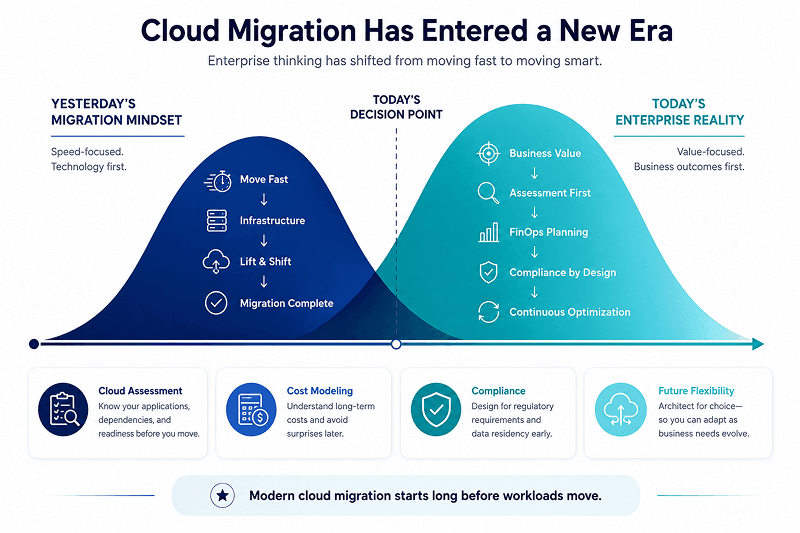
That shift changes how you should evaluate cloud migration consulting services. Technical expertise still matters, but so does a provider's ability to help you avoid expensive decisions before migration begins.
Cloud spending is growing, but so is accountability
According to Gartner, worldwide IT spending is expected to reach $6.31 trillion in 2026, reflecting continued investment in cloud technologies, AI, cybersecurity, and digital transformation initiatives.
At the same time, cloud budgets are no longer viewed as open-ended investments. Technology leaders increasingly expect migration projects to demonstrate measurable returns, predictable operating costs, and long-term operational improvements.
We've noticed this change across enterprise technology discussions. Conversations have shifted from "How quickly can we migrate?" to "Which workloads actually belong in the cloud, and what value will they deliver?"
We've also seen a similar shift in AI initiatives, where organizations are focusing less on adopting new technologies and more on creating measurable business value from their technology investments.
Many migration challenges appear long before migration starts
One of the biggest misconceptions about cloud migration consulting is that the hardest work happens during the migration itself. In reality, many costly problems originate during planning.
Flexera's 2026 State of the Cloud Report found that organizations continue to struggle most with understanding application dependencies and assessing technical feasibility before workloads are migrated.
These findings reinforce an important lesson. Successful cloud migration begins with a thorough cloud migration assessment, not with provisioning infrastructure or selecting migration tools.
The same principle applies when evaluating technology partners. Investing time upfront to assess capabilities, processes, and long-term fit often prevents far more expensive mistakes later.
Cost optimization starts before workloads move
Cloud migration promises flexibility and scalability, but those benefits don't automatically translate into lower costs. Organizations therefore need effective cloud cost optimization solutions before and after workloads move.
Flexera reports that organizations estimate 29% of cloud spending is wasted, highlighting how easily costs can escalate when workloads are migrated without careful planning.
What's encouraging is that many organizations are changing how they approach this challenge. Rather than optimizing costs after migration, they are evaluating whether certain workloads should move to the cloud at all.
This "shift-left" approach to financial planning is one of the most significant changes we've observed. Instead of assuming every application belongs in the cloud, organizations are asking:
- Will this workload actually benefit from migration?
- Is a hybrid architecture more appropriate?
- How will operating costs compare over the next three to five years?
These conversations are why cloud migration and management services increasingly include FinOps expertise for cloud cost optimization alongside technical implementation.
How We Evaluated These Cloud Migration Service Providers
With cloud migration becoming more strategic, we wanted our evaluation criteria to reflect what matters throughout the entire lifecycle of a migration, not just during implementation.
Instead of ranking providers only on the basis of market size or brand recognition, we assessed them using six criteria that we believe most directly influence long-term business outcomes.
| Evaluation Criteria | Why It Matters |
| Migration success track record | Demonstrates experience delivering migrations across environments of similar complexity. |
| Infrastructure as Code (IaC) and automation maturity | Reduces manual effort, improves consistency, and minimizes deployment risk. |
| Vertical compliance expertise | Essential for regulated industries such as healthcare, financial services, and government. |
| FinOps and post-migration optimization | Ensures cloud environments remain cost-efficient long after migration is complete. |
| Pricing transparency | Helps organizations understand the true cost of migration and ongoing operations. |
| Architectural flexibility and repatriation readiness | Supports future business changes by avoiding unnecessary vendor or platform lock-in. |
These criteria are closely aligned with the challenges organizations are experiencing today. For example, growing cloud costs make FinOps expertise more valuable than ever, while the rise of selective workload repatriation means architectural flexibility should be part of every vendor evaluation.
Next, we'll use this framework to rank the top cloud migration providers for 2026 by buyer type, helping you find the best fit for your business instead of comparing one-size-fits-all options.
Top 10 Cloud Migration Companies for 2026: Ranked by Buyer Type
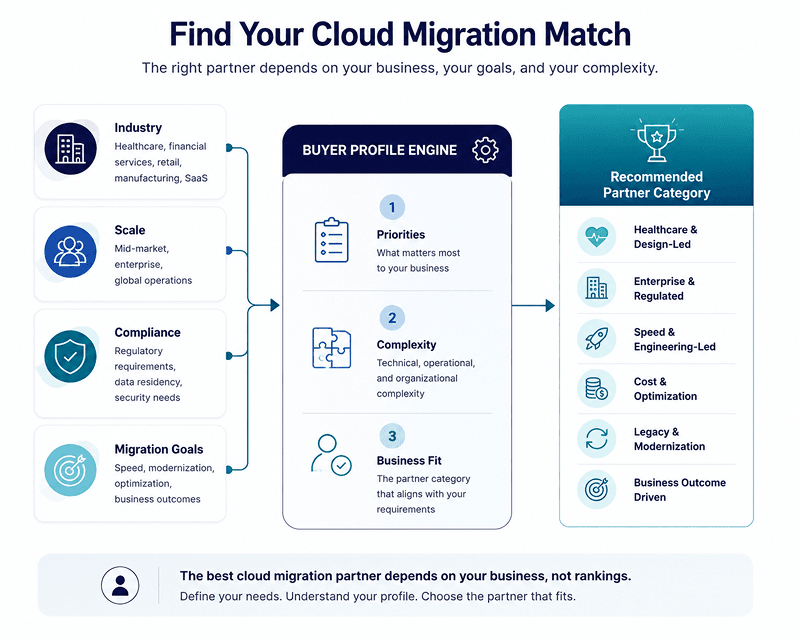
One of the biggest shortcomings of most "top cloud migration companies" lists is that they assume every organization has the same requirements.
In reality, a healthcare provider modernizing patient-facing applications has very different priorities than a global bank migrating legacy mainframes or a fast-growing SaaS company looking to scale quickly.
That's why we've grouped these providers by the types of organizations they serve best. Rather than asking, "Who's the biggest?" we've asked, "Who's the best fit for this business challenge?"
Best for Mid-Market Healthcare and Design-Led Modernization
1. Millipixels
Best at: Combining cloud migration with product, user experience, and application modernization.
Millipixels is well suited for mid-market organizations that see cloud migration as part of a broader digital transformation initiative rather than a standalone infrastructure project. This is particularly valuable for healthcare organizations, SaaS businesses, and digital product companies that want to improve customer experiences while modernizing their technology stack.
From what we've seen, one of the biggest mistakes organizations make is treating migration as an infrastructure exercise alone. Moving applications without improving usability, workflows, or system architecture often limits the business value of the migration itself.
That's why cloud migration should begin with a simple question: What business outcome are you trying to achieve? Once that answer is clear, technology decisions become much easier to make.
Why organizations choose Millipixels?
Many organizations aren't looking for a vendor that simply moves workloads from one environment to another. They need a partner that can help modernize applications, improve digital experiences, and prepare their technology for future growth. This broader approach is where digital transformation can help connect modernization efforts with long-term business goals.
Millipixels takes that broader view. Alongside cloud migration, our teams help organizations modernize digital products, adopt AI where it creates real business value, and support larger digital transformation initiatives. This means cloud migration isn't treated as an isolated project, but as part of a strategy that helps the business become more efficient, scalable, and ready for what's next.
Ideal for
- Mid-market organizations
- Healthcare providers
- SaaS and digital product companies
- Organizations modernizing customer-facing applications
- Businesses looking to combine cloud migration with AI and digital transformation initiatives
Planning a Cloud Migration? Let's Make Sure You Get It Right.
Consult MillipixelsBest for Fast, Speed-Focused Migrations
2. Web Panel Solutions
Best at: Web applications, custom software, and cloud-based development.
Web Panel Solutions works with businesses on web applications, mobile apps, ecommerce platforms, and custom software. Its development services can also support projects where an existing application needs to be updated as part of a cloud migration.
Ideal for
- Web application migration
- Ecommerce businesses
- Startups
- Custom software projects
- Application modernization
Trade-off
The team handles development, API integration, ecommerce, mobile apps, and ongoing maintenance. This makes it a suitable choice for businesses that need both application development and cloud migration support.
3. TechMagic
Best at: Migration supported by DevOps automation and FinOps.
TechMagic stands out by combining migration expertise with DevOps practices and cost optimization from the beginning of the engagement.
This helps organizations establish operational discipline rather than treating cloud cost management as an afterthought.
Ideal for
- Software companies
- Product-led organizations
- Businesses prioritizing automation
Trade-off
Organizations seeking large-scale business transformation consulting may find TechMagic more engineering-focused than strategy-focused.
Best for Large Regulated Enterprises
3. Accenture
Best at: Enterprise-scale transformation programs.
Accenture remains one of the strongest choices for organizations looking for a single strategic partner across cloud strategy, migration, security, operations, and business transformation.
Its breadth of services makes it particularly attractive to global enterprises operating across multiple business units and regions.
Ideal for
- Global enterprises
- Multi-cloud transformations
- Complex governance programs
Trade-off
The scale that benefits large enterprises can also make Accenture less suitable for organizations seeking highly personalized engagement or smaller migration projects.
4. IBM
Best at: Hybrid cloud and highly regulated industries.
IBM has built significant expertise around hybrid cloud environments, making it a strong choice for organizations balancing on-premises infrastructure with public cloud services.
Its experience in industries such as banking, healthcare, and government also makes it well positioned for organizations with strict compliance requirements.
Ideal for
- Financial services
- Government agencies
- Large healthcare enterprises
- Hybrid cloud environments
Trade-off
IBM's solutions can be more comprehensive than necessary for organizations with relatively straightforward migration requirements.
Best for Legacy and Mainframe Modernization
6. Cognizant
Best at: Modernizing tightly coupled legacy environments.
Many enterprise migrations become challenging because decades-old systems cannot simply be moved to the cloud. Cognizant has built a strong reputation for helping organizations modernize legacy applications while reducing operational disruption.
Ideal for
- Large enterprises
- Legacy modernization initiatives
- Mainframe transformation
Trade-off
Projects often require significant planning and stakeholder coordination, making them less suitable for organizations seeking rapid deployment.
7. HCLTech
Best at: Long-term optimization after migration.
Migration is only one stage of cloud adoption. HCLTech differentiates itself by investing heavily in post-migration optimization through FinOps and continuous operational improvement. For organizations managing large cloud environments, this long-term focus can produce meaningful cost savings over time.
Ideal for
- Large enterprises
- Organizations prioritizing operational efficiency
- Long-term cloud optimization
Trade-off
Its enterprise-first approach may be more comprehensive than smaller organizations require.
Best for Mid-Market and Cost-Conscious Organizations
8. Slalom
Best at: Change management alongside cloud migration.
Technology projects often succeed or fail based on user adoption rather than technical execution.
Slalom combines migration expertise with organizational change management, helping internal teams develop the capabilities needed to operate successfully in cloud environments.
Ideal for
- Mid-market businesses
- Organizations with smaller internal IT teams
- Companies undergoing operational change
Trade-off
Organizations requiring highly specialized infrastructure engineering may benefit from pairing Slalom with additional technical partners.
9. Wipro
Best at: Industry-focused migration programs.
Wipro has developed strong expertise across industries such as manufacturing, retail, and consumer goods while maintaining competitive pricing compared with some larger consulting firms. Its balance of industry knowledge and delivery capability makes it attractive for organizations seeking enterprise experience without enterprise-level costs.
Ideal for
- Manufacturing
- Retail
- Mid-market enterprises
Trade-off
Organizations seeking boutique consulting experiences may find engagement models more standardized.
Best for Business Outcome-Led Transformation
10. Capgemini
Best at: Connecting migration decisions to business outcomes.
Capgemini approaches cloud migration as a business transformation initiative rather than simply an infrastructure project. This perspective often resonates with executive leadership because discussions focus on agility, customer experience, operational performance, and innovation rather than infrastructure alone.
Ideal for
- Executive-sponsored transformation initiatives
- Business-led cloud programs
- Organizations modernizing enterprise operations
Trade-off
Its broader transformation approach may involve longer planning phases before migration begins.
Comparison at a Glance
| Company | Best For | Key Strength | Consider Before Choosing |
| Millipixels | Mid-market modernization | Product-led cloud transformation | Not intended for massive global migrations |
| Accenture | Global enterprises | End-to-end transformation | May be more than smaller organizations need |
| IBM | Regulated industries | Hybrid cloud expertise | Best suited for complex environments |
| Simform | Speed-focused migrations | Engineering delivery | Limited strategic consulting |
| TechMagic | DevOps-driven migration | Automation and FinOps | More technical than business-focused |
| Cognizant | Legacy modernization | Complex application transformation | Longer planning cycles |
| HCLTech | Post-migration optimization | FinOps and continuous improvement | Enterprise-first engagement |
| Slalom | Organizational adoption | Change management | Less infrastructure specialization |
| Wipro | Cost-conscious enterprises | Industry expertise | Standardized delivery approach |
| Capgemini | Business transformation | Executive alignment | Longer strategic planning phase |
Questions to Ask Before You Sign Anything
Choosing among cloud migration service providers shouldn't end with comparing certifications or reading case studies. The quality of your conversations with prospective partners often reveals far more than marketing materials.
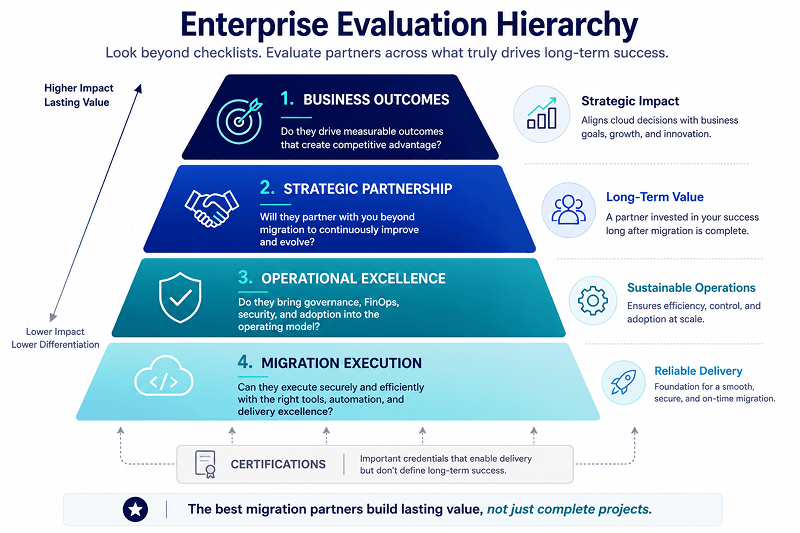
Here are six questions worth asking before making a decision.
1. Have you completed migrations similar to ours?
Look beyond the number of migrations completed. Ask about organizations of similar size, architecture, regulatory requirements, and operational complexity.
2. How much of the migration is automated?
Modern migrations should rely heavily on Infrastructure as Code and automation. Manual configuration increases risk, slows delivery, and makes future maintenance more difficult.
3. How do you approach cloud cost optimization?
Migration is only part of the financial picture. A good provider should explain how they'll help monitor, govern, and optimize cloud spending after workloads go live.
4. How will you address compliance requirements?
Rather than asking whether they hold certifications, ask how they'll design governance, security controls, identity management, and data residency into the migration plan. The answers should be specific to your industry.
5. What's the rollback strategy if something goes wrong?
Every migration carries risk. Experienced providers prepare rollback procedures before migration begins rather than creating them during an incident.
6. If we decide to repatriate workloads later, what would that involve?
This may be the most important question on the list. Business priorities change. Costs change. Regulations evolve.
A migration partner should design architectures that support future flexibility instead of locking your organization into decisions that become expensive to reverse.
Conclusion: Choose the Right Cloud Migration Service Providers, Not Just the Biggest Name
Cloud migration is no longer just about moving workloads. It's about making decisions that will shape your business for years to come.
The providers on this list each bring different strengths. Some are built for large-scale enterprise transformations, while others excel at legacy modernization or helping mid-market organizations modernize applications alongside their cloud journey. The right choice depends on your business goals, technical environment, and long-term strategy.
Before making a decision, look beyond certifications and market presence. Evaluate how each provider approaches planning, automation, compliance, cost optimization, and architectural flexibility. Those conversations will tell you far more than any marketing brochure.
Every migration decision has long-term implications. If you'd like a second opinion on your cloud migration strategy, get in touch with the Millipixels team. We'll help you evaluate your options, identify potential risks, and make informed decisions before your project begins.
Frequently Asked Questions
1. What is cloud migration?
Cloud migration is the process of moving applications, databases, workloads, and other IT resources from on-premises infrastructure or one cloud environment to another. It can involve public, private, or hybrid cloud environments depending on an organization's goals. A successful migration focuses not only on moving workloads but also on improving performance, scalability, security, and long-term operational efficiency.
2. What are the primary cloud migration benefits for enterprises in 2026?
The benefits extend well beyond infrastructure modernization. Organizations that approach migration strategically often gain:
- Greater scalability to support business growth.
- Improved business continuity and disaster recovery.
- Faster deployment of applications and digital services.
- Better access to AI, analytics, and cloud-native technologies.
- Reduced infrastructure maintenance.
- Increased operational flexibility through hybrid and multi-cloud environments.
The biggest benefit, however, comes from aligning migration with business objectives rather than treating it as a technology upgrade. Enterprises that carefully evaluate which workloads should move to the cloud are more likely to see measurable returns.
3. Why should a business hire cloud migration consulting services instead of doing it in-house?
While internal IT teams understand their existing environment, they may not have experience planning and executing complex migrations across different cloud platforms. That's where cloud migration consulting services add value.
An experienced cloud migration consulting partner helps assess application dependencies, identify technical and business risks, recommend the right migration strategy, and establish governance from the beginning. Many providers also offer cloud migration and management services, ensuring cloud environments remain secure, optimized, and cost-effective after migration is complete.
For organizations with mission-critical applications or compliance requirements, external expertise can significantly reduce project risk and accelerate time to value.
4. What should be included in a comprehensive cloud migration checklist?
A practical cloud migration checklist should include:
- Business goals and success metrics
- Application and infrastructure inventory
- Security and compliance requirements
- Dependency mapping
- Cost estimation and FinOps planning
- Backup and rollback strategy
- Testing and validation plan
- Post-migration monitoring and optimization
5. How does a cloud migration assessment help avoid project failures?
A thorough cloud migration assessment identifies application dependencies, infrastructure readiness, security risks, compliance requirements, and potential cost issues before migration begins.
Instead of discovering problems during implementation, organizations can address them early, reducing delays, unexpected costs, and operational disruption. This planning stage is often one of the strongest indicators of a successful migration project.
6. How do top cloud migration companies ensure secure cloud data migration?
Leading cloud migration companies typically secure cloud data migration by encrypting data in transit and at rest, implementing identity and access controls, performing continuous security testing, and following industry-specific compliance requirements. They also establish backup and rollback procedures to minimize risk throughout the migration process.
7. What are the main cloud migration challenges and how can they be overcome?
Some of the most common cloud migration challenges include application dependencies, cost overruns, downtime, security concerns, compliance requirements, and skills gaps.
These challenges can be addressed through careful planning, a detailed migration roadmap, phased implementation, automation, ongoing cost optimization, and selecting a migration partner with experience in projects similar to yours.
8. What is the difference between cloud migration consulting and managed cloud services?
Cloud migration consulting focuses on planning and executing the move to the cloud. It includes strategy development, architecture design, workload assessment, migration planning, and implementation.
Managed cloud services begin after migration and focus on day-to-day operations such as monitoring, security, performance optimization, patch management, and ongoing infrastructure support. Many organizations choose providers that offer both services to ensure continuity throughout the cloud lifecycle.
Written by

Parthsarathy Sharma
With 4+ years of experience across AI, UX, GCC/outsourcing, enterprise technology, and brand strategy, Parthsarathy brings a research-driven lens to digital experience content. His work focuses on turning emerging technology, customer experience, and business trends into clear, practical perspectives for readers.
- Introduction
- Before You Migrate: What the Data Actually Says
- How We Evaluated These Cloud Migration Service Providers
- Top 10 Cloud Migration Companies for 2026: Ranked by Buyer Type
- Best for Mid-Market Healthcare and Design-Led Modernization
- Best for Fast, Speed-Focused Migrations
- Best for Large Regulated Enterprises
- Best for Legacy and Mainframe Modernization
- Best for Mid-Market and Cost-Conscious Organizations
- Best for Business Outcome-Led Transformation
- Comparison at a Glance
- Questions to Ask Before You Sign Anything
- Conclusion: Choose the Right Cloud Migration Service Providers, Not Just the Biggest Name
- Frequently Asked Questions