How to Choose the Right Outsourcing Partner: A 7-Step Evaluation Framework
Learn how to choose the right outsourcing partner with seven steps to evaluate expertise, AI readiness, governance, and long-term business fit.
July 17, 2026
Written by

Introduction
Choosing the right outsourcing partner has never been more important, or more complicated.
Everyone blames deadlines or poor communication when an outsourcing project fails. But the truth is, the real problem started long before the work even began. It starts when you choose the wrong partner. Many enterprises spend weeks comparing rates, tech capabilities, delivery models, and team size. Later, they realize that the real issue was not pricing or skill availability. The partner they selected was never the right fit for the outcomes they needed.
The outsourcing market has changed significantly. AI is reshaping how work gets done, outcome-based contracts are replacing old models, and vendor governance is now a key topic. Today, it’s not enough to just find a partner who can build software or manage operations.
This guide will help you evaluate outsourcing partners before cost, capability, or a nice proposal leads to a decision. Rather than just another checklist, it offers a practical framework based on how companies are choosing outsourcing partners in 2026.
Start by Asking Whether Outsourcing Is the Right Move
Before you start looking for outsourcing partners, ask yourself a basic question: should you outsource this work at all?
A common mistake is to assume outsourcing is always the best choice. That’s not true. Some projects benefit from outside help, but others are more valuable when kept in-house.
Picking the wrong delivery model can cause even more problems than picking the wrong vendor.
The biggest mistake is outsourcing the wrong work
Outsourcing works best when you're looking to accelerate delivery, access expertise, or scale without making major investments in hiring and infrastructure.
It’s less effective if you outsource work that gives your business a competitive edge or requires deep knowledge of your company.
Before evaluating any business process outsourcing partner, define which capabilities should remain core to your business and which can be successfully delivered by an external team.
A simple question can help you get started:
If this capability disappeared tomorrow, would it weaken your competitive advantage?
If you answer yes, then keeping strong internal ownership is usually the better approach.
When outsourcing creates value, and when building in-house is the smarter investment
Today, companies have more choices than just outsourcing everything or hiring all staff internally. Many successful businesses use a mix of delivery models based on their needs.
For instance, a company might outsource application modernization to an IT partner while also building a small Global Capability Center (microGCC) for long-term product innovation. Others may use outsourcing to move faster in the short term, then bring selected capabilities in-house once the function becomes more strategic.
Many companies are now choosing selective insourcing. Rather than stopping outsourcing completely, they bring important skills back in-house.
That is why the choice of the right operating model depends on more than just cost. Enterprises are comparing traditional outsourcing, specialized delivery partners, and Micro GCC providers in India, to determine which approach offers the right balance of governance, talent, and long-term scalability.
The best approach depends on your business goals, the capabilities you want to own, and the level of control required over time.
Not Sure Which Outsourcing Partner Is Right for Your Business? Let the Experts Help You.
Consult MillipixelsWhy Choosing an Outsourcing Partner Is More Complicated Than It Was Five Years Ago
Five years ago, evaluating an outsourcing provider often meant comparing costs, technical expertise, and delivery periods. Those factors still matter, but they are no longer enough.
Today, outsourcing decisions are influenced by many factors that change over time. Some of these include AI-assisted delivery, regulatory expectations, distributed teams, geopolitical uncertainty, and outcome-based contracts.
If you are looking for new operating models, you should also consider whether outsourcing is the right long-term strategy or if establishing a Nano GCC is a better fit.
Cost savings are no longer enough
Cutting costs is still a reason to outsource, but it’s rarely the main way companies measure success now. More and more, companies expect outsourcing to improve product quality, speed up innovation, lower risks, and support long-term change.
This change has also affected contracts. More companies are now moving toward outcome-based partnerships, where success is measured against defined KPIs and not by the hours worked alone.
This shift raises the key question when choosing a vendor. Instead of asking how many engineers they can provide, ask what business results they can deliver and how they will show progress.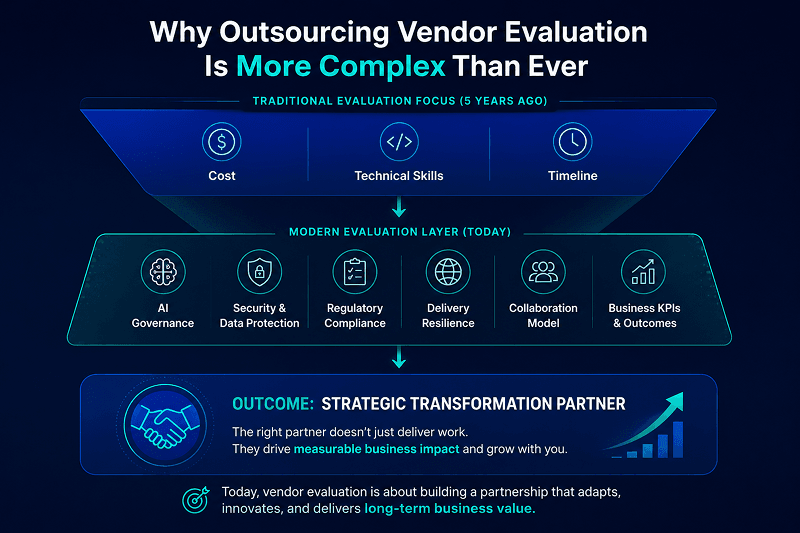
AI has changed what "technical capability" actually means
Now, nearly every tech provider claims to use AI. That alone doesn’t help you compare vendors anymore.
A better question is how they actually use AI.
A good outsourcing partner should explain how AI fits into their work. Ask them how they manage AI development outsourcing, protect sensitive data, check AI-generated code, and measure if AI is really improving quality, speed, or productivity.
These discussions tell you much more than a product demo ever could. They reveal if AI is truly part of their process or just an experiment.
Vendor risk now extends far beyond cybersecurity
Security certifications are still important, but they are only one part of the picture when choosing an IT outsourcing provider.
Your outsourcing relationship should stay reliable even when business conditions change. So, look at things like business continuity, compliance, global risks, delivery locations, supply chain strength, and how teams share and keep knowledge.
For example, if your delivery model is based in just one region, your business could face problems during political unrest, infrastructure failures, or regulatory changes.
Similarly, when comparing nearshore and offshore outsourcing, do not just look at the hourly rates. Think about how each option affects teamwork, time zones, scalability, compliance, and long-term stability.
The goal isn’t just to cut costs. It’s to build a partnership that can adapt as your business, technology, and priorities change.
That’s why top organizations see outsourcing partners as long-term investments, not just short-term vendors. The next section’s seven-step framework will help you make a confident choice.
The Millipixels Framework for Choosing the Right Outsourcing Partner
The best outsourcing partnerships don’t come from the perfect proposal or the lowest price. They’re built through a careful evaluation process that focuses on business results, long-term fit, and strong governance from the start.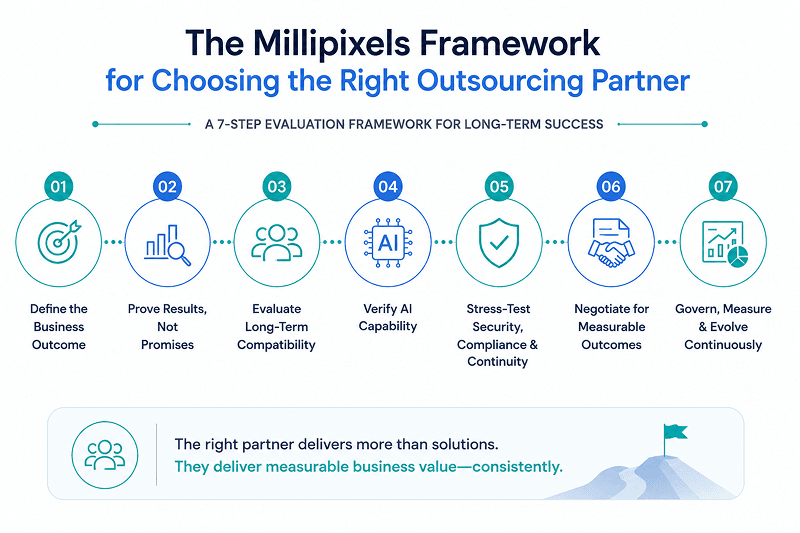
Most partners we’ve worked with follow a similar process. They ask many questions, look beyond just technical skills, and check if a provider can deliver real value over time.
Further, many organizations that are looking for long-term delivery models also explore whether a purpose-built Micro GCC team can complement or eventually replace certain outsourced functions.
Based on many such interactions, we have developed a 7-step framework to help organizations evaluate outsourcing partners more clearly.
Step 1. Define the business outcome before discussing deliverables
Many outsourcing talks start with a list of requirements, but that’s often not the best place to begin.
Before you talk about timelines, team size, or technology, first define the business problem you want to solve. Are you trying to launch faster, improve customer experience, update old systems, or grow your engineering team? Each goal needs a different approach.
At Millipixels, we often help organizations clarify their business problem before talking about delivery. Teams may have detailed requirements, but leaders aren’t always clear on what success means. This can lead to vendors giving different proposals for the same project, making it hard to compare options and increasing the risk of changes later. Defining the business outcome first keeps everyone on the same page.
If outcomes aren’t clear, vendors focus on outputs instead. They might deliver features and finish tasks, but the project could still miss real business impact. Clear business outcomes also make it easier to judge proposals. Instead of just looking for the lowest price, you can see who has the best plan to reach your goals.
Checklist
- Have you clearly defined the business problem?
- What success metrics will determine whether the engagement delivers value?
- Which outcomes matter most to leadership?
- Which capabilities must remain under internal ownership?
- What risks are you trying to reduce through outsourcing?
Step 2. Shortlist partners that can prove results, not just promise them
Every vendor says they have skilled engineers, strong processes, and happy clients. The real challenge is telling apart marketing claims from proven results.
Look for proof that the partner has solved problems like yours. Case studies, client references, independent reviews, and industry experience are more valuable than a polished sales pitch.
If you're evaluating a software development outsourcing partner for a regulated industry, ask about previous work in similar environments. If you're modernizing enterprise applications, look for examples of large-scale migration or transformation initiatives rather than generic software development projects.
Independent review sites can help, but go further. If you can, talk directly to current or past clients to learn how the partnership worked after the project started.
Some questions worth asking include:
- Did the partner consistently meet expectations?
- How did they respond when priorities changed?
- Were issues communicated transparently?
- Would the client choose the same partner again?
Step 3. Look beyond technical skills and evaluate long-term compatibility
Technical expertise gets projects started. Strategic compatibility keeps them successful.
In practice, the alignment between organizations is often just as important as technical skills. Differences in communication, decision-making, governance, or company culture can quietly hurt even the best teams.
We’ve seen skilled teams struggle when expectations about ownership, escalation, and teamwork weren’t clear from the start.
When evaluating partners, notice how they communicate. Do they question assumptions when needed? Can they explain complex ideas simply? Are senior leaders involved, or do they disappear after the sale?
Good partners act as advisors, not just order takers. They ask tough questions because they know solving the right problem matters more than just delivering features. Check compatibility in several areas.
| Evaluation Area | Questions to Ask |
| Communication | Are updates proactive, transparent, and easy to understand? |
| Strategic alignment | Do they understand your business goals beyond technical requirements? |
| Decision-making | How are risks identified, escalated, and resolved? |
| Culture | Will your teams collaborate effectively over the long term? |
| Leadership involvement | Are senior stakeholders engaged throughout the partnership? |
A partnership built on trust and shared objectives typically delivers far better results than one built solely on technical qualifications.
Step 4. Separate genuine AI capability from marketing claims
AI is now one of the most talked-about features in outsourcing, but it’s also one of the most misunderstood.
Many providers call themselves AI-enabled but don’t show how AI actually improves delivery, quality, customer results, or efficiency.
Don’t just ask if a partner uses AI, ask how they use it. Can they explain where AI fits in their process? How do they check AI-generated work? What rules keep things accurate and secure? How do they measure AI’s value?
The best partners treat AI as a real business tool, with clear rules, measurement, and human oversight. They can show where AI speeds up work and where human skills are still needed. This distinction becomes especially important when sensitive customer data, regulated environments, or proprietary intellectual property are involved.
Ask questions such as:
- How is AI governed across development workflows?
- What safeguards protect client data?
- How do you measure productivity improvements created by AI?
- Which engineering activities continue to require human review?
- How do you ensure AI recommendations remain accurate and compliant?
Organizations that answer these questions confidently are far more likely to deliver sustainable value than those relying on broad marketing statements.
| Traditional Vendor Evaluation | Modern Outcome-Based Evaluation |
| Number of developers available | Ability to solve defined business problems |
| Technology stack | IT strategy aligned with business outcomes |
| Hourly rates | Measurable value delivered over time |
| AI mentioned in presentations | AI governance, measurable ROI, and secure implementation |
| Delivery capacity | Long-term partnership, adaptability, and continuous improvement |
By the end of these four steps, your shortlist should already look very different. Instead of comparing vendors primarily on pricing or technical skills, you'll be evaluating which organizations have the experience, strategic alignment, and operational maturity to become trusted business partners.
The remaining steps focus on protecting that investment through governance, commercial structure, and long-term partnership management.
Step 5. Stress-test security, compliance, and business continuity before signing
Many companies see security and compliance as boxes to tick before signing a contract. But this is often where the costliest outsourcing failures start.
A partner might have great technical skills, but without strong security and resilience planning, your business could face disruptions, fines, or damage to your reputation. These risks are getting more expensive. IBM's Cost of a Data Breach Report 2025 found the average global cost of a data breach is now USD 4.44 million, showing why security and governance must be top priorities.
Don’t just check certifications, ask how the partner manages risk day-to-day. Learn about their access controls, incident response, disaster recovery, data location, and business continuity plans. If you’re in a regulated industry, make sure they have experience meeting your compliance needs. Also clarify ownership of code, documentation, AI-generated artifacts, training data exposure, and reusable components before signing.
It’s also important to know how they handle surprises. Can they keep services running during outages? Do they have teams in different locations? How fast can they recover from problems?
Step 6. Negotiate for measurable outcomes, not just lower hourly rates
Negotiations often focus on one thing: cost. But a better question is, what value are you getting? The lowest hourly rate rarely means the lowest total cost. Delays, rework, and poor communication can quickly erase any savings.
At Millipixels, we’ve seen that the best business discussions move past hourly rates quickly. Instead, they focus on defining success, how to measure it, and how both sides will stay accountable. This shift isn’t unique to us, it’s a trend across the industry.
Deloitte's Global Outsourcing Survey also found that organizations increasingly evaluate outsourcing providers based on their ability to improve service quality, increase agility, and deliver business outcomes, rather than focusing on cost reduction alone.
Instead, build contracts around clear, measurable outcomes. Define SLAs, delivery milestones, quality standards, and performance metrics. Make sure ownership of intellectual property is clear, pricing models are transparent, and exit clauses are in place to protect both sides if things change.
An outcome-based contract encourages both organizations to focus on delivering measurable business value rather than simply completing tasks.
Step 7. Your evaluation doesn't end when the contract begins
Signing the contract is just the start of your partnership, not the end of your evaluation.
One big reason outsourcing relationships fail is weak governance after the project starts. Even the best partner can’t make up for unclear roles, poor communication, or missing performance reviews. Set up a governance model before work begins.
Decide how you’ll measure success, how often you’ll review progress, who makes decisions, and how problems will be handled. Big companies may use a Vendor Management Office (VMO), while smaller ones can assign clear governance roles. A strong governance model should define who owns decisions, who escalates risks, who approves changes, and how performance will be reviewed.
A simple governance rhythm could include:
- Weekly operational reviews
- Monthly KPI and SLA reporting
- Quarterly business reviews focused on strategic goals
- Annual roadmap planning and continuous improvement initiatives
The best partnerships grow over time because both sides keep measuring performance, sharing feedback, and adjusting as business needs change.
Five Red Flags That Should Make You Walk Away Immediately
Not every outsourcing provider will be a good match. Watch out for these warning signs during your evaluation.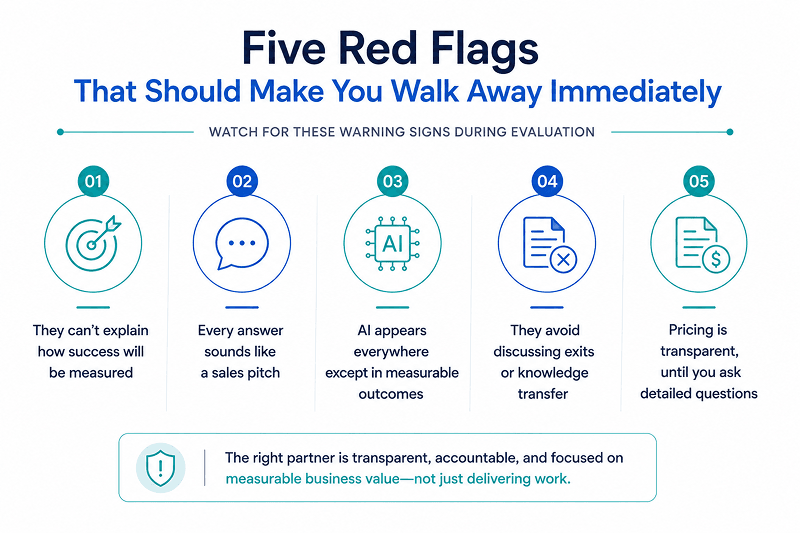
They can't explain how success will be measured
If a vendor talks extensively about activities but struggles to define measurable business outcomes, accountability is likely to become a problem later.
Every answer sounds like a sales pitch
Good partners admit tradeoffs, ask smart questions, and talk openly about risks. Be wary of anyone who says they can solve every problem with no limits.
AI appears everywhere except in measurable outcomes
If AI is mentioned repeatedly but the provider cannot explain governance, security, or measurable business impact, treat those claims with caution.
They avoid discussing exits or knowledge transfer
Healthy partnerships include a clear transition strategy. If a provider resists conversations around documentation, knowledge transfer, or exit planning, you risk creating long-term dependency.
Pricing is transparent until you ask detailed questions
Hidden costs can show up in change requests, support, infrastructure, or extra governance. A trustworthy partner will explain all costs upfront.
What Does the Right Outsourcing Partner Actually Cost?
There’s no one-size-fits-all pricing model because every project depends on your goals, technical needs, and delivery expectations. Instead of asking, “What does outsourcing cost?” ask, “What creates long-term value?”
Why the cheapest proposal often becomes the most expensive project
A low hourly rate might look good at first, but hidden costs can show up as slow delivery, more defects, extra management, or repeated training. Companies should look at total business value, not just the upfront project cost.
What really drives outsourcing costs in 2026
| Cost Driver | Impact on Pricing |
| Geography | Onshore teams typically cost more than offshore teams, while nearshore models often balance cost and collaboration. |
| Technical expertise | Specialized AI, cloud, cybersecurity, and enterprise architecture skills command higher rates. |
| Governance model | Strong governance requires investment but significantly reduces delivery risk. |
| Pricing structure | Outcome-based contracts differ from fixed-price or time-and-materials engagements. |
| AI maturity | Mature AI-enabled delivery may increase initial investment while improving long-term productivity and quality. |
When comparing proposals from top IT outsourcing companies, look at the whole engagement, not just hourly rates. A partner who delivers real business results usually offers more value than one with the lowest price.
A Practical Checklist You Can Use Before Signing Any Outsourcing Contract
Before making your final decision, review this checklist.
Business alignment
- Business objectives clearly defined
- Success metrics agreed upon
- Internal ownership established
Partner evaluation
- Relevant experience verified
- Customer references checked
- Case studies reviewed
- Cultural and communication fit assessed
Technology and AI
- AI governance evaluated
- Technical capabilities validated
- Data protection practices reviewed
Risk and governance
- Security and compliance assessed
- Business continuity reviewed
- Exit clauses included
- Governance model established
- KPI review cadence agreed
Following this checklist doesn’t guarantee success, but it greatly increases your chances of building a partnership that delivers lasting value.
Conclusion: The Best Outsourcing Partner Is One That Grows with Your Business
The right outsourcing partner is not always the lowest bidder or the one with the largest capability list. It is the partner that understands your business goals, communicates clearly, manages risk, and can adapt as priorities change.
Most successful organizations see outsourcing as a long-term partnership based on accountability, the value delivered, and ongoing governance. They look at technical skills, business alignment, AI maturity, resilience, communication, and the ability to adapt as priorities shift. They know that successful outsourcing starts with asking the right questions before signing any contract.
If you’re comparing vendors now, taking time to check strategic fit, governance, and long-term delivery can help you avoid costly mistakes later.
At Millipixels, we help organizations review outsourcing strategies, technical fit, governance, and delivery before making a commitment. Talk to our experts to see how we can help your business.
Frequently Asked Questions
1. What is an outsourcing partner?
An outsourcing partner is an external team or company that works alongside your business to deliver specific services or capabilities. Unlike a traditional vendor that simply completes assigned tasks, a true outsourcing partner collaborates with you to solve business problems and deliver measurable outcomes.
For example, a software development outsourcing partner might help you launch products faster, modernize legacy systems, or scale your engineering team without the time and cost of hiring internally. Similarly, a business process outsourcing partner can take over operational functions so your internal teams can focus on higher-value work.
The difference comes down to the relationship. The best outsourcing partnerships are built on shared goals, clear accountability, and ongoing collaboration, not just contracts and deliverables.
2. What should I consider when choosing an outsourcing partner?
If you're trying to figure out how to choose the right outsourcing partner, start by looking beyond cost.
Ask yourself whether the partner understands your business goals, has experience solving similar challenges, and can demonstrate results through case studies or customer references. It's also worth evaluating how they communicate, how they approach security and compliance, and whether they have clear governance processes in place.
If AI is part of their offering, don't just ask if they use it. Ask how they govern it, protect your data, and measure the business value it creates.
At Millipixels, we've found that the strongest partnerships begin with strategic alignment. Technical expertise matters, but long-term success depends just as much on trust, transparency, and a shared understanding of what success looks like.
3. What are the benefits of working with an outsourcing partner?
The right outsourcing partner can help your business move faster without sacrificing quality.
Instead of spending months hiring and building new teams, you gain access to specialized expertise when you need it. That can mean accelerating product development, scaling delivery, adopting new technologies, or freeing up your internal teams to focus on strategic priorities.
Perhaps the biggest benefit is flexibility. As your business grows or market conditions change, an experienced partner can adapt alongside you, making it easier to scale resources, introduce new capabilities, or respond to changing customer demands without rebuilding your entire operating model.
4. What are the main benefits of outsourcing software development?
Outsourcing software development gives you faster access to experienced engineering talent, helps reduce hiring time, scales development teams more easily, and allows your internal teams to stay focused on innovation and business growth.
5. Are there any risks associated with outsourcing IT functions?
Yes, but most risks are manageable. Common challenges include communication gaps, security concerns, unclear expectations, and weak governance. Choosing an experienced IT outsourcing partner and establishing clear goals, KPIs, and review processes from the start can significantly reduce these risks.
Written by

Parthsarathy Sharma
With 4+ years of experience across AI, UX, GCC/outsourcing, enterprise technology, and brand strategy, Parthsarathy brings a research-driven lens to digital experience content. His work focuses on turning emerging technology, customer experience, and business trends into clear, practical perspectives for readers.
- Introduction
- Start by Asking Whether Outsourcing Is the Right Move
- Why Choosing an Outsourcing Partner Is More Complicated Than It Was Five Years Ago
- The Millipixels Framework for Choosing the Right Outsourcing Partner
- Five Red Flags That Should Make You Walk Away Immediately
- What Does the Right Outsourcing Partner Actually Cost?
- A Practical Checklist You Can Use Before Signing Any Outsourcing Contract
- Conclusion: The Best Outsourcing Partner Is One That Grows with Your Business
- Frequently Asked Questions