The Real Cost of AI in Healthcare: Pricing, ROI, and the Costs Most Business Cases Miss
Explore the cost of implementing AI in healthcare, key cost drivers, ROI, hidden expenses, & practical ways to build a defensible AI business case.
August 31, 2026
Written by

Introduction
If you're evaluating AI for a healthcare organization, two questions usually come up first: How much will it cost, and when will we see a return?
The first question has a deceptively simple answer. Depending on the use case, the cost of implementing AI in healthcare can range from tens of thousands of dollars for a focused administrative application to more than $1 million for an enterprise-wide platform. The second question is harder.
You will find plenty of AI healthcare ROI numbers online. Some promise returns of several times the original investment. Others quote specific payback periods as though they apply equally to every hospital, health system, payer, and healthcare technology company. They don't.
The difference is not just the AI model. It is the data, integration, workflow, validation, adoption, infrastructure, maintenance, and scale around it.
At Millipixels, we have seen how easily an AI business case can become more about the technology than the problem it is meant to solve, especially in healthcare technology environments. The strongest business cases start with a different question: what problem are we trying to solve, what is that problem costing the organization today, and what evidence will show that the AI solution delivers enough value to justify the investment?
This guide breaks down the cost of implementing AI in healthcare, what actually drives that cost, what the research says about ROI, and more!
Let's get into it.
What Does AI in Healthcare Actually Cost?
There is no universal price for healthcare AI.
A documentation assistant connected to an existing workflow is a fundamentally different investment from a clinical decision-support system that has to work with complex patient data, integrate with an EHR, undergo validation, and operate within a regulated environment.
The ranges below are indicative Millipixels estimates based on experience with healthcare technology projects. They are intended to help teams start a conversation about budget, not serve as fixed project quotes.
| AI use case | Indicative implementation range | Typical complexity | Relative path to ROI |
| Documentation and administrative AI | $10K–$300K | Low to moderate | Often faster |
| Workflow and revenue-cycle automation | $50K–$300K | Moderate | Often faster |
| Clinical and predictive AI | $150K–$800K | High | Usually longer |
| Medical imaging AI | $150K–$800K | High | Longer |
| Enterprise AI platform | $1M+ | Very high | Longer-term |
The most important thing to notice is not the price range itself. It is why the range is so wide.
A healthcare organization buying a relatively focused AI capability may spend far less than one building a custom system across multiple departments. Two organizations can pursue what appears to be the same use case and still have very different implementation costs because their data, systems, workflows, and readiness are different.
Administrative and Documentation AI: Roughly $10K–$300K
This category includes documentation, scheduling, patient communication, revenue cycle, and workflow automation. Costs are generally lower when teams can use an existing platform with limited customization, and rise when the solution requires more integrations, complex workflows, or broader adoption support.
The value can be easier to understand when you look at what changes in someone's day. At The Permanente Medical Group, more than 7,200 physicians used ambient AI documentation across more than 2.5 million patient encounters between October 2023 and December 2024. The organization estimated that the technology saved more than 15,700 hours of documentation time, with greater benefits among physicians who used it more frequently.
For a clinician, that value is not really about the number of hours saved at an organizational level. It is about what happens to the time that comes back.
Less time writing notes after an appointment. Fewer administrative tasks competing for attention. More opportunity to focus on the patient in front of them.
That is the better way to think about AI ROI. Instead of asking only “How much will this save?”, ask “What will this make easier for the people doing the work?”
Will clinicians spend less time documenting? Will staff have fewer repetitive tasks? Will patients get more time and attention from their care teams?
Those are the outcomes that help show whether an AI investment is creating meaningful value, not just reducing a line item.
Clinical and Diagnostic AI: Roughly $150K–$800K
Clinical AI covers imaging, predictive analytics, decision support, risk prediction, and patient monitoring. The higher investment often comes from what teams need around the AI, including data preparation, integration, validation, monitoring, governance, and patient-safety requirements.
Enterprise-Wide AI Platforms: $1M+
At this scale, AI touches multiple teams, workflows, systems, and user groups. Organizations also need stronger security, governance, infrastructure, and ongoing support.
The key difference is scale: you are no longer buying an AI application for a specific team. You are creating an environment where people across the organization can use AI reliably and naturally. That makes the experience around the technology just as important as the technology itself. From how clinicians interact with AI to how patients experience digitally enabled care, thoughtful healthcare UX can determine whether these investments actually feel useful to the people they are meant to serve. This is closely connected to the broader healthcare UX trends shaping how people interact with digital healthcare experiences.
How Is Healthcare AI Priced?
The implementation cost is only part of the decision. Healthcare AI can also be priced differently depending on how your people use it and how widely you deploy it.
| Pricing model | How you pay | What to consider |
| Per seat | Per user | Costs grow as more people use it |
| Per member per month (PMPM) | Per member covered | Common for population-level solutions |
| Per encounter | Per patient encounter | Costs increase with usage |
| Per study | Per imaging or clinical study | Model against expected volume |
| Subscription | Recurring platform fee | Check what support and usage are included |
| Perpetual license | Larger upfront fee | Maintenance and upgrades may be additional |
| Usage-based | Based on AI consumption | Costs can change as usage grows |
The important question is not just “What does it cost today?” It is “What will it cost as more people start relying on it?”
Before choosing a solution, understand what is included, how pricing changes with adoption, and what you could spend over one, three, and five years. A lower upfront price is not always the lower-cost option once the solution becomes part of everyday work.
The same AI project can cost 10 times more in a different organization
Before using any benchmark in a budget discussion, ask where your organization sits on these variables:
| Cost driver | Lower complexity | Higher complexity |
| Data | Clean, accessible, structured | Fragmented, inconsistent, difficult to access |
| Integration | Existing APIs and modern systems | Multiple legacy systems |
| Customization | Standard workflow | Highly customized workflow |
| Scope | One team or department | Multiple departments or locations |
| AI use | Administrative | Clinical decision support |
| Validation | Limited operational validation | Extensive clinical validation |
| Adoption | Small user group | Organization-wide rollout |
| Maintenance | Stable use case | Continuous monitoring and retraining |
What Actually Drives the Cost of a Healthcare AI Project?
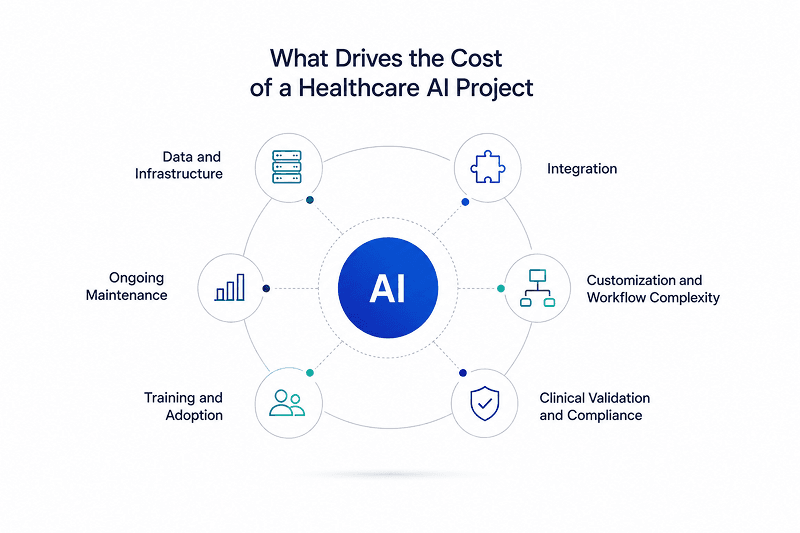
The cost of healthcare AI is rarely about the AI model alone. Much of the investment comes from everything your teams need to make it work: usable data, connected systems, redesigned workflows, training, validation, and ongoing support.
The Biggest Cost Drivers
Data and infrastructure: Healthcare data often sits across systems and needs to be cleaned, normalized, labeled, secured, and made accessible before teams can use it. Before choosing a model, ask: Do we have the data environment this use case requires?
Integration: AI creates more value when it fits into the systems people already use, including EHRs, claims, laboratory, imaging, scheduling, and patient platforms. At Millipixels, we have seen that a strong AI capability can still fall short if it forces people to leave their existing workflows to use it.
Customization and workflow complexity: Supporting one standardized workflow is very different from serving multiple departments, roles, policies, and exceptions. More customization means more implementation and adoption effort.
Clinical validation and compliance: When AI affects patient care, teams may need to account for FDA requirements for SaMD or clinical decision support, ONC's HTI-1 transparency requirements, HIPAA and BAA requirements when vendors handle protected health information, and state-specific AI laws. These requirements take time and expertise, so they belong in the cost from the start. They also help make sure AI is safe, understandable, and useful for the people relying on it.
Reimbursement and revenue: Some AI applications can do more than reduce costs. For imaging and diagnostic teams, applicable CPT codes or programs such as Medicare's New Technology Add-on Payment (NTAP) may create reimbursement opportunities for qualifying services or technologies. That can help organizations invest in tools that improve how clinicians work and how patients receive care. Reimbursement is not automatic, though. Eligibility depends on the use case, setting, and payer, so it should be verified as part of the business case.
Training and adoption: People need time to learn new tools and adjust how they work. Training, workflow redesign, change management, and user support all affect the real cost and eventual ROI.
Ongoing maintenance: AI needs attention after deployment. Teams may need to monitor performance, data quality, accuracy, usage, and model drift, and eventually recalibrate or retrain the system.
The key question is not simply "What does the AI cost?" It is "What will our people and systems need to make it work reliably over time?"
How Much ROI Can You Realistically Expect?
There is no single ROI number that applies to every healthcare AI investment. A documentation tool, revenue-cycle platform, and clinical AI system solve very different problems.
A better starting point is your own baseline:
- What is the problem costing us today?
- What will change for the people doing the work?
- What will it take to implement and maintain?
- How will we know the investment is working?
For example, if AI is expected to save clinicians time, measure what actually changes in their day. Does it reduce documentation? Give them more time with patients? Or simply create another task to review?
The goal is not to find the most impressive ROI number. It is to understand whether the investment will create enough real value for your people and your organization to justify the cost.
Know Where AI Can Deliver Real Value
Identify the right healthcare AI opportunities, understand the true cost of implementation, and build a business case grounded in measurable outcomes.
Consult Millipixels
What Does the Peer-Reviewed Evidence Actually Say?
Research shows that AI can create economic value in healthcare, but the results vary by use case and setting.
A 2025 npj Digital Medicine review by Rabie Adel El Arab and Omayma Abdulaziz Al Moosa examined 19 economic evaluations of clinical AI and found that AI was often associated with better health outcomes and lower costs. The review also noted that implementation and infrastructure costs were not always fully captured.
A separate 2025 review by Yue Zhang and colleagues examined 48 economic evaluations of AI-enabled precision medicine and found AI was cost-saving or cost-effective in 89% of base-case analyses. The researchers also highlighted potential bias and differences across applications.
For healthcare leaders, the takeaway is simple: research can show what is possible, but it cannot predict your ROI. Your business case still needs to account for your people, workflows, implementation costs, adoption, and measurable outcomes.
The Costs Your Business Case Needs to Account For
The price of an AI solution is easy to see. What is harder to account for is everything your people and teams need to make it work.
What Your Teams Need to Make AI Work
Your business case should account for:
- Infrastructure and integration: The systems, data, security, testing, and support needed to fit AI into existing workflows
- Clinical validation and compliance: The work required to validate performance, meet regulatory requirements, and monitor the solution after deployment
- Training and adoption: The time clinicians and operational teams need to learn the tool and adjust how they work
- Ongoing model management: The people and processes needed to monitor performance, address data changes, and retrain or update the model
This last point is easy to overlook. AI should fit around people's work rather than asking people to constantly work around the AI. That makes the design of the experience an important part of implementation, particularly as generative AI and clinical AI reshape healthcare experiences.
The impact on day-to-day work matters too. If an AI tool saves a clinician 30 minutes but requires 15 minutes of additional review, the real productivity gain is 15 minutes. Measure what changes for the people using the system, not just what the technology promises.
Look at the Full Cost of Keeping AI Useful
AI can also create different outcomes across patient populations if model performance or access to supporting infrastructure varies. That makes equity and access important considerations in understanding the true value of an AI investment.
A more realistic calculation is:
Total AI investment = Development/configuration + Data preparation + Infrastructure + Integration + Validation + Deployment + Training + Monitoring + Maintenance + Retraining
From our experience at Millipixels, the initial implementation quote is only part of the picture. What matters most is understanding what people and teams will need to make the technology easy to use, dependable, and genuinely valuable in their day-to-day work.
How to Build an AI ROI Case You Can Defend
The best ROI calculation starts before you talk to a vendor. It starts with the problem.
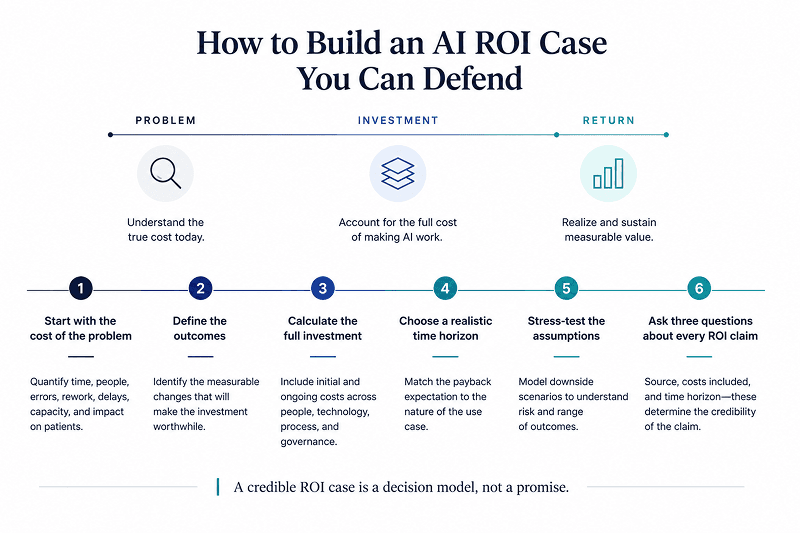
1. Start with the cost of the problem, not the price of the AI
Ask what the current process costs your organization.
For example:
- How many hours are spent on it?
- How many employees are involved?
- What is the turnaround time?
- Where do errors occur?
- How much rework is created?
- What revenue is delayed or lost?
- What clinical capacity is constrained?
- What patient experience is affected?
If you cannot describe the baseline, you cannot confidently describe the return.
2. Define the outcomes you expect to change
The right metric depends on the use case.
Use case | Potential value metrics |
Documentation AI | Documentation time, clinician capacity, turnaround time |
Revenue-cycle AI | Cost to collect, denial rate, recovery rate, processing time |
Scheduling AI | Staff hours, utilization, appointment fill rate, no-show rate |
Clinical decision support | Accuracy, outcomes, unnecessary procedures, time to intervention |
Patient engagement AI | Response time, completion rate, support volume, patient satisfaction |
Workflow automation | Processing time, error rate, manual effort, throughput |
Don't start by deciding what ROI number you want.
Start by deciding what measurable change would make the investment worthwhile.
3. Calculate the full investment
Separate your costs into two buckets.
Initial investment
- Development or configuration
- Data preparation
- Integration
- Validation
- Deployment
- Training
- Ongoing investment
- Licensing
- Infrastructure
- Monitoring
- Support
- Maintenance
- Retraining
- Governance
This makes the business case easier to review and easier to challenge.
4. Choose a realistic time horizon
A 12-month payback expectation may make sense for some administrative applications.
It may not make sense for a clinical AI program where validation, adoption, and measurable outcomes take longer.
The time horizon should reflect the use case.
Do not force a clinical investment into an administrative AI payback model simply because the shorter number looks better in a presentation.
5. Stress-test the assumptions
A credible ROI model should survive an unfavorable scenario.
Ask:
- What happens if adoption is 30% lower than expected?
- What if implementation takes six months longer?
- What if integration costs increase?
- What if productivity gains are only half the estimate?
- What if retraining is required more frequently?
- What if the expected financial benefit takes longer to materialize?
- This is where a business case becomes useful to leadership.
- It stops being a promise and becomes a decision model.
6. Ask three questions about every ROI claim
Before accepting any number from a vendor, analyst, consultant, or industry report, ask:
1. What is the source?
Is it peer-reviewed research, an industry survey, a vendor case study, or a modeled estimate?
2. What costs are included?
Does it include integration, infrastructure, validation, training, monitoring, maintenance, and retraining?
3. What is the time horizon?
Is the return measured over six months, one year, three years, or longer?
Those three questions can change the quality of an AI investment conversation considerably.
A Simple Healthcare AI ROI Example
Imagine a healthcare organization considering an AI documentation tool for 50 clinicians. Rather than starting with a promised ROI percentage, the team starts by understanding how documentation affects their clinicians today.
They might look at:
- How much time clinicians currently spend documenting outside patient interactions
- How much of that time the AI could realistically reduce
- How many clinicians are likely to use the tool regularly
- What the implementation and ongoing costs will be
- What the organization could do with the time clinicians get back
From there, the organization can build a simple model.
Start with the baseline: Measure documentation time before introducing the tool.
Set a realistic adoption assumption: Not every clinician will use a new tool immediately, so model what happens if adoption is high, moderate, or lower than expected.
Estimate the potential benefit: If clinicians spend less time documenting, the value might come from reduced after-hours work, more capacity for patients, or less administrative burden.
Account for the full investment: Include implementation, integration, training, licensing, support, and ongoing maintenance rather than looking only at the initial price.
Calculate the payback period: Compare the expected annual benefit with the total cost to understand how long it could take to recover the investment.
Then test the downside
The first calculation should not be the final answer. Ask what happens if:
- Adoption is lower than expected
- Clinicians save less time than anticipated
- Implementation takes longer
- Integration costs more than planned
- The organization needs additional training or support
If the business case still makes sense under those conditions, leadership has something much more useful than a headline ROI number. It has a clearer view of what needs to be true for the investment to help the people using it and deliver enough value to justify the cost.
Case Study: Helping a Leader in Genetics Testing Scale COVID-19 Testing When Speed Mattered
When organizations needed to reopen workplaces and schools safely, our client, a leader in genetics testing, needed a solution that could support very different users and requirements without slowing down deployment.
Millipixels worked closely with clinical and product leadership to understand those needs and create a flexible, mobile-first UX framework that could adapt across counties, schools, and organizations. The team also developed an integrated patient portal for COVID-19 and hereditary cancer testing, with usability and HIPAA compliance built into the experience.
The result was a scalable experience that helped our client launch large-scale COVID-19 testing programs in just 10 days. The platform supported thousands of concurrent users without requiring a UI overhaul and increased mobile engagement by more than 50%.
More importantly, the flexible framework gave teams the ability to adapt the experience as requirements changed, helping organizations respond quickly during an uncertain and rapidly evolving period.
See What It Takes to Scale Healthcare Experiences Under Pressure
Where Should Your Organization Start?
Not every healthcare organization needs to begin with the most ambitious AI project.
In many cases, the better starting point is the use case where the value is clear, the risk is manageable, and the organization is ready to implement.
Administrative AI can provide a practical starting point
Consider areas such as:
- Documentation
- Revenue cycle
- Scheduling
- Patient communication
- Workflow automation
These use cases can offer a clearer operational baseline and faster feedback.
For example, if a team spends thousands of hours each month on a repetitive process, the potential value of automation can be measured against a relatively clear starting point.
That does not make administrative AI automatically more valuable. It makes the economics easier to test.
Clinical AI requires a higher evidence threshold
Clinical AI can create significant value, but the investment case needs to account for more than operational efficiency.
You may need to consider:
- Clinical performance
- Patient safety
- Validation
- Regulatory requirements
- Monitoring
- Clinician adoption
- Longer time horizons
The same people-first principle applies here. Clinical AI needs to support clinicians without adding unnecessary friction, while giving them enough confidence and context to make informed decisions. This becomes particularly important as technologies such as remote patient monitoring reshape AI-driven healthcare, creating new ways for care teams to understand and respond to patients beyond traditional clinical settings.
The right conclusion is not that clinical AI should come later for every organization. It is that clinical AI deserves a different standard of evidence before it reaches patients.
Choose your first use case based on value, risk, and readiness
A simple way to evaluate potential projects is to score them across three dimensions:
Dimension | Question to ask |
Value | How significant is the problem we're trying to solve? |
Risk | What happens if the AI performs poorly? |
Readiness | Do we have the data, systems, people, and workflow needed to implement it? |
The strongest first use case is usually where all three are reasonably strong. A high-value problem with no usable data is not ready. A technically ready project with little business value is not worth prioritizing. And a high-value clinical application with significant safety implications may require much more validation before it becomes a sensible first deployment.
Use phased pilots to validate economics before scaling
A pilot should not simply answer:
"Does the AI work?"
It should answer five questions:
- Does it perform adequately?
- Do people actually use it?
- Does it improve the workflow?
- Are the expected operational or financial benefits appearing?
- Are the risks and ongoing costs manageable?
This approach lets an organization validate its assumptions before committing to a larger rollout.
This is an important distinction in how we think about digital transformation in healthcare at Millipixels. The goal of a pilot is not to prove that AI is impressive, but to understand how it works for the people using it and generate enough evidence to make a better scaling decision.
Conclusion: The Best AI Investment Is One You Can Prove
Healthcare AI does not have a shortage of promising numbers. What it often lacks is the context needed to turn those numbers into a sound investment decision.
The strongest business cases start with your organization, not an industry benchmark. They define the problem, establish what it costs today, account for the full lifecycle of the investment, and set clear measures for what success should look like. They also test what happens when adoption, implementation timelines, or expected benefits fall short.
At Millipixels, we believe that is what makes an AI investment case credible. The technology is only one part of the equation. Real value comes when it fits the people using it, the workflows they depend on, the systems around them, and the outcomes the organization needs to achieve.
AI can create significant value in healthcare. The right business case makes that value measurable, testable, and worth investing in.
Want to build a stronger AI business case? Consult Millipixels.
Frequently Asked Questions
1. How much does it cost to implement AI in a company?
The cost of AI implementation varies widely based on the use case, level of customization, data requirements, integrations, and scale. A focused AI application may cost tens of thousands of dollars, while a complex enterprise implementation can run into hundreds of thousands or millions. The best way to estimate the cost of implementing AI in healthcare is to assess the full implementation lifecycle, including technology, integration, security, training, governance, and ongoing operations.
2. How does AI impact the costs of healthcare services?
AI can influence healthcare costs in both directions. It can lower the cost of services by improving operational efficiency, reducing administrative workloads, supporting earlier detection, and helping healthcare professionals use resources more effectively. At the same time, implementing AI introduces costs related to technology, integration, validation, cybersecurity, workforce training, and ongoing maintenance.
The economic impact of AI in healthcare therefore depends on where it is deployed and what process it changes. AI that improves a high-volume, expensive workflow can create substantially more value than an application addressing a low-cost process.
3. How does AI reduce healthcare costs?
AI can reduce healthcare costs by addressing inefficiencies across clinical and administrative workflows. Common examples include:
- Automating repetitive administrative tasks
- Reducing manual data entry and documentation
- Improving scheduling and resource utilization
- Supporting faster claims processing
- Identifying potential billing errors or revenue leakage
- Helping clinicians analyze large volumes of medical information
- Supporting earlier identification of potential health risks
- Reducing unnecessary duplication of work
The most effective approach is not to introduce AI simply because a process can be automated. Organizations should identify where delays, errors, manual effort, or underutilized resources are creating measurable costs, then evaluate whether AI can address those specific problems.
4. How will AI affect healthcare financially?
AI is likely to create financial effects across both the cost and revenue sides of healthcare. Organizations may see productivity gains, lower administrative expenses, improved resource utilization, and new opportunities to expand capacity. However, these benefits will need to be balanced against investments in infrastructure, implementation, governance, cybersecurity, and workforce adaptation.
The financial impact will therefore vary considerably between providers, payers, pharmaceutical companies, and healthcare technology organizations.
5. How is AI impacting the healthcare industry?
AI is changing healthcare across clinical care, operations, research, and patient engagement. Beyond diagnosis and medical imaging, some of the fastest-growing applications include clinical documentation, patient communication, revenue-cycle management, drug discovery, workflow automation, and decision support.
Its larger impact is that AI is increasingly becoming part of digital transformation in the healthcare industry, rather than functioning as a standalone technology initiative.
6. What are the most promising AI solutions currently used in healthcare?
Some of the most promising applications include:
- Ambient clinical documentation: Reduces the administrative burden associated with clinical notes.
- Medical imaging AI: Supports image analysis and clinical decision-making.
- Predictive analytics: Helps identify risks and prioritize interventions.
- Revenue-cycle AI: Automates parts of coding, claims, and denial management.
- Patient-facing AI: Supports navigation, communication, and routine inquiries.
- Drug discovery AI: Accelerates parts of research and development.
- Clinical decision support: Helps clinicians interpret complex information and identify relevant patterns.
The strongest opportunities tend to be those where AI can augment professionals while fitting naturally into existing workflows.
7. What are the risks and challenges of implementing AI in healthcare?
The challenges of implementing AI in healthcare extend beyond choosing the right model. Organizations also need to consider data quality, interoperability, cybersecurity, privacy, regulatory requirements, model performance, workforce adoption, bias, explainability, and ongoing monitoring. Another challenge is ensuring that AI improves the existing workflow rather than creating additional review or administrative work.
Following best practices for AI integration in healthcare means addressing these considerations before deployment, establishing clear ownership and governance, testing AI in the intended workflow, and continuously monitoring its performance after launch.
8. What are the challenges of funding AI technology in healthcare?
Funding AI can be difficult because the initial investment often arrives before the financial benefits are fully measurable. Healthcare organizations may also struggle to compare AI projects with competing technology or operational investments.
A practical approach is to fund AI incrementally. Start with a clearly defined problem, establish measurable outcomes, validate the technology and economics through a controlled deployment, and use those results to inform larger investments. This reduces the financial risk of committing significant capital before the organization has evidence that the solution will deliver value.
For organizations assessing the cost of artificial intelligence in healthcare, Millipixels can help evaluate the technology, integration requirements, and implementation considerations together rather than treating AI as an isolated technology purchase.
Written by

Parthsarathy Sharma
With 4+ years of experience across AI, UX, GCC/outsourcing, enterprise technology, and brand strategy, Parthsarathy brings a research-driven lens to digital experience content. His work focuses on turning emerging technology, customer experience, and business trends into clear, practical perspectives for readers.
Reviewed by

Devish
Devish Chopra is an AI Product Manager who enjoys turning emerging AI capabilities into products that solve real business problems. His work spans agentic AI, enterprise automation, GRC, and product strategy. Through his writing, he shares practical perspectives on AI products, product management, and building scalable enterprise software.
- Introduction
- What Does AI in Healthcare Actually Cost?
- What Actually Drives the Cost of a Healthcare AI Project?
- How Much ROI Can You Realistically Expect?
- What Does the Peer-Reviewed Evidence Actually Say?
- The Costs Your Business Case Needs to Account For
- How to Build an AI ROI Case You Can Defend
- A Simple Healthcare AI ROI Example
- Case Study: Helping a Leader in Genetics Testing Scale COVID-19 Testing When Speed Mattered
- Where Should Your Organization Start?
- Conclusion: The Best AI Investment Is One You Can Prove
- Frequently Asked Questions