Digital Transformation Capability Framework: A Complete Guide for Enterprises
Explore a digital transformation capability framework to assess gaps, strengthen capabilities, and build an organization ready for change.
August 26, 2026
Written by

Introduction
A transformation can look successful on paper and still feel painfully slow inside the organization.
You have the strategy. You have the technology. You have teams working on transformation initiatives. Yet decisions still take too long, important signals get lost, and people keep falling back on the way things have always been done.
So what is actually missing? Is your organization able to see change early enough? Can it act when an opportunity appears? And once it acts, can it change the way people actually work?
That is where the idea of capability becomes more useful than another technology checklist. A digital transformation capability framework should not simply tell you what your organization has. It should help you understand what your organization is capable of doing when circumstances change.
The Sense–Seize–Transform lens builds on David Teece’s work on dynamic capabilities: how organizations notice what is changing, decide what to do about it, and help people work differently as the business evolves. At Millipixels, we use this thinking with clients to understand where transformation is getting stuck, whether teams are missing important signals, decisions are taking too long, or people are struggling to adopt new ways of working.
The rest of this guide looks at what those capabilities mean in practice, where organizations typically get stuck, and how you can identify the capability gap that is holding your transformation back.
What Digital Transformation Capability Actually Looks Like
Most digital transformation frameworks start by asking what technologies an organization has adopted. How mature is its cloud environment? How advanced is its data architecture? Does it have the right cybersecurity controls? How widely has AI been deployed? These considerations also matter when evaluating enterprise software solutions for long-term organizational needs.
Those questions matter. They just do not tell you enough.
A company can score highly across technology domains and still be unable to respond quickly when a customer expectation changes, a competitor introduces a new model, or a new technology creates an opportunity. That is the difference between having digital capabilities and being capable of change.
Technology maturity does not tell you whether you can change
A traditional digital maturity model is useful for establishing a baseline. It can show where technology, processes, data, or governance need investment.
The problem starts when the score becomes the objective. Consider two organizations with similar scores:
Capability area | Organization A | Organization B |
Cloud | Advanced | Advanced |
Data | Advanced | Advanced |
AI | Developing | Developing |
Cybersecurity | Advanced | Advanced |
Decision-making | Slow, centralized | Faster, distributed |
Workforce adoption | Uneven | Strong |
Resource reallocation | Difficult | Flexible |
Ability to change operating processes | Low | High |
On a conventional digital maturity assessment, these companies might look broadly similar. In practice, they could have very different transformation outcomes. The missing variable is not another technology domain. It is organizational adaptability.
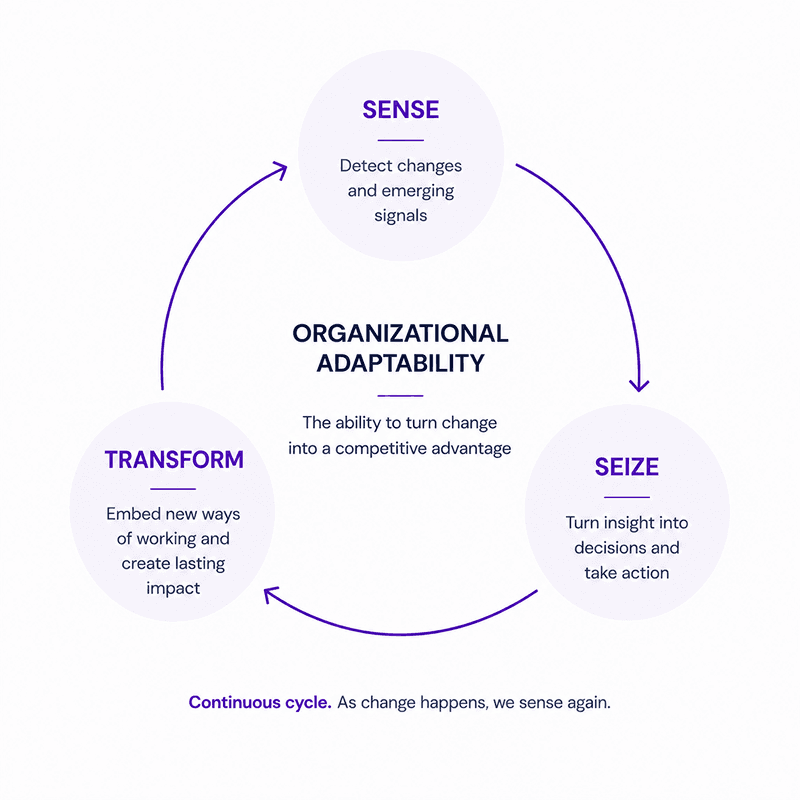
The three capabilities that matter
A more useful way to think about digital transformation capabilities is:
Sense → Seize → Transform
| Capability | The question it answers | What it depends on |
| Sense | Can we recognize meaningful change early enough? | Signals, customer insight, data, market intelligence, frontline feedback |
| Seize | Can we act once we know what matters? | Decision rights, funding, prioritization, leadership, resource allocation |
| Transform | Can we change how the organization actually works? | People, processes, operating model, incentives, culture, change management |
This is the foundation of the framework.
Teece’s work gives us the underlying framework; our focus is on applying it to the practical problems enterprises face during transformation.
The important point is that these are not three more technology categories. They describe the organization's ability to turn change into action and action into a new way of working
We have seen this distinction matter in practice: organizations often do not need another assessment to tell them that their technology needs improvement. They need to understand why the organization is still slow to respond even after the technology has been improved.
Sense: Can You See Change Before It Becomes a Problem?
Organizations rarely suffer from a complete lack of information. They suffer from information that arrives too late, stays inside functional silos, or never reaches someone who can do anything with it. That is a sensing problem.
Sensing is more than market research
Sensing is the organization's ability to identify meaningful changes in its environment and understand what those changes could mean. That includes:
- Changes in customer expectations
- Competitor moves
- Emerging technologies
- Regulatory developments
- Operational signals
- Frontline observations
- Changes in employee behavior
- New business models
- Shifts in market economics
The goal is not to collect more signals. It is to identify the signals that deserve action.
A useful sensing capability connects information from different parts of the organization. Customer-service teams can surface recurring customer signals before the product team sees a broader pattern. An engineer might identify a technology shift before it appears in a strategic planning document. A sales team may recognize a changing buyer requirement months before it appears in formal market research. The capability exists when those signals can travel.
Where sensing usually breaks down
A common enterprise pattern looks like this:
Signal → Functional team → Report → Review meeting → Committee → Decision
By the time the signal reaches someone with authority to act, the opportunity may have changed.
The issue is not necessarily the number of dashboards or reports. It is the distance between seeing something important and getting it in front of someone who can respond.
Strong sensing therefore requires more than data collection. It requires ownership, feedback loops, cross-functional visibility, and a mechanism for escalating meaningful signals.
Questions to test your sensing capability
Ask your leadership team:
- Who is responsible for identifying emerging threats and opportunities?
- How quickly can an important customer signal reach a decision-maker?
- Which information tends to stay trapped inside functions?
- How often do we challenge the assumptions behind our current strategy?
- What did we know six months ago that we only acted on recently?
If your organization consistently reacts late, the first capability to examine may not be execution. It may be sensing.
What can help people see change earlier?
If important signals are getting lost, start by making it easier for people to share what they are seeing and for others to act on it.
- Give frontline teams a voice. Make it easy for people who work closely with customers, operations, and technology to flag patterns they are noticing.
- Connect the dots across teams. Bring customer feedback, employee observations, market changes, and operational data together so people can see the bigger picture.
- Make time to ask what has changed. Give leaders and teams a regular space to discuss new signals and question whether old assumptions still hold.
The goal is not to give people more information. It is to help them recognize what matters while there is still time to respond.
Build the Capability Behind the Technology
Clarify where your transformation is getting stuck and create a practical roadmap for stronger decision-making, workforce readiness, and organizational change.
Talk to Our ExpertsSeize: Can You Act Once You See the Opportunity?
Seeing change is valuable only if the organization can respond. This is where many transformation programs encounter a different kind of friction. The organization knows what needs to happen, but cannot mobilize quickly enough to do it. That is a seizing problem.
Why good ideas die inside large organizations
An opportunity may be obvious, yet action can stall when compliance and approval requirements add friction because:
- No single leader owns the decision.
- Funding sits in another business unit.
- Multiple committees need to approve the initiative.
- Existing budgets cannot be redirected.
- Teams are measured against competing priorities.
- Leaders want more certainty before committing resources.
- A transformation portfolio is already overloaded.
This creates a frustrating situation. The organization is not unaware. It is simply slow to convert awareness into commitment.
What strong seizing capability looks like
Organizations that can seize opportunities tend to make several things clearer, including where prospects are in the buying journey and what needs to happen next.
- Decision rights: People know who can make the call.
- Resource flexibility: Funding and talent can move when priorities change.
- Cross-functional ownership: Important opportunities do not become stranded between departments.
- Experimentation: Teams can test an idea without requiring a full-scale business case from day one.
- Prioritization: Leadership is willing to stop lower-value initiatives to create capacity for more important ones.
This last point is often overlooked. Transformation capability is not just the ability to start initiatives. It is also the ability to stop, redirect, or deprioritize work when circumstances change.
Questions to test your seizing capability
Ask:
- How long does it take to move from identifying an opportunity to funding it?
- Who can make that decision?
- How many approval layers stand between an idea and action?
- Can resources move when strategic priorities change?
- What transformation initiatives should we stop but continue funding anyway?
A useful internal metric is simple:
Time from meaningful signal to committed action.
If that number is measured in months, the organization may have a decision-making capability problem, even if its technology maturity is high.
What can help people act faster?
If good ideas are getting stuck in the organization, look at what makes it difficult for people to move from knowing something needs to happen to actually doing it.
- Make it clear who can decide. People should know who can approve an idea, release resources, or change direction without having to navigate unnecessary layers.
- Give teams room to respond. When priorities change, people need a realistic way to move time, budget, and skills toward what matters most.
- Let people test before they commit. Small experiments can help teams learn what works without asking them to build the entire solution upfront.
The goal is not to make every decision faster. It is to help people make the right decisions at the right level, while the opportunity is still relevant.
Transform: Can You Change How People Actually Work?
This is where transformation becomes real. A cloud migration or new platform can be completed in weeks or months. Changing the way an organization operates is harder.
If employees continue following the same processes, managers continue making decisions the same way, incentives continue rewarding old behavior, and legacy systems remain embedded in everyday work, the organization has adopted technology without fully transforming.
Transformation is proven by changed behavior
Ask what is different after the technology goes live:
- Are decisions made differently?
- Are customers served differently?
- Are teams collaborating differently?
- Have unnecessary processes disappeared?
- Have responsibilities changed?
- Are employees using the new capability without being pushed to do so?
Those questions get closer to transformation than deployment statistics do. A useful distinction is:
| Technology implementation | Organizational transformation |
| New platform deployed | New way of working adopted |
| Users trained | New behaviors become routine |
| Process automated | Process redesigned around the new capability |
| System integrated | Decisions and workflows change |
| Adoption measured | Business outcomes and behavior change measured |
| Project completed | Capability becomes part of normal operations |
The difference is important because a successful technology implementation can still produce a weak transformation outcome.
Why transforming is the hardest capability
Transformation touches the parts of the organization that are hardest to change:
- Roles and responsibilities
- Operating models
- Leadership behavior
- Incentives
- Skills
- Processes
- Governance
- Culture
- Employee habits
This is also where change management becomes more than a communication exercise. A peer-reviewed study found that change management mediates the relationship between dynamic capabilities and digital transformation success. In other words, having the organizational capability is not enough. That capability has to be translated into workforce action and new ways of working.
That finding has an important practical implication:
Change management should not be treated as the final stage of transformation. It is part of the mechanism that turns capability into outcomes.
The workforce is part of the capability
You cannot transform an organization without transforming the capabilities of the people doing the work. The World Economic Forum's Future of Jobs Report 2025 estimated that 59% of the global workforce will require reskilling or upskilling by 2030.
But there is another problem that receives less attention: organizations often do not have a reliable picture of the skills they already possess. The Gartner research cited in the underlying analysis found that only 8% of organizations have reliable workforce skills data, while 50% acknowledge that they are not effectively leveraging the skills they already have.
That changes the question leaders should ask. Instead of immediately asking:
"What skills do we need to hire?"
start with:
"What capabilities does our strategy require, what do we already have, and where are the real gaps?"
Sometimes the problem is a skills shortage. Sometimes it is poor visibility. Sometimes the organization has the skills but has placed them in the wrong part of the operating model. Those require very different responses.
Questions to test your transformation capability
Ask:
- What are employees doing differently because of the transformation?
- Which legacy processes are still operating underneath the new technology?
- Are incentives aligned with the new way of working?
- Which decisions still require the old organizational structure?
- What capabilities will employees need to operate the new model?
- What are we asking people to stop doing?
The real test of transformation is not whether the technology works. It is whether the organization works differently because of it.
What can help people work differently?
When a transformation asks people to change how they work, the technology is only part of the transition. People also need clarity, support, and a reason to believe the new approach will make their work better.
- Change the work alongside the technology. Look at which tasks, processes, and responsibilities should actually change instead of asking people to fit new technology into old ways of working.
- Give people time and support to adapt. Training matters, but so do practical guidance, feedback, and space to build confidence with the new approach.
- Listen to what is getting in the way. If people are not adopting a new process, ask why. The answer may reveal a process problem, a skills gap, or something in the new operating model that needs to change.
The goal is not simply to get people to use something new. It is to help them feel confident working in a new way and make that way of working sustainable.
Why People Are the Missing Layer in Most Capability Frameworks
Technology gets most of the attention because it is easier to see and measure. You can count cloud migrations. You can measure system uptime. You can track AI deployments and platform adoption.
People and organizational capability are harder to quantify.
Yet they often determine whether those investments produce value.
The research behind dynamic capabilities has focused on an organization's ability to sense opportunities and threats, seize them through resource mobilization, and transform its structures and routines. That makes capability fundamentally different from a list of technologies an organization has purchased.
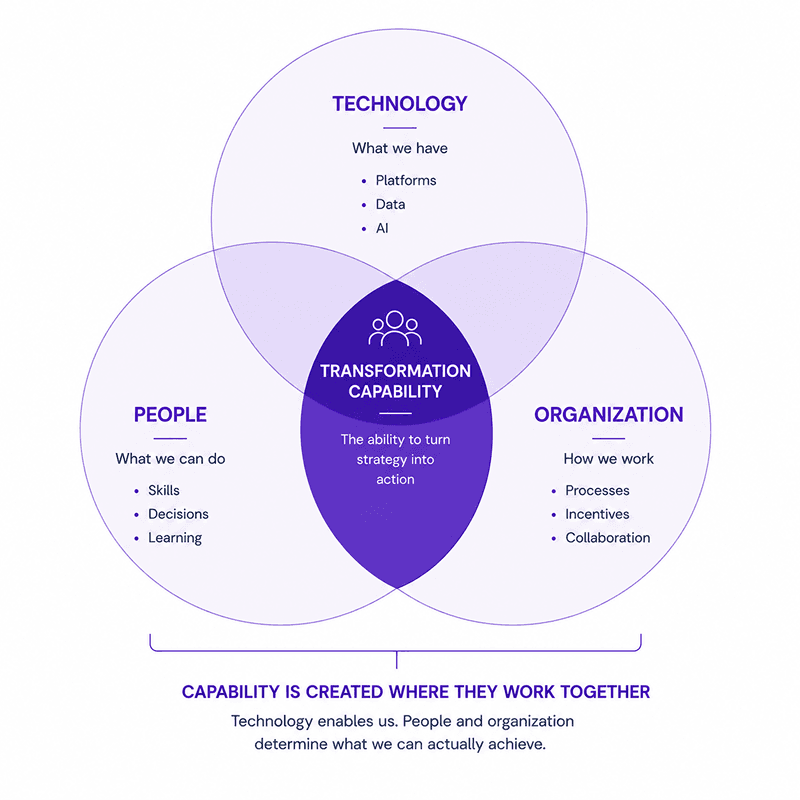
This also explains why culture and change cannot be treated as side topics. Capability lives in:
- How leaders make decisions
- How teams share information
- How quickly resources can move
- How employees learn new skills
- How incentives influence behavior
- How functions collaborate to create value with clients
- How quickly new ways of working become normal
A digital transformation framework that ignores these factors may produce a detailed assessment without explaining why the organization cannot execute.
At Millipixels, we approach capability questions by looking beyond the technology layer. The more useful question is usually not "How mature is this organization?" but "What is preventing this organization from doing what its strategy requires?"
Where Existing Digital Transformation Frameworks Fit
There is no shortage of digital transformation frameworks for enterprises. McKinsey, MIT, PwC, BCG, Capgemini, and other organizations have developed models for assessing transformation readiness, organizing capabilities, and guiding change. These frameworks can be useful, particularly when an organization needs a common language for discussing transformation. The mistake is treating the framework itself as the capability.
What these frameworks can help you do
| Use case | What a framework can provide |
| Establishing a baseline | A structured way to understand the current state |
| Creating a common language | Shared definitions across business and technology teams |
| Identifying investment areas | A way to highlight capability or maturity gaps |
| Structuring transformation | A sequence or set of dimensions for organizing work |
| Communicating with leadership | A concise view of complex transformation issues |
What a framework cannot do for you
A framework cannot resolve unclear decision rights. It cannot make employees adopt a new process. It cannot automatically move funding between competing priorities. It cannot tell a leadership team which transformation initiative should be stopped. And it cannot create the organizational willingness to change.
That is why we would treat a digital transformation maturity model as a diagnostic tool, not the destination. The best model is the one that helps you make better decisions about the organization, rather than the one that produces the most sophisticated score.
How to Find Your Biggest Digital Transformation Capability Gap
The most useful assessment does not begin with a five-point maturity scale. It begins with three questions.
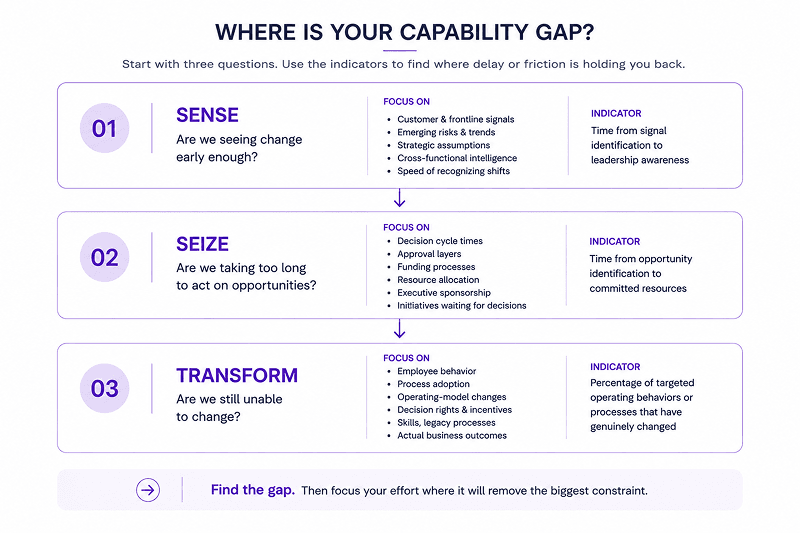
1. Sense: What are we failing to see early enough?
Look at:
- How customer and frontline signals move.
- How quickly emerging risks reach leadership.
- How frequently strategic assumptions are challenged.
- Whether teams share intelligence across functions.
- How long it takes to recognize a meaningful market or technology shift.
Possible indicator: time from signal identification to leadership awareness.
2. Seize: What are we taking too long to act on?
Look at:
- Decision cycle times.
- Approval layers.
- Funding processes.
- Resource allocation.
- Executive sponsorship.
- The number of initiatives waiting for decisions.
Possible indicator: time from opportunity identification to committed resources.
3. Transform: What are we still unable to change?
Look at:
- Employee behavior.
- Process adoption.
- Operating-model changes.
- Decision rights.
- Incentives.
- Skills.
- Legacy processes.
- Actual business outcomes.
Possible indicator: percentage of targeted operating behaviors or processes that have genuinely changed.
A simple way to find where you're stuck
Give each capability a score from 1 to 5 based on how it feels in everyday work:
- 1: We struggle with this.
- 3: It works, but not consistently.
- 5: People can do this quickly and confidently.
Then ask:
- Sense: Do people see important changes early enough?
- Seize: Can people act when something important comes up?
- Transform: Do people have what they need to work differently?
Your lowest score is a good place to start.
- If Sense is lowest, look at how information reaches people.
- If Seize is lowest, look at who can make decisions and move resources.
- If Transform is lowest, look at the support, skills, and processes people need to change.
A practical diagnostic
| Question | If the answer is "no" | Likely capability gap |
| Are important signals reaching decision-makers quickly? | We discover important changes too late | Sense |
| Can we commit resources quickly when priorities change? | Good opportunities stall in governance | Seize |
| Are people working differently after transformation? | Technology changes, behavior does not | Transform |
| Do we know which skills we already have? | Workforce decisions are based on assumptions | Transform |
| Can we stop lower-value work when priorities shift? | Resources remain trapped in old commitments | Seize |
The goal is not to achieve a perfect score across every dimension. It is to find the constraint that is limiting the value of your transformation investment. Remember:
- If sensing is weak, improve information flow.
- If seizing is weak, improve decision rights and resource allocation.
- If transforming is weak, address operating-model, workforce, and change-management barriers.
That is a much more useful outcome than discovering that your organization is "Level 3" on another digital transformation maturity model.
What a Better Digital Transformation Strategy Framework Looks Like
A strategy framework becomes more useful when it connects transformation goals to the capabilities required to achieve them. Instead of starting with: "Which technologies should we adopt?", start with: "What does the business need to become capable of doing?" Then work backward.
| Business ambition | Required organizational capability | Questions to ask |
| Respond faster to customers | Faster sensing and decision-making | How quickly do customer signals reach the right people? |
| Launch new digital products | Faster seizing and experimentation | Can teams access funding and make decisions quickly? |
| Scale AI across the enterprise | Workforce and operating-model transformation | Are roles, skills, processes, and governance ready? |
| Reduce operational complexity | Process and operating-model transformation | Which legacy processes should disappear? |
| Respond to market disruption | Strong sensing and resource flexibility | Can we detect change and redirect resources quickly? |
This is where a digital transformation strategy framework becomes genuinely useful. The technology roadmap should follow the capability requirement, not the other way around. Organizations can also explore AI-driven digital transformation services when they need support turning these strategic requirements into execution.
For example, if the strategic objective is faster customer response, buying another platform may not solve the problem if the real constraint is fragmented customer data and slow decision rights.
If the objective is enterprise AI adoption, deploying models may not be the hardest part. The larger challenge may be workforce skills, governance, process redesign, and trust. The capability gap should influence the technology investment, not the technology investment define the capability strategy.
Conclusion: The Bottom Line: Build the Ability to Change
Digital transformation capability is not about having the most advanced technology. It is about whether your people and organization can respond when the business needs to change.
Maturity tells you where you are today. Capability tells you what you can do next.
The difference shows up in everyday decisions: how quickly teams recognize a customer shift, how easily leaders move resources, and whether employees can adopt a genuinely different way of working.
So before your next transformation investment, ask three questions: What are we failing to see? What are we too slow to act on? What are we still unable to change?
If you need to answer one of these questions, start with the one creating the greatest drag on your transformation. At Millipixels, we help enterprises identify the organizational capability bottleneck that is preventing technology investments from delivering the outcomes they were meant to create. Let’s identify what is holding your transformation back.
Frequently Asked Questions
1. What are digital transformation frameworks?
Digital transformation frameworks are structured models that help organizations assess their current capabilities, define transformation priorities, and organize the changes needed to achieve business outcomes. They may cover areas such as technology, data, processes, workforce, governance, customer experience, and organizational change. Digital transformation frameworks for enterprises are particularly useful for creating a shared view of priorities across business and technology teams.
However, a digital transformation framework should be treated as a guide rather than a formula for success. A useful framework helps you understand what your organization needs to become capable of doing, where the current gaps are, and what actions should come next. The strongest approach connects technology investments with decision-making, workforce capability, operating-model changes, and measurable business outcomes.
2. What are the key components of a digital transformation framework?
The key components typically include strategy and business goals, technology and data capabilities, operating processes, workforce skills, governance, customer experience, and organizational change. The exact components should reflect the organization's transformation objectives rather than follow a fixed checklist.
For a digital transformation capability framework, it is particularly useful to assess three organizational abilities: sensing meaningful change, seizing opportunities through timely decisions and resource allocation, and transforming how people and processes work. This moves the assessment beyond technology maturity and toward the organization's actual ability to change.
3. What are the common challenges faced when implementing digital transformation frameworks?
Common challenges include unclear strategic priorities, fragmented ownership, slow decision-making, technology-first planning, workforce capability gaps, resistance to change, and difficulty translating transformation goals into measurable business outcomes.
4. How do I choose the right digital transformation strategy framework for my organization?
Choose a digital transformation strategy framework based on the business problem you need to solve, the organization's current capabilities, the scale of change required, and how well the framework supports decision-making. Avoid choosing a model simply because it is popular or comprehensive.
A good framework should help you identify capability gaps, prioritize investments, clarify ownership, and connect technology decisions to business outcomes. If you already use a digital maturity model, consider whether it tells you only where you are today or also helps you determine what the organization needs to become capable of doing next.
5. Can you recommend some effective digital transformation frameworks used in the industry?
Commonly referenced approaches include frameworks and methodologies associated with McKinsey, MIT, PwC, BCG, and other major consulting and research organizations. They differ in how they organize transformation around areas such as strategy, technology, operating models, people, and organizational change.
Rather than selecting a framework based only on its name, compare what each model helps you assess and whether it fits your organization's transformation priorities. Your digital transformation capabilities and the specific business outcomes you are pursuing should ultimately determine which approach is most useful.
6. What are the key stages in digital transformation maturity?
A digital transformation capability maturity model framework typically moves from fragmented or largely reactive capabilities toward more integrated, standardized, data-driven, and continuously improving ways of working. Organizations may use different maturity levels and terminology, so there is no single universal scale.
A digital transformation maturity model is most useful when it helps establish a baseline and identify priorities. Maturity should not become the end goal. The more important question is whether the organization is becoming better at sensing change, acting on opportunities, and transforming how it operates.
Written by

Parthsarathy Sharma
With 4+ years of experience across AI, UX, GCC/outsourcing, enterprise technology, and brand strategy, Parthsarathy brings a research-driven lens to digital experience content. His work focuses on turning emerging technology, customer experience, and business trends into clear, practical perspectives for readers.
- Introduction
- What Digital Transformation Capability Actually Looks Like
- Sense: Can You See Change Before It Becomes a Problem?
- Seize: Can You Act Once You See the Opportunity?
- Transform: Can You Change How People Actually Work?
- Why People Are the Missing Layer in Most Capability Frameworks
- Where Existing Digital Transformation Frameworks Fit
- How to Find Your Biggest Digital Transformation Capability Gap
- What a Better Digital Transformation Strategy Framework Looks Like
- Conclusion: The Bottom Line: Build the Ability to Change
- Frequently Asked Questions