AI adoption challenges and how to overcome them in 2026
Explore the AI adoption challenges shaping enterprises in 2026, from integration and governance to model flexibility, observability, cost, and measurable business value.
July 29, 2026
Written by

Introduction
For most of the past decade, the enterprise AI conversation revolved around intelligence.
Could a machine understand the question? Could it interpret complex information, write credible code, recognize patterns, or make a useful recommendation? Considerable money, talent, and attention went into answering those questions.
The answer, in many parts of the enterprise, is now a definitive yes. Intelligence is no longer the rarest ingredient. It can be bought, accessed, or integrated through a growing field of large language models, specialized models, copilots, and autonomous agents. What remains difficult is giving that intelligence a place inside the business without allowing it to become fragmented, opaque, expensive, or unsafe.
That is the more consequential AI adoption challenge of 2026. The enterprise no longer needs to ask only whether AI can perform the work. It must ask whether the work, systems, policies, and people around it are prepared for AI to participate.
A capable model may generate the right answer and still fail the enterprise. It may sit outside the workflow employees actually use. It may depend on data it cannot reliably access. It may act through permissions nobody designed for an autonomous system. It may produce an outcome that cannot be reconstructed, challenged, or explained after the fact.
None of these are failures of intelligence. They are failures of adoption.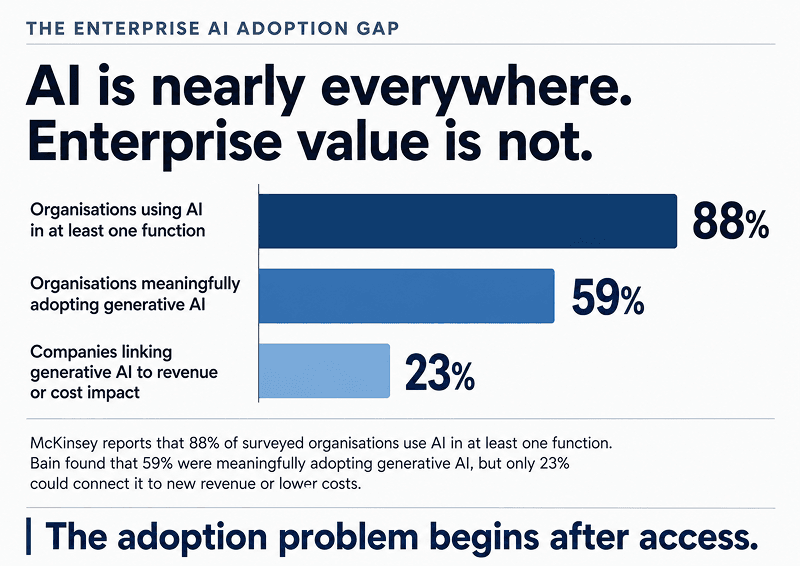
AI adoption begins before the tool is chosen
Enterprises often approach AI in the reverse order. A platform is purchased, accounts are created, and teams are asked to find useful applications for it. The organization has acquired capability before deciding where that capability belongs.
This produces a great deal of motion, but very little direction. One team launches a knowledge assistant. Another builds a customer-service copilot. A third experiments with an autonomous workflow. Usage rises, leadership sees evidence of interest, and the company begins to describe itself as an AI adopter.
The question that remains unanswered is whether any of those initiatives address the enterprise’s most important constraints.
AI adoption should begin with the business as it exists, not with the tool as it is marketed. Where does work become slow, expensive, inconsistent, or difficult to govern? Which decisions depend on fragmented information? Which processes require people to move repeatedly between systems? Where does growth create operational strain that cannot be solved by adding more people?
These questions reveal whether AI is necessary, what form it should take, and how deeply it must be integrated.
Without that understanding, the enterprise is not adopting AI. It is accumulating software.
Usage is not adoption, and adoption is not yet value
The easiest way to measure AI is also the least revealing.
Seats activated, sessions completed, queries submitted, and hours spent inside a platform can all be counted neatly. They create dashboards that move, and movement has a reassuring quality in executive meetings.
Yet none of these measures explains what changed because AI was present.
Usage may indicate curiosity, repeated experimentation, poor interface design, or genuine reliance. Without the context of the workflow and the business outcome, the number remains ambiguous. Adoption begins when AI becomes part of how work moves.
The system must be available where the work happens, connected to the data and applications the process depends on, and used consistently by the people accountable for the result. It must reduce effort, improve judgment, or create a capability that did not exist before.
Value comes later, when that change appears in a measure the enterprise already understands.
A faster underwriting decision. A lower cost per service request. A shorter release cycle. Fewer manual exceptions. Better compliance coverage. Greater capacity without an equivalent increase in headcount.
Usage proves access. Adoption proves behavioral and operational change. Value proves that the change was worth making. Confusing these three stages is one of the principal reasons enterprises continue funding AI programs whose contribution nobody can defend.
The integration question is the adoption question
AI cannot become part of the enterprise while remaining outside its technology environment. A model may perform impressively in isolation, but enterprise work rarely begins and ends inside one interface. It moves through customer platforms, internal applications, data stores, identity systems, approval chains, communication tools, and old infrastructure that still carries critical business logic.
When AI is not connected to that environment, the burden falls back on the employee. The model generates an answer. A person checks it, copies it, adjusts the format, signs into another platform, and completes the process manually. AI has entered the task without improving the workflow.
This is why openness to integration should be treated as a core adoption requirement rather than a technical consideration reserved for later. The enterprise needs an AI architecture capable of connecting with its current systems while remaining adaptable enough to accommodate what comes next. That includes new models, new agents, new policies, and new forms of work.
A closed platform may offer speed at the beginning. Over time, it can leave the organization dependent on one provider’s technology, pricing, roadmap, and assumptions about how work should be structured. Adoption should create flexibility, not exchange one constraint for another.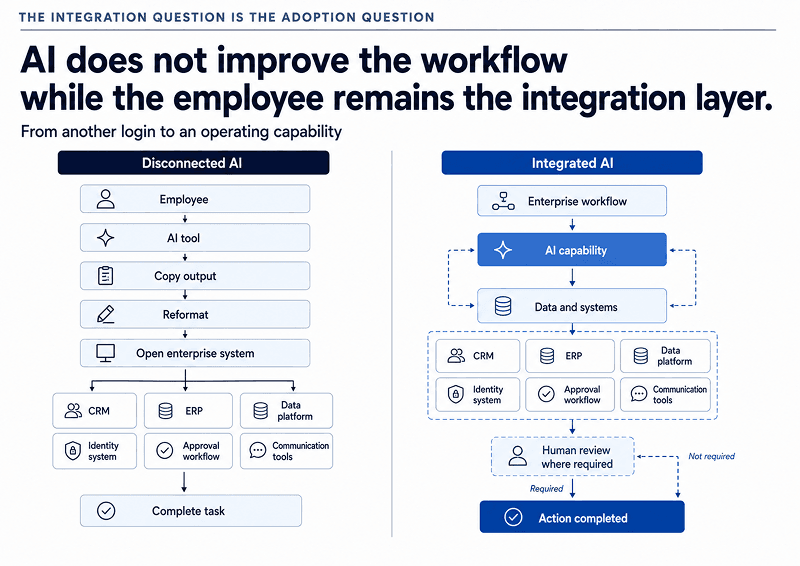
The enterprise should not depend on one model
No single model will remain the best answer for every enterprise use case.
Some models will be stronger at complex reasoning. Others will offer lower latency, greater privacy, better economics, or deeper capability in a particular domain. The same variation will appear among AI agents, each designed to complete different forms of work across different systems.
The enterprise must therefore prepare for plurality. A model-agnostic and agent-agnostic architecture allows the organization to choose the right intelligence for the task while retaining a consistent approach to governance, access, monitoring, and accountability.
This matters because model choice should remain a business and technical decision, not an architectural inheritance.
An organization should be able to replace a model when its performance no longer justifies its cost. It should be able to introduce a new agent without rebuilding every policy. It should be able to compare providers without losing the controls required to operate responsibly.
The enterprise does not need to own every form of intelligence it uses. It does need to own the rules under which that intelligence operates.
Your next AI investment should begin with a clearer diagnosis
Identify where data, integration, governance, or operating design is limiting adoption.
Find the Real ConstraintAgentic AI changes the stakes
A model that answers a question remains largely within the realm of assistance.
An agent that interprets a goal, selects tools, retrieves information, coordinates actions, and moves work across systems enters a different category. This is where AI becomes more useful to the enterprise because business processes are rarely neat enough to be solved through a single prompt. Work contains exceptions, changing information, conflicting priorities, and decisions that depend on context.
Agentic AI introduces the flexibility to respond to those conditions. It also introduces a greater capacity to cause harm. An agent may access information the user should not see. It may act through permissions that were designed for a person rather than an autonomous system. It may take a reasonable action in one context and an unacceptable one in another. It may complete a task successfully while leaving no useful account of the path it followed.
The intelligence problem may be largely solved. The control problem is not. As AI becomes more capable of action, governance has to move closer to the work.
Ethics cannot remain a statement of intent
Enterprise AI is often described as intelligent, flexible, and ethical, as though these qualities naturally arrive together. They do not.
A system may be highly intelligent and operationally flexible while still behaving in ways the organization cannot accept. It may expose sensitive information, reproduce unfair decisions, exceed its authority, or take actions that conflict with company policy.
Ethics cannot depend on the hope that the model will behave correctly. It must be translated into enforceable rules. That means defining which data a model or agent may access, which tools it may use, what actions require approval, and where a human decision must remain final. It means ensuring that the authority granted to an AI agent does not exceed the authority of the person or function it represents.
Policy management and role-based access, therefore, are not administrative features around AI. They are part of the AI system itself. A flexible system without enforceable ethics is not enterprise-ready. An ethical principle without operational controls is little more than reassurance.
The organization needs both the belief and the mechanism.
Governance must sit above the models and agents
Enterprises are likely to use many forms of AI across many parts of the business. Without a common governance layer, each model and agent may arrive with its own permissions, monitoring logic, policy interpretation, and audit trail. The result is not an AI ecosystem but a collection of isolated systems that become harder to understand as they expand.
A governance layer provides continuity across that changing environment.
It can apply policy consistently, manage role-based access, enforce approval thresholds, restrict tools and data, and define when human review is required. It can allow the organization to change models and agents without rebuilding the controls around every workflow.
This separation is strategically important. The intelligence layer will continue to change rapidly. Governance must remain stable enough to preserve trust while flexible enough to accommodate new capabilities. The enterprise should be free to adopt better intelligence without surrendering the ability to govern it.
Observability is how flexibility becomes accountable
AI systems become difficult to trust when their actions cannot be seen clearly. An enterprise should be able to determine which model handled a task, what information it used, which tools it accessed, what policy governed the decision, where a person intervened, and what action followed.
This is observability in its most useful form. It is not limited to technical uptime or model performance. It creates a record of how intelligence moved through the business. That record matters when something goes wrong, but it is equally valuable when the system appears to be working.
Without visibility, the organization cannot identify unnecessary interventions, understand cost, compare model performance, improve policy, or determine whether the workflow is becoming more reliable over time.
Observability turns AI from an inscrutable capability into an operating system the enterprise can examine and improve. Flexibility is valuable only when someone can still explain what the system did.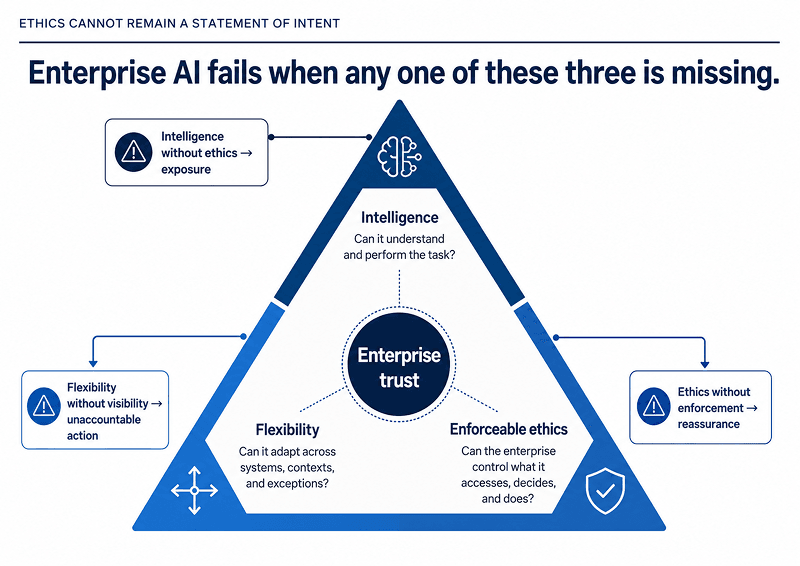
Should the enterprise build its own AI?
The appeal of building is easy to understand. A proprietary model appears to offer greater control, stronger differentiation, and freedom from dependency. For a small number of organizations with highly specialized data, unusual requirements, or a business model built directly around proprietary intelligence, that investment may be justified.
For most enterprises, the economics are more difficult. Building AI requires considerable compute, specialist talent, evaluation, infrastructure, security, and ongoing maintenance. The cost does not end when the model is deployed. Performance must be monitored, data must be updated, risks must be assessed, and the system must continue evolving as the wider AI market advances.
By the time the organization has built its own intelligence, the market may already offer something stronger at a fraction of the cost. Buying is easier, but ease creates its own illusion.
A company can procure a model, activate licenses, and begin using it almost immediately. Yet the organization may still be left with a disconnected tool, uncertain data movement, weak governance, limited visibility, and growing vendor dependence.
The company is logged in, but the enterprise has not necessarily adopted anything. The better question is not whether the organization should build or buy AI in absolute terms. It is what the organization must own to create lasting advantage.
For many enterprises, the model itself will not be the answer. The valuable assets will be the company’s data, context, workflows, policies, integrations, and decision rights. Intelligence can increasingly be sourced. Enterprise judgment cannot.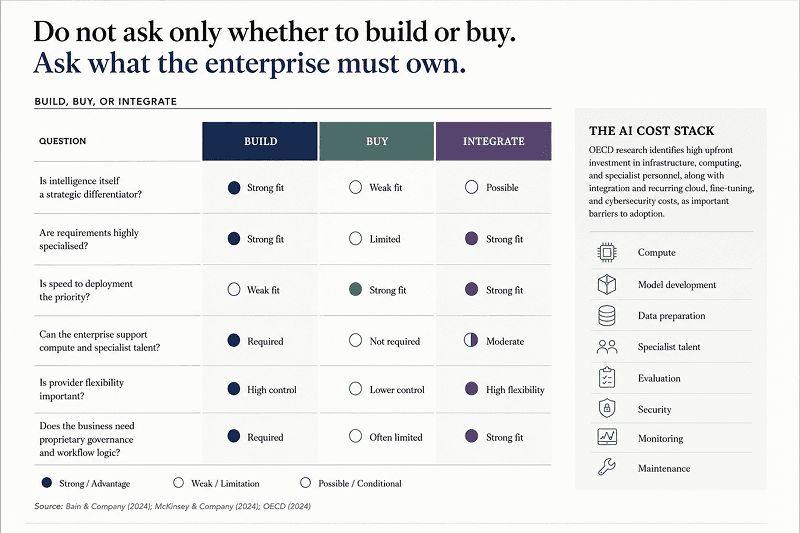
The most durable architecture separates intelligence from control
A flexible enterprise AI environment has several distinct layers.
- The first is the intelligence layer, where different models and agents can be selected according to the task.
- The second is the integration layer, which connects that intelligence with the organization’s data, applications, and workflows.
- The third is the governance layer, which applies policy, permissions, approval thresholds, and role-based access consistently.
- The fourth is the observability layer, which records how the system behaved, what it cost, and where human intervention occurred.
Separating these layers allows the enterprise to evolve without losing control.
A model can change without rewriting every policy. An agent can be introduced without receiving unrestricted access. A workflow can be expanded while preserving the decision rights that made it safe in the first place. This is the foundation of responsible flexibility.
A more useful path to AI adoption
The right sequence begins with restraint.
- Understand the enterprise need before selecting the technology. Identify the workflow that must change and the business measure that will reveal whether it improved.
- Choose whether to build, buy, or integrate based on the nature of the advantage the organization is trying to create. Avoid building intelligence that the market can supply more effectively, and avoid buying a closed operating model that limits future choice.
- Design for integration from the beginning. AI should enter the systems and processes where work already happens rather than asking employees to build new habits around another disconnected interface.
- Keep the architecture model-agnostic and agent-agnostic wherever practical. The enterprise should be able to change the intelligence without abandoning the controls.
- Establish governance before granting autonomy. Policies, role-based access, human review, and escalation paths should exist before AI begins acting across live systems.
- Make every important action observable. The organization should understand what happened, why it happened, and what it cost.
- Measure adoption through the depth of change in the workflow and the value created, rather than the volume of usage surrounding the tool.
What the enterprise should measure
A credible adoption framework looks beyond access. It asks whether AI is used repeatedly inside the intended process, whether it covers enough of that process to reduce friction, and whether employees continue relying on it after the novelty has faded.
It examines how often people correct, override, or escalate the system’s output. Those interventions are not merely signs of failure; they reveal where the model lacks context, where policy remains unclear, and where human judgment continues to carry the greater value.
It measures changes in cycle time, throughput, cost, quality, and risk. It also asks whether the capability can be reused. Can the same integration, governance, policy, and observability layers support the next use case, or must the enterprise begin each time again?
Adoption becomes durable when every new use case strengthens the foundation for the one that follows.
Conclusion
The next enterprise advantage will not belong to the company with the largest collection of models. Nor will it belong automatically to the company that builds the most expensive one. It will belong to the organization that knows where intelligence should enter, what it should be allowed to do, and how its contribution will be judged.
The intelligence market will continue moving. Models will become faster, cheaper, and more capable. Agents will take on longer and more complex sequences of work. The temptation will be to follow each improvement with another purchase, pilot, or proof of concept.
The more valuable discipline is to build an enterprise that can absorb change without being governed by it. That means keeping the technology stack open to integration, remaining free to choose among models and agents, and placing governance above the intelligence rather than inside any one provider. It means making ethics enforceable through policy and role-based access. It means observing AI closely enough to improve it and restrain it when necessary.
Above all, it means refusing to confuse activity with adoption. The purpose of enterprise AI is not to make the organization look more intelligent. It is to help the organization act with greater clarity, adaptability, and control. Everything else is access.
Build an enterprise that can absorb AI without surrendering control
Millipixels helps you connect models and agents to real workflows, govern how they operate, and measure the value they create.
Talk to the Millipixels AI TeamFrequently Asked Questions
1) What are the main risks of AI adoption?
The largest risks arise when AI enters real workflows without clear limits. Poor data quality, weak access controls, hidden model behavior, privacy exposure, vendor dependency, and unclear accountability can all turn a useful system into an operational liability. The risk grows further when agents can act across systems without adequate oversight.
2) What is the most common challenge in AI implementation?
The most common problem is beginning with the technology rather than the enterprise need. Companies buy platforms, launch pilots, and measure usage before defining which workflow should change or what value should result. Without a clear business objective, even technically successful initiatives struggle to earn wider adoption or sustained investment.
3) What causes AI integration problems in existing systems?
Integration problems usually stem from fragmented data, legacy applications, inconsistent permissions, and workflows not designed for AI participation. When the model sits outside the systems where work happens, employees become the connection point, manually moving information between tools. That may increase activity without improving the process itself.
4) How can companies overcome enterprise AI adoption challenges?
Start by identifying the business constraint before selecting the model or platform. Connect AI to existing workflows, keep the architecture open to different models and agents, establish governance before granting autonomy, and define measurable outcomes from the beginning. Adoption should be judged by operational change, not by licenses, logins, or prompt volume.
5) What are the best practices for governing generative AI systems?
Governance should include policy management, role-based access, approval thresholds, human review, audit trails, and clear accountability for outcomes. Organizations should also be able to see which model acted, what data it used, which tools it accessed, and what followed. Effective governance must remain consistent even when models or agents change.
Written by

Taniya Adhikari
Taniya brings 7+ years of experience across technology, AI, UX, and consulting content, shaped by work with brands such as Tata Communications, Tanishq USA, Marico, and Kaya. This cross-industry exposure informs how she develops content at Millipixels, bringing clarity, context, and relevance to complex digital topics.
- Introduction
- AI adoption begins before the tool is chosen
- Usage is not adoption, and adoption is not yet value
- The integration question is the adoption question
- The enterprise should not depend on one model
- Agentic AI changes the stakes
- Ethics cannot remain a statement of intent
- Governance must sit above the models and agents
- Observability is how flexibility becomes accountable
- Should the enterprise build its own AI?
- The most durable architecture separates intelligence from control
- A more useful path to AI adoption
- What the enterprise should measure
- Conclusion
- Frequently Asked Questions