B2B SEO Strategy for SaaS: A Step by Step Framework for Winning the 80% of the Buying Journey You Never See
Build a B2B SEO strategy that attracts the right buyers, supports buying committees, & drives sustainable growth with practical steps.
August 11, 2026
Written by

Introduction
What happens before a prospect books a demo?
For many B2B SaaS companies, that's the biggest blind spot in their B2B SEO strategy. Buyers aren't discovering your SaaS website design and making a decision in one visit. They're comparing vendors, validating claims, sharing resources internally, and building consensus long before your sales team knows they exist.
We've seen organizations invest heavily in SEO, only to wonder why rising traffic doesn't translate into qualified pipeline. The issue usually isn't visibility. It's that the content attracts searchers instead of helping buyers make decisions.
The way people buy software has changed. Before reaching out to a vendor, buying teams spend time understanding the problem, comparing solutions, and building internal alignment. Gartner found that 75% of B2B buyers prefer a rep-free sales experience during the early stages of their journey. That means your content has a bigger role than attracting clicks. It needs to answer questions, build confidence, and give buyers the information they need to make a case for your solution inside their organization.
This guide shares a practical framework for building a B2B SaaS SEO strategy that reflects how enterprise buying works today. You'll learn how to create content that supports buying committees, compounds over time, and stays relevant as search continues to evolve.
Why Most B2B SaaS SEO Strategies Stall Before They Deliver Results
Many SEO programs don't fail because teams aren't putting in the effort. They struggle because they're built around the wrong objective. Through our work with enterprises, including organizations evaluating generative AI consulting partners and benchmarking Micro GCC providers, we've seen three common patterns that consistently hold SEO programs back.
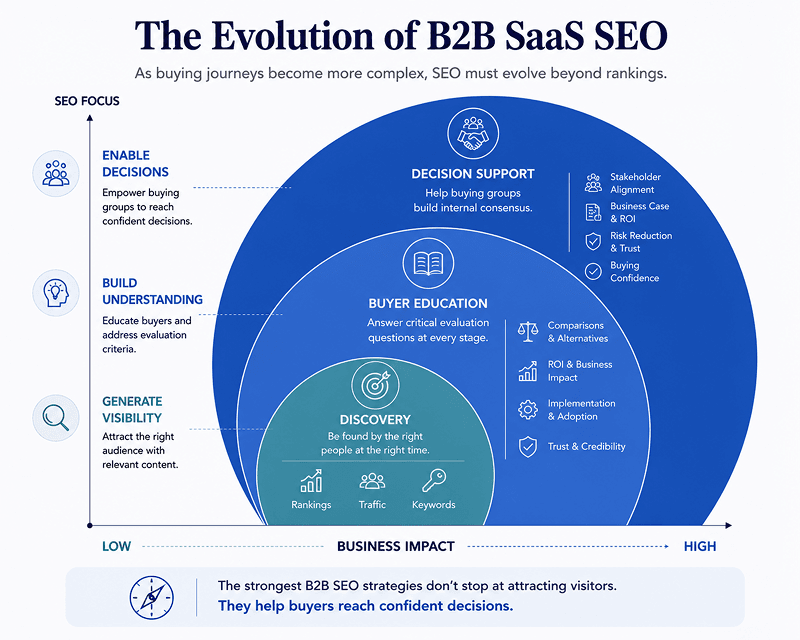
Chasing traffic instead of helping buyers make decisions
High search volume doesn't always mean high business value. A page may attract thousands of visitors but contribute little to pipeline if it doesn't answer the questions buyers ask before making a purchase. So, instead of asking, "How do we rank for this keyword?" ask, "Will this page help someone move the buying process forward?"
Publishing campaigns instead of building long term assets
Many teams treat SEO like a series of campaigns. They publish content, promote it briefly, and move on to the next topic. Sustainable growth comes from building evergreen resources that continue earning traffic, links, and trust over time. A handful of well-maintained assets often outperform dozens of articles that are never revisited.
Answering search queries instead of buying questions
Ranking for a keyword is only part of the challenge. Enterprise buyers want answers to questions like:
- How difficult is implementation?
- What ROI can we realistically expect?
- How does this compare with alternatives?
- What risks should we plan for?
For example, if you're selling AI-powered enterprise solutions, buyers are often looking for guidance on how to choose the right AI integration partner, not just product specifications or feature comparisons.
If your content stops at definitions and best practices, buyers will continue their research elsewhere.
The buying reality most SEO strategies ignore
According to Gartner, B2B buyers now spend just 17% of their total purchase journey in direct contact with suppliers - leaving roughly 80% of the buying process self-directed. The typical buying group includes 6 to 10 stakeholders, each evaluating the decision from a different perspective.
That changes the role of SEO. You're not creating content for one decision maker. You're creating resources that help technical teams, finance leaders, executives, and procurement teams reach agreement.
Remember, the most effective B2B SEO content strategy doesn't just attract visitors. It gives internal champions the information they need to confidently recommend your solution.
Turn Search Traffic Into Business Growth
Build an SEO strategy that brings the right people to your website and moves them closer to becoming customers.
Consult MillipixelsIs Your B2B SaaS SEO Strategy Ready for Today's Buyers?
Before improving your strategy, take a step back and see whether your current approach reflects how enterprise buyers actually make decisions. Use this quick checklist.
| Question | Yes / No |
| Is your content built for an entire buying committee instead of one persona? | □ |
| Can buyers understand pricing, implementation, and ROI without speaking to sales? | □ |
| Does your website answer the same questions your sales team answers every week? | □ |
| Do you regularly update your highest-performing content? | □ |
| Do you have comparison pages and measurable case studies? | □ |
| Are you measuring business outcomes instead of just rankings and traffic? | □ |
If you answered "No" to three or more of these questions, your SEO strategy may be limiting growth before prospects ever contact your sales team.
The good news is that improving it doesn't require publishing more content. It requires building the right content for the right people at the right stage of the buying journey. Let's look at how to do that.
Step 1: Build Content for the Buying Committee, Not Individual Personas
Most B2B keyword research starts with personas. While personas are useful, they rarely reflect how enterprise software decisions are made. A CIO evaluates risk. Finance looks at cost and ROI. IT validates integrations and security. Procurement reviews contracts. End users care about adoption.
Each stakeholder asks different questions, but they all influence the same decision. A strong B2B SEO strategy helps these stakeholders build confidence together instead of trying to persuade one person.
Why consensus matters more than personas
Think about your last enterprise deal. Chances are the person who found your website wasn't the only one involved in approving the purchase.
The best content doesn't stop working when someone leaves your website. It helps buyers answer questions from colleagues, build confidence in their recommendation, and move the conversation forward. A technical guide gives engineering teams clarity on architecture and integration. A case study with measurable outcomes helps department heads justify the investment. A pricing guide prepares procurement before negotiations begin.
The goal isn't to create separate websites for every stakeholder. It's to create resources that answer the questions each stakeholder will eventually ask.
The Buying Committee Framework
A useful way to think about content is to align it with the decisions buyers need to make.
| Buying Stage | What Buyers Need | Content That Helps |
| Technical Validation | Will this work with our systems? | Integration guides, security documentation, technical FAQs |
| Business Validation | Will this solve our problem? | Industry guides, solution pages, customer stories |
| Financial Validation | Is the investment justified? | ROI calculators, pricing guidance, business cases |
| Executive Approval | Is this the right strategic decision? | Executive summaries, implementation roadmaps, outcome-focused case studies |
Is your content easy to share internally?
One of the simplest ways to evaluate your content is to imagine it being forwarded inside a company. Ask yourself:
- Can a CFO quickly understand the business value?
- Can IT validate integrations and security?
- Can procurement find enough pricing information to move discussions forward?
- Can leadership understand expected outcomes without reading five different pages?
- Can an internal champion confidently recommend your solution using only your content?
If the answer is "No," buyers will continue searching until another vendor fills those gaps.
Step 2: Design Content for the Buying Journey You Cannot See
Many organizations focus on publishing more content. The better question is whether you're publishing the right content. By the time someone requests a demo, they've usually answered dozens of questions on their own. Every unanswered question increases the chance they'll look elsewhere.
Every sales conversation tells you what to publish next
One of the most overlooked sources of SEO ideas isn't a keyword tool. It's your sales team. Review recent sales calls and look for recurring questions.
For example:
- How long does implementation take?
- What's involved in migration?
- How does your platform compare with alternatives?
- What results have similar companies achieved?
- How quickly can teams adopt the solution?
If your sales team answers these questions every week, your website should answer them first. Your best content ideas already exist inside customer conversations.
Build content around buying questions, not just keywords
Search intent matters, but buying intent matters more. Instead of creating content solely because a keyword has high search volume, create resources that help buyers make informed decisions.
For example, teams evaluating major software investments often look for practical implementation guidance, security information, and ROI benchmarks long before they speak with a vendor.
Remember, the most valuable B2B content is created to be shared, not just discovered. When it clearly answers questions about pricing, security, or ROI, it becomes easy for internal champions to share in Slack conversations, Microsoft Teams chats, emails, and presentations as they build support for a purchase.
| Buyer Intent | Recommended Content |
| Learning | Educational blogs and guides |
| Comparing | Competitor comparisons and alternative pages |
| Validating | Case studies with measurable outcomes |
| Justifying | ROI calculators, pricing guidance, implementation timelines |
| Deciding | Product demos, onboarding guides, FAQs |
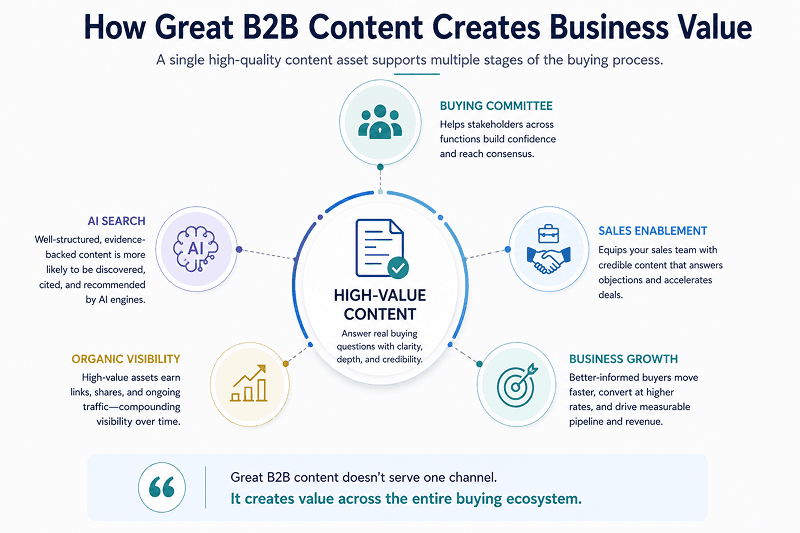
This is where a strong B2B SEO content strategy creates value. It doesn't stop at attracting visitors. It supports every stage of evaluation until buyers are ready to make a decision.
The same content also strengthens your AI SEO strategy because AI search engines increasingly surface comprehensive, well-structured resources that answer complete questions instead of isolated keywords.
Step 3: Build for Compounding Growth Instead of Continuous Publishing
One of the biggest misconceptions in SEO is that growth comes from publishing more content.
In reality, sustainable growth comes from publishing content that continues delivering value long after it's published.
Publishing more content doesn't always lead to better results. HubSpot's analysis of more than 15,000 company blogs found that only 10% of blog posts become "compounding" assets, yet they account for 38% of total blog traffic. In other words, a handful of well-maintained, evergreen articles can deliver significantly more long-term value than a larger library of content that's published once and never updated.
What makes content compound over time?
Compounding content isn't defined by length. It's defined by usefulness. The strongest assets typically:
- Solve a recurring business challenge.
- Stay relevant beyond current trends.
- Include original expertise and credible research.
- Connect naturally to related content across your website.
- Support buyers at multiple stages of their decision-making journey.
We've found that organizations often publish new articles while overlooking the pages already driving results. Refreshing an existing high-performing guide can often deliver greater returns than publishing three new ones.
Build a content maintenance system
Ask yourself one question every quarter: Which pages deserve another year of growth? Use a simple refresh schedule like this.
| Refresh Frequency | Content Type |
| Quarterly | Statistics, pricing pages, comparison content |
| Every 6 months | Evergreen guides, implementation resources |
| Annually | Foundational educational content |
This approach also supports the best organic traffic for B2B because fresh, trustworthy content continues earning visibility long after publication.
Step 4: Make Your Content Easy for AI Search to Discover and Trust
AI search is changing how people discover information, but it isn't changing what makes content valuable. People still want credible answers, practical guidance, and trustworthy sources. AI simply rewards machine-readable content that delivers those qualities consistently.
What AI search rewards
Research from Princeton and Georgia Tech found that well-structured, evidence-backed content is significantly more likely to be cited by AI search engines.
That means your content should:
- Answer questions clearly.
- Support claims with credible research.
- Include first-hand insights wherever possible.
- Stay current through regular updates.
- Make information easy to scan.
Notice that none of these recommendations are shortcuts. They're simply good content practices applied consistently.
Four practical ways to strengthen your AI SEO strategy
As AI-powered search becomes part of how people research software, your content needs to be easy to understand, trustworthy, and genuinely useful. Here are four practices that make a difference:
Answer questions upfront.
Start each section with a short, direct summary before diving into the details. This helps both readers and AI systems quickly understand the key takeaway.
Back up your claims with evidence.
Support important points with credible research, first-party data, or recognized industry reports. Well-sourced content builds trust with buyers and AI models alike.
Use structured schema markup.
Implement schema such as Article, FAQPage, and Organization to help search engines better understand your content and improve its visibility in AI-powered search experiences.
Publish insights only you can provide.
Share customer success stories, original research, expert perspectives, and proprietary frameworks. Unique, experience-based content is far more valuable than information that can be found on dozens of other websites.
Quality matters more than volume
Some organizations worry that AI search will reduce website traffic. The better question is whether it improves visitor quality. Research from Seer Interactive suggests that visitors arriving through AI search often convert at much higher rates because they begin their journey with stronger intent and more context. That reinforces an important point. The goal isn't simply more traffic. It's attracting better-qualified buyers.
Step 5: Measure the Signals That Predict Revenue, Not Just Rankings
Traffic is important, but it isn't the outcome your business cares about. Instead of asking whether rankings improved, ask whether your content is helping buyers move closer to a decision.
Track metrics such as:
- Branded search growth.
- Engagement with comparison pages.
- Case study views.
- ROI calculator usage.
- Assisted conversions.
- AI referral traffic.
These signals often show progress well before pipeline numbers begin to move. McKinsey's 2026 B2B growth research echoes this finding: the companies pulling ahead are those that consistently invest in connected systems and customer experiences over time, rather than relying on isolated marketing campaigns.
A Practical 90-Day Plan to Put This Framework into Action
Building a successful B2B SEO strategy doesn't require rebuilding your website overnight. Start with focused improvements that create momentum and build on each other.
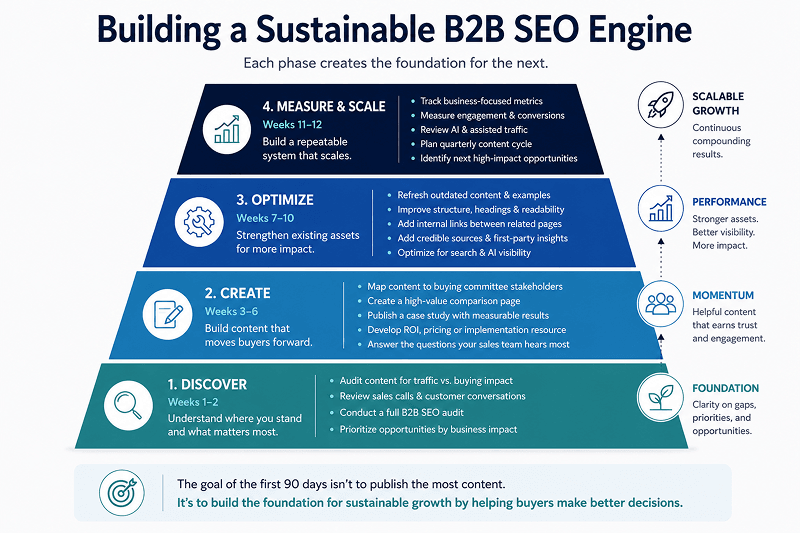
Phase 1 (Weeks 1 to 2): Understand Where You Stand
Before creating anything new, understand what's already working and where buyers are getting stuck.
Focus on:
- Audit your existing content to identify pages that drive traffic but don't support buying decisions.
- Review recent sales calls and customer conversations to uncover recurring questions and objections.
- Conduct a B2B SEO audit to identify gaps in content, technical SEO, and user experience, and explore the best SEO companies for small businesses for additional support.
- Prioritize opportunities based on business impact rather than search volume.
Outcome: A clear understanding of what content to improve, what to create, and where your biggest opportunities lie.
Phase 2 (Weeks 3 to 6): Build Content That Moves Buyers Forward
Now that you've identified the gaps, focus on creating resources buyers actually need.
Prioritize:
- Map existing and planned content to different stakeholders in the buying committee.
- Create one high-value comparison page that answers common evaluation questions.
- Publish one case study with measurable business outcomes.
- Develop an ROI calculator, pricing guide, or implementation resource that helps buyers justify the investment.
- Expand your B2B SEO content strategy by answering the questions your sales team hears most often.
Outcome: Buyers have more of the information they need before contacting your sales team.
Phase 3 (Weeks 7 to 10): Strengthen Your Existing Assets
Instead of immediately publishing more articles, improve the ones already generating results. Actions include:
- Refresh outdated statistics, examples, and references.
- Add stronger internal links between related pages.
- Improve headings, structure, and readability.
- Add credible sources and first-party insights.
- Optimize cornerstone content for both traditional search and your AI SEO strategy.
Outcome: Your highest-value content becomes more useful for buyers while improving long-term search visibility.
Phase 4 (Weeks 11 to 12): Measure, Learn, and Build a Repeatable System
SEO becomes sustainable when it's treated as an ongoing business process instead of a publishing schedule. During this phase:
- Build dashboards that track business-focused metrics instead of rankings alone.
- Measure engagement with comparison pages, case studies, and decision-stage content.
- Review assisted conversions and AI referral traffic.
- Create a quarterly content refresh calendar.
- Identify the next set of high-impact content opportunities based on buyer behavior.
Outcome: You leave the first 90 days with a repeatable system that continues improving over time instead of starting from scratch every quarter.
Remember, the goal of the first 90 days isn't to publish the most content. It's to build the foundation for sustainable growth by helping buyers make better decisions.
The Framework at a Glance
| Step | Primary Outcome |
| Build content for the buying committee | Help stakeholders reach consensus |
| Design for the unseen buying journey | Answer buying questions before sales does |
| Create compounding content | Generate sustainable organic growth |
| Strengthen your AI SEO strategy | Improve visibility across traditional and AI search |
| Measure business outcomes | Connect SEO efforts to pipeline and revenue |
Conclusion: B2B SEO Strategy Is About Helping Buyers Make Better Decisions
A successful B2B SEO strategy is no longer measured by rankings alone.
It's measured by how effectively your content helps buyers understand their options, answer important questions, and build confidence before they ever speak with your sales team.
Organizations that treat SEO as a long-term business asset instead of a publishing calendar are better positioned to earn trust, generate qualified opportunities, and adapt as search continues to evolve.
At Millipixels, we've found that the strongest SEO programs have one thing in common: they put buyers first. They don't chase clicks or rankings for the sake of visibility. They create content that helps people solve problems, evaluate solutions, and make informed decisions with confidence.
If you're rethinking your SEO strategy, start by looking beyond rankings and traffic. Focus on the questions your buyers are asking, the information they need to move forward, and the confidence they need to recommend your solution internally. When your content genuinely helps people make better decisions, stronger visibility, better-qualified leads, and sustainable growth naturally follow.
If you're looking for fresh perspectives on building a people-first SEO strategy, explore more insights from Millipixels or reach out to continue the conversation.
Frequently Asked Questions
1. What tools are best for B2B SEO analysis and optimization?
The right tools depend on your goals, but most successful B2B SEO strategies rely on a combination of platforms rather than a single solution.
For B2B keyword research and competitor analysis, tools like Ahrefs, Semrush, and Google Search Console help uncover search opportunities and track performance. Screaming Frog is valuable for conducting a B2B SEO audit, while GA4 and Looker Studio provide insights into user behavior and conversions.
If your goal is lead generation for SEO, prioritize tools that connect SEO performance with CRM or marketing automation platforms. This helps you understand which pages influence qualified leads instead of focusing only on rankings or traffic.
2. How can an AI search monitoring platform improve SEO strategy?
AI-powered search is changing how people discover information, making it important to understand not only where your website ranks but also how often your brand appears in AI-generated answers.
An AI search monitoring platform helps you track brand mentions, AI citations, and visibility across platforms like ChatGPT, Gemini, Perplexity, and Google AI Overviews. Instead of relying solely on traditional ranking reports, these platforms show whether your content is being used to answer real user questions.
This insight strengthens your AI SEO strategy by helping you identify which pages are frequently cited, which topics need stronger expertise or fresher information, and where competitors are gaining visibility. It also highlights opportunities to improve your B2B SEO content strategy through better structure, authoritative sources, and original insights that AI systems are more likely to reference.
As AI-powered search continues to grow, monitoring AI visibility should become part of every modern B2B SaaS SEO strategy, alongside traditional SEO metrics.
3. What strategies improve brand visibility in AI search engines?
Improving visibility in AI search starts with creating trustworthy, well-structured content. Follow proven B2B SEO best practices by publishing original insights, citing credible sources, updating content regularly, and answering user questions clearly. Strong topical authority, a thoughtful guest posting strategy, and consistent off page SEO strategies also help establish the credibility AI search engines look for when selecting sources.
4. Does keyword strategy affect visibility in AI search results?
Yes. While AI search focuses more on context than exact-match keywords, a well-planned B2B keyword research process still matters. Use keywords naturally, organize content around complete topics, and answer related questions comprehensively. This approach improves visibility in both traditional search and AI-generated results while supporting the best organic traffic for B2B over the long term.
5. What is Generative Engine Optimization (GEO) in B2B SaaS SEO?
Generative Engine Optimization (GEO) is the practice of creating content that AI-powered search experiences, such as ChatGPT, Perplexity, and Google AI Overviews, can easily understand, trust, and reference.
Instead of focusing only on rankings, GEO focuses on helping people find clear, reliable answers. That means publishing content that answers questions directly, demonstrates real expertise, includes credible sources, and shares original insights that AI systems can confidently cite.
6. How do AI search engines decide which B2B content to cite?
AI search engines look for content that is clear, trustworthy, and genuinely helpful. They favor pages that answer questions directly, support claims with credible evidence, and cover a topic in enough depth to give people confidence in the information.
Content is also easier for AI to understand when it's well structured, regularly updated, and uses schema markup to provide additional context.
7. Why should B2B SaaS companies create content for buying committees instead of one persona?
Enterprise software decisions are made by groups, not individuals. A technical lead may care about security and integration, while finance wants to understand costs and executives focus on business outcomes.
Content that addresses these different questions helps internal champions build consensus, answer stakeholder concerns, and move the buying process forward with greater confidence.
8. How does updating content improve AI search visibility?
AI-powered search favors content people can trust. Regularly reviewing and updating your articles keeps statistics, examples, and recommendations accurate, making your content more useful for readers and more reliable for AI systems.
Refreshing high-performing content also helps maintain search visibility, strengthens credibility, and extends the value of your best-performing pages over time.
Written by

Parthsarathy Sharma
With 4+ years of experience across AI, UX, GCC/outsourcing, enterprise technology, and brand strategy, Parthsarathy brings a research-driven lens to digital experience content. His work focuses on turning emerging technology, customer experience, and business trends into clear, practical perspectives for readers.
Reviewed by

Amrendra Kumar
With 7+ years of experience in SEO, I help businesses grow through data-driven organic search strategies and AI-first optimisation. My expertise spans SEO, Generative Engine Optimisation (GEO), Answer Engine Optimisation (AEO), and emerging search technologies. Having worked with leading organisations, including TCS, and clients across multiple industries, I share actionable insights on search trends, AI-powered discovery, and content strategies that drive measurable business growth.
- Introduction
- Why Most B2B SaaS SEO Strategies Stall Before They Deliver Results
- Is Your B2B SaaS SEO Strategy Ready for Today's Buyers?
- Step 1: Build Content for the Buying Committee, Not Individual Personas
- Step 2: Design Content for the Buying Journey You Cannot See
- Step 3: Build for Compounding Growth Instead of Continuous Publishing
- Step 4: Make Your Content Easy for AI Search to Discover and Trust
- Step 5: Measure the Signals That Predict Revenue, Not Just Rankings
- A Practical 90-Day Plan to Put This Framework into Action
- The Framework at a Glance
- Conclusion: B2B SEO Strategy Is About Helping Buyers Make Better Decisions
- Frequently Asked Questions