Machine Experience Design: The Future of AI-First Search & the Invisible Web
Learn how Machine Experience Design improves AI search visibility with structured data and machine-readable content.
August 18, 2026
Written by

Introduction
Your website ranks well on Google. It loads quickly, follows SEO best practices, and delivers a great user experience. Yet when a potential customer asks ChatGPT, Perplexity, or Google AI for a recommendation, your business doesn't appear.
If that sounds familiar, you're not alone.
Many organizations are discovering that being visible in traditional search no longer guarantees visibility in AI-powered search. The reason isn't necessarily poor SEO or weak content. It's that the web now has two audiences: people and machines. While most digital strategies have been built around human users, AI systems are increasingly becoming the first point of discovery, comparison, and recommendation.
This shift has created a new challenge that many businesses haven't fully recognized yet. We call it Machine Experience Design. It's the practice of designing websites, content, and digital experiences that humans can use easily and AI systems can understand accurately.
At Millipixels, we've observed that organizations investing in AI search optimization often focus on isolated tactics such as adding structured data or experimenting with Generative Engine Optimization. Those efforts certainly help, but they rarely address the bigger question: Can AI truly understand what your business does and why it should recommend you?
In this guide, we'll explore why websites are becoming invisible to AI, what Machine Experience Design means in practice, and how you can prepare your digital presence for an AI-first web.
Why Your Website Isn't Just Competing for Human Attention Anymore
For years, digital teams shared a common goal: attract more visitors.
Success was measured through rankings, clicks, and conversions. If people could find your website, navigate it easily, and complete an action, you were doing something right. That assumption is changing.
Today, a growing share of online interactions begins with an AI assistant instead of a traditional search engine. Rather than clicking through several websites, people increasingly ask AI to compare products, summarize research, recommend vendors, or answer complex questions in a single conversation. This changes who your website needs to communicate with.
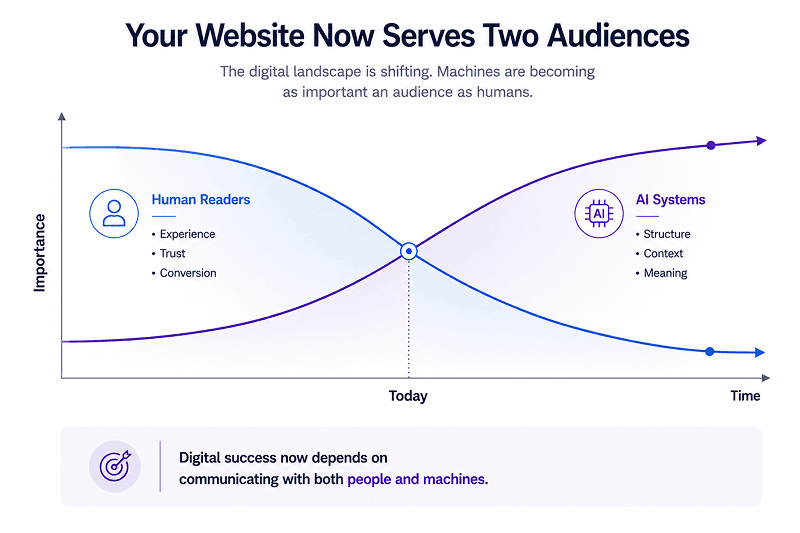
Instead of serving only human visitors, your content is now read by AI systems that decide whether your business deserves to be mentioned in an answer. Those systems don't experience your website the way people do. They don't appreciate visual design, brand storytelling, or intuitive navigation. While creating intuitive, human-centered experiences remains essential, they rely on structure, context, relationships between information, and signals that help them understand what your content actually means.
That doesn't make human experience less important. It simply means it's no longer the whole picture.
Machines Are Becoming an Important Audience
Recent industry research highlights just how significant this shift has become.
Cloudflare and Imperva have both reported that automated traffic now accounts for a substantial share of overall web activity, although their figures differ because they measure different types of traffic. The important takeaway isn't the exact percentage. It's that machines are no longer occasional visitors to the web. They are becoming one of its primary audiences.
Just as importantly, not all machine traffic serves the same purpose.
| Machine Audience | What They're Trying to Do | Why It Matters |
| AI training crawlers | Collect publicly available information to improve foundation models | Determines whether your content contributes to future AI knowledge |
| AI search and answer engines | Retrieve information to generate responses for users | Influences whether your business is cited or recommended |
| Autonomous AI agents | Browse websites and complete tasks on behalf of users | Increasingly affects digital commerce, bookings, and transactions |
Treating all AI bots as one category often leads organizations to make poor decisions about accessibility, content strategy, and governance.
Search Is Becoming More Conversational
We've also seen a noticeable shift in how people search. Instead of typing short keywords into Google, users are asking detailed questions and expecting complete answers. Whether they're researching enterprise software, comparing vendors, or looking for implementation advice, they're increasingly turning to AI assistants for direct, conversational responses.
This shift isn't just changing user behavior. It's changing how businesses get discovered. In fact, Gartner predicts that traditional search engine volume will decline by 25% by 2026 as AI chatbots and virtual agents become a preferred way for people to find information.
For businesses, this changes the goal.
Success is no longer measured only by whether someone clicks your website. Increasingly, success depends on whether AI understands your business well enough to include it in the conversation before a customer ever reaches your site.
That raises an important question: What if your website is perfectly visible to people but almost invisible to the machines helping them make decisions?
That's exactly the challenge the next section explores.
Build a Website That AI Can Understand, and Customers Can Trust
Your customers may already be discovering businesses through AI. Let's assess how visible your website is to AI systems and identify practical ways to improve your Machine Experience Design.
Schedule a Strategy ConsultationWhy Your Website Can Be Easy for People to Find but Invisible to AI
At first glance, the idea sounds contradictory. If your website ranks on Google, loads quickly, and contains valuable information, surely AI systems can understand it too. Not necessarily.
One of the biggest misconceptions we see is the assumption that search visibility and AI visibility are the same thing. They overlap, but they're no longer identical. A website can perform well in traditional search while still struggling to appear in AI-generated answers.
That's because AI isn't simply looking for pages to rank. It's trying to identify the most reliable information to understand, summarize, and recommend. Those are very different tasks.
The Invisible Web Has Taken on a New Meaning
The term Invisible Web isn't new. In the 1990s, it referred to parts of the internet that search engines couldn't index, such as password-protected pages, private databases, and dynamic content. If a crawler couldn't access it, it remained invisible.
Today's Invisible Web is different. Your content might be completely public, fully indexed, and easily accessible to human visitors. Yet an AI system may still struggle to interpret what your business does, which products you offer, or why your content deserves to be cited.
In other words, your website isn't invisible because it can't be found. It's invisible because it can't be fully understood. That's an important distinction because discoverability is no longer the only goal. Understanding is becoming just as important. For many organizations, making this shift is one of the biggest AI adoption challenges they face.
Visibility Is No Longer Binary
For years, digital visibility was relatively straightforward. You either ranked or you didn't. Today, there are multiple layers of visibility.
| Traditional Search | AI-Powered Search |
| Finds pages based on keywords and relevance | Understands information, relationships, and context |
| Rewards pages that satisfy search intent | Rewards content AI can confidently interpret and cite |
| Success measured by rankings and clicks | Success measured by mentions, recommendations, and citations |
| Optimized through SEO | Requires SEO plus machine-readable content and structured information |
This doesn't mean SEO is becoming obsolete; far from it. Strong technical SEO, helpful content, and excellent user experience remain essential. But they're increasingly becoming the foundation rather than the finish line.
The next layer is making your content understandable to machines. That's where machine experience design comes in.
What Is Machine Experience Design, and Why Does It Matter Now?
Machine Experience Design (MXD) is the practice of making your digital presence easier for AI systems to understand, interpret, and represent, while continuing to create a strong experience for the people using it.
Why does that matter now? Because AI is becoming part of how people research and make decisions. Gartner found that 51% of consumers surveyed had changed their research habits because of GenAI, while 16% said they use AI chatbots to search for new products or services to buy.
For businesses, that creates a new question: Can AI understand your business as clearly as your customers can?
Traditional UX focuses on helping people find information, navigate a website, and take action. SEO helps search engines discover and rank that information. Machine Experience Design brings another consideration into the picture: whether AI systems can accurately understand what your business offers, who it serves, what makes it credible, and which information matters.
| For People | For Machines |
| Clear navigation | Clear information structure |
| Visual hierarchy | Semantic structure |
| Easy-to-understand content | Explicit context and relationships |
| Trust through experience | Trust through authoritative signals |
This doesn't mean creating a separate website for AI or replacing SEO with another optimization tactic. It means making the digital experience clearer for everyone.
What's Missing From Most Websites in the AI Era?
Most organizations have invested heavily in user experience (UX). They've improved navigation, page speed, accessibility, and mobile responsiveness because they understand that better experiences lead to better business outcomes.
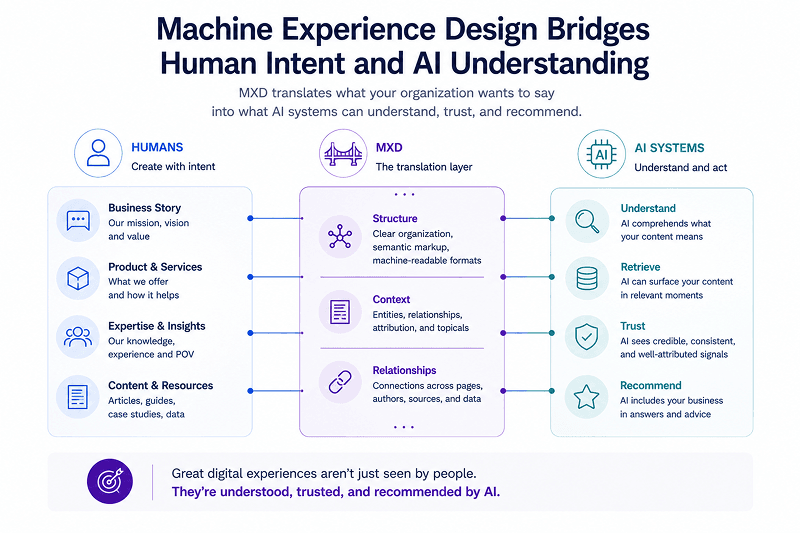
Now there's another audience to consider.
Machines don't experience websites visually. They don't admire a beautifully designed homepage or intuitively understand that a particular paragraph describes your flagship product. Instead, they look for explicit signals that remove ambiguity.
Machine Experience Design (MXD) is the practice of intentionally creating those signals.
Rather than asking,
"Can people use this website?"
it also asks,
"Can AI understand this website with confidence?"
From our perspective at Millipixels, that's the mindset shift many organizations are still missing. We've seen businesses focus almost exclusively on AI content optimization or Generative Engine Optimization while overlooking whether their digital experience is fundamentally machine-readable.
Those optimizations deliver far greater value when they're built on a strong Machine Experience Design foundation.
Machine Experience Design Has Three Layers
Thinking about MXD becomes much easier when you break it into three connected layers.
| Layer | Key Question | Why It Matters |
| Brand Legibility | Can AI understand who you are and what you specialize in? | Helps AI accurately position your business in recommendations. |
| Content Legibility | Can AI identify your expertise, products, services, and relationships? | Reduces ambiguity and improves machine readability. |
| Infrastructure Legibility | Can AI access and interpret your content efficiently? | Enables AI systems to retrieve, process, and reference your information. |
Many organizations perform well in one or two of these areas while overlooking the third.
For example, a company might publish exceptional thought leadership but rely heavily on JavaScript for rendering critical content. Another might have technically sound infrastructure but content that never clearly identifies its expertise or unique value.
Machine experience design brings these pieces together.
This Is Bigger Than SEO
It's tempting to think of MXD as simply another name for AI search optimization. We don't think that's the right way to look at it. A strong SEO strategy remains an important foundation for making content discoverable and useful across traditional and AI-powered search.
Search engine optimization has traditionally focused on helping search engines find and rank content. While machine experience design is concerned with helping AI systems understand, trust, retrieve, and recommend that content. That's an important difference.
Research from Princeton University and Georgia Tech on Generative Engine Optimization found that AI systems are more likely to reference content that includes clearly attributed expert quotations and well-sourced statistics. The takeaway isn't that every page needs more quotes or data. It's that AI responds better when information is structured in ways that increase confidence and reduce ambiguity.
The same principle applies across your entire website. Whether you're using semantic HTML, implementing structured data for AI, or improving machine-readable content for AI, every decision should answer one question: If an AI had to explain your business to someone who had never heard of you before, would it have enough context to get it right?
Answering that question begins with understanding how AI actually reads a website, which is exactly where we'll go next.
How to Tell If AI Can Actually Read and Recommend Your Website
By now, you might be wondering whether your own website has this problem.
The good news is that you don't need a complete redesign to find out. In our experience, a few targeted checks can quickly reveal whether your website is easy for AI systems to understand or whether critical information is getting lost along the way.
Think of this as a starting point rather than a technical audit. The goal isn't perfection. It's understanding where the biggest gaps are so you know what to improve first.
| Check | Ask Yourself | Why It Matters |
| Content Visibility | Is your most important content available in the page's HTML, or does it only appear after JavaScript loads? | Many AI systems still rely heavily on raw HTML when interpreting webpages. |
| Machine Readability | Have you clearly identified your products, services, authors, and organization using structured data? | AI can interpret explicit information far more reliably than implied context. |
| AI Accessibility | Have you decided how different AI crawlers and agents should interact with your website? | Training crawlers, AI search systems, and autonomous agents may require different access policies. |
| Real-World Visibility | Does your business appear when you ask AI the questions your customers ask? | The fastest way to understand how AI currently perceives your brand. |
One practical exercise we often recommend is surprisingly simple.
Open ChatGPT, Perplexity, or Google AI Overviews and ask questions that a prospective customer might ask.
For example:
- Who are the best cloud migration partners for healthcare companies?
- Which agencies specialize in AI product development?
- What are the biggest challenges with enterprise ERP modernization?
Then look beyond whether your company appears. Ask yourself:
- Is the description accurate?
- Does AI understand your expertise?
- Are your competitors being cited instead?
- Does the answer inspire confidence?
Those answers often reveal far more than an SEO ranking report ever could.
What Happens When AI Reads Something Different From Your Customers?
Most discussions about AI visibility focus on discoverability. A less discussed challenge is trust.
Recent security research has shown that AI agents can sometimes receive a different version of a webpage than the one shown to human visitors. Because AI systems have recognizable fingerprints, websites can detect them and deliver alternative content containing hidden instructions or misleading information without a human ever seeing it.
This is no longer just a theoretical concern. A 2026 empirical study analyzing 1.2 billion URLs across 24.8 million hosts identified more than 15,000 validated indirect prompt injections, with nearly 70% of these machine-targeted instructions hidden in non-rendered HTML, such as comments, metadata, and headers rather than content visible to human visitors.
For most organizations, this isn't an everyday operational concern. But it does highlight an important reality. Machine experiences are becoming a real part of the web. Just as businesses learned to think carefully about mobile experiences, accessibility, and cybersecurity, they'll also need to think intentionally about how AI systems interact with their digital properties.
At Millipixels, we see this as a governance challenge as much as a technical one. As AI becomes more involved in research, procurement, and customer journeys, organizations should know exactly what information machines can access, how it's presented, and whether it accurately represents the business. Building the right AI governance strategy often starts with choosing trusted generative AI consulting partners who can help navigate these emerging risks.
Leaving that to chance is becoming an increasingly unnecessary risk.
What Should You Do Differently From Today?
Many organizations assume preparing for AI-first search requires an entirely new strategy. We don't think that's the case.
Instead, it's about extending the principles that already make for a high-quality website. Clear information architecture, trustworthy content, and strong technical foundations remain just as important. The difference is that they now need to work for machines as well as people.
Here's a practical framework we've found useful when thinking about Machine Experience Design.
| Principle | Why It Matters |
| Make important information machine-readable by default. | Don't rely on JavaScript alone to expose essential business information. |
| Describe entities explicitly. | Clearly identify products, services, authors, locations, and organizations using structured data where appropriate. |
| Build with semantic HTML. | Well-structured content helps both accessibility technologies and AI systems interpret information more accurately. |
| Treat AI access as a governance decision. | Decide how different AI crawlers and autonomous agents should interact with your content instead of applying blanket rules. |
| Create content worth citing, not just ranking. | Well-supported insights, expert perspectives, and credible sources increase trust for both people and AI systems. |
Perhaps the biggest shift is changing how success is measured. Historically, digital teams asked, "Can people find us?" Increasingly, they'll also need to ask, "Can AI confidently understand and recommend us?" Those are related questions, but they're no longer the same.
How Should Businesses Prepare for an AI-First Web?
The rise of AI isn't replacing search overnight, nor does it make SEO irrelevant. What it changes is how people discover, evaluate, and act on information.
Increasingly, AI assistants are becoming part of the buying journey. They're helping users compare vendors, summarize technical documentation, evaluate products, and answer questions before someone ever visits a company's website. McKinsey estimates that generative AI could contribute between $2.6 trillion and $4.4 trillion in annual economic value across industries, much of it by transforming knowledge work and customer interactions. As AI becomes embedded in everyday workflows, the way businesses are discovered will inevitably change too.
For organizations, this means success will depend on more than attracting clicks. It will depend on whether AI systems can accurately understand, interpret, and represent your business throughout the customer journey.
This is why we believe MDX will become an increasingly important discipline over the next few years.
Conclusion: Designing for One Audience Is No Longer Enough
For years, digital success was built on creating experiences people could easily discover, navigate, and trust. That foundation remains just as important today.
What's changed is who influences those experiences.
AI systems are increasingly becoming the first touchpoint in a customer's journey. They compare vendors, summarize information, answer questions, and shape purchasing decisions before someone ever visits your website. As AI-powered search becomes a larger part of how people discover and evaluate businesses, organizations need to think beyond human users alone.
This is where machine experience design becomes essential.
It's not about replacing UX, abandoning SEO, or chasing another marketing trend. It's about ensuring your website, content, and digital experiences are as understandable to AI systems as they are to the people you serve.
At Millipixels, we help organizations assess how well their digital experiences perform in today's AI-driven discovery landscape. Whether you're looking to improve AI search visibility, strengthen machine readability, or prepare your digital presence for the next generation of search, our team can help you identify practical opportunities that deliver long-term value.
If you're exploring how your website is positioned for AI-first search or want to understand where machine experience design fits into your digital strategy, we'd be happy to start the conversation.
Frequently Asked Questions
1. What is Machine Experience Design?
Machine Experience Design (MXD) is the practice of designing digital experiences that are easy for both people and AI systems to understand. While traditional UX focuses on how humans interact with a website, machine experience design considers how AI models, search assistants, and autonomous agents interpret content, relationships, and context.
As AI-powered search becomes more common, websites need to do more than rank well in search engines. They need to present information in ways machines can accurately interpret and trust. That means using clear information architecture, semantic HTML, structured data for AI, and machine-readable content for AI so systems like ChatGPT, Google AI Overviews, and Perplexity can confidently identify your expertise, products, and services.
Rather than replacing SEO, Machine Experience Design 2026 represents the next evolution of digital experience strategy. It combines user experience, technical SEO, content strategy, and AI accessibility into a unified approach that helps businesses remain visible in an AI-first web.
2. Is SEO dead or evolving in 2026?
SEO is evolving, not disappearing. Traditional SEO remains important, but businesses also need to consider AI search vs traditional search. Modern optimization increasingly includes AI search optimization, semantic search, and Machine Experience Design alongside established SEO best practices.
3.How does AI read websites?
AI systems typically analyze a website's HTML, content structure, entities, metadata, and relationships between pieces of information. Many AI crawlers rely heavily on semantic HTML, structured data for AI, and machine readability to interpret content accurately, rather than simply matching keywords.
4. How do I optimize my content for AI?
Focus on creating authoritative, well-structured content supported by credible sources. Use clear headings, implement structured data for AI, improve machine-readable content for AI, and follow AI content optimization and Generative Engine Optimization best practices to make your content easier for AI systems to understand and cite.
5. How do AI search algorithms differ from traditional search methods?
Traditional search engines primarily rank webpages based on relevance, authority, and user signals. AI search systems go a step further by interpreting meaning, synthesizing information from multiple sources, and generating direct answers. This shift makes context, entity relationships, and semantic SEO for AI increasingly important.
6. How does AI search optimization work?
AI search optimization focuses on helping AI-powered search engines and assistants understand, retrieve, and recommend your content accurately. Unlike traditional SEO, which primarily aims to improve rankings, AI search optimization improves how machines interpret the meaning, credibility, and relationships within your content.
Successful AI content optimization typically includes:
- Creating well-structured, authoritative content that answers real user questions.
- Implementing structured data for AI to identify products, organizations, authors, and services.
- Using semantic HTML so content has clear hierarchy and context.
- Publishing expert insights supported by credible sources.
- Building machine-readable content AI systems can easily interpret.
- Following best practices for Generative Engine Optimization (GEO) and semantic SEO for AI to improve visibility in AI-generated responses and citations.
The objective isn't simply to rank higher. It's to increase the likelihood that AI systems understand your expertise well enough to reference, summarize, or recommend your business when users ask relevant questions.
7. What is AI content optimization?
AI content optimization is the process of creating and structuring content so AI systems can accurately understand, retrieve, summarize, and recommend it. It complements traditional SEO by improving machine comprehension rather than focusing solely on rankings.
8. What is semantic HTML?
Semantic HTML uses meaningful HTML elements such as <article>, <section>, <header>, and <nav> to clearly describe the structure and purpose of content. This improves accessibility while helping search engines and AI systems better understand webpages.
9. How do I make content AI readable?
To improve machine readability, organize content logically, use descriptive headings, implement structured data for AI, write clearly, identify entities explicitly, and ensure important information is available in HTML rather than relying entirely on JavaScript-rendered content.
10. What is the difference between traditional SEO and semantic SEO?
Traditional SEO focuses on improving rankings through keywords, backlinks, and technical optimization. Semantic SEO for AI emphasizes meaning, context, entity relationships, and content structure, helping AI systems understand information rather than simply indexing pages.
Written by

Parthsarathy Sharma
With 4+ years of experience across AI, UX, GCC/outsourcing, enterprise technology, and brand strategy, Parthsarathy brings a research-driven lens to digital experience content. His work focuses on turning emerging technology, customer experience, and business trends into clear, practical perspectives for readers.
Reviewed by

Anukriti Tuli
With 6 years of experience across product and experience design, Anukriti brings a practical UX lens to the team. At Millipixels Interactive, she works across research, usability testing, visual design, and product launches, helping ensure digital experiences stay clear, functional, and user-centered.
- Introduction
- Why Your Website Isn't Just Competing for Human Attention Anymore
- Why Your Website Can Be Easy for People to Find but Invisible to AI
- What Is Machine Experience Design, and Why Does It Matter Now?
- What's Missing From Most Websites in the AI Era?
- How to Tell If AI Can Actually Read and Recommend Your Website
- What Happens When AI Reads Something Different From Your Customers?
- What Should You Do Differently From Today?
- How Should Businesses Prepare for an AI-First Web?
- Conclusion: Designing for One Audience Is No Longer Enough
- Frequently Asked Questions