Why GCC Talent Acquisition Needs to Focus on Capability Over Headcount
Learn why GCC talent acquisition should focus on capability, ownership, and workforce readiness, rather than treating headcount growth as the measure of success.
September 21, 2026
Written by

Introduction
Effective GCC talent acquisition begins with a clear view of what the center will eventually be expected to own. Headcount can show how quickly an organization is growing, but it says little about whether the workforce has the technical depth, business context, leadership, and institutional knowledge to carry a meaningful enterprise mandate. As GCCs assume greater responsibility for products, platforms, AI, data, and global operations, talent strategy has to be designed around capabilities first and roles second.
The people are visible. The capability takes longer to see.
The easiest thing to count in a GCC is people, which may be why headcount has long been considered as shorthand for progress long after it stopped telling the whole story.
There is a certainty that a workforce plan built around numbers brings and looks appealing. The business can see how many engineers have joined, how many positions remain open, whether recruitment is ahead of schedule, and how closely the center is tracking against its first-year target. A growing team makes the investment tangible.
What the spreadsheet cannot tell you quite so easily is whether those people, together, have become capable of carrying weight for the enterprise.
That distinction matters more now because the work moving into GCCs has changed considerably. The 2026 Zinnov Nasscom GCC Landscape places India's ecosystem at 2,117 GCCs, generating $98.4 billion in revenue and employing 2.36 million professionals. More revealing than the scale, however, is the movement of these centers towards global ownership, product responsibility, innovation, and increasingly consequential decision-making.
A delivery center can grow by adding capacity. But as a GCC takes ownership of a product platform, an AI capability, enterprise architecture, or a critical business function, adding people is only part of the job. The team has to build enough business and technical context to make sound decisions, while local leaders need enough authority to make those decisions without repeatedly looking to headquarters for approval.
That process is neither immediate nor incidental to hiring. PwC's 2026 study of 200 senior GCC executives found that it takes an average of 8.69 months to convert talent into enterprise-ready capability. The same research found that 72% of GCCs need to reskill or upskill more than 40% of their workforce. Nearly nine months is a useful reminder that a signed offer marks the beginning of the value curve, not its end.
Why GCC talent acquisition needs a better measure of progress
There was a period when the size of an offshore center revealed quite a lot about its importance. Large teams usually implied that more processes, functions, or delivery responsibility had moved into the location.
The relationship is weaker today. Zinnov's latest GCC maturity model classifies centers as Outposts, Satellites, Portfolio Hubs, and Transformation Hubs. The progression is significant because the distinction rests on the nature of the mandate and the degree of enterprise ownership, rather than on a simple contest of scale.
A large operation devoted mainly to fragmented execution may employ far more people than a compact center entrusted with the architecture of a global platform. Few leadership teams would argue that the first is therefore more mature. A better measure of GCC maturity is not simply how many people the center employs, but how much consequential work the enterprise is prepared to entrust to it.
This is also why the continuing shift towards purpose-built Micro GCCs deserves attention. They illustrate the same principle at a smaller scale. When a team is formed around a defined product, platform, or technical capability, coherence matters more than volume.
For leaders planning the next stage of a GCC, the useful question is therefore less concerned with how large the center can become and more concerned with what the enterprise should eventually feel comfortable asking it to own. Once that question has a credible answer, the talent strategy becomes far easier to design.
GCC talent acquisition should begin before the first job description
Recruitment usually enters the conversation once a role has been defined. The organization needs a cloud architect, a product manager, a machine learning engineer, or a data specialist, and the talent team is asked to find one.
That sequence works well when the requirement itself is settled. GCCs are often being asked to solve a more complex problem. The workforce is being assembled at the same time as responsibility is moving between geographies, leadership structures are changing, and the center's long-term place within the enterprise is still taking shape.
Under those conditions, starting with job titles can produce an impressive collection of résumés without producing an equally impressive organization.
Suppose a business wants its GCC to establish an enterprise AI capability. Recruiting machine learning engineers is an obvious part of the response, but production AI draws on far more than model expertise. The work may depend on data engineering, platform architecture, cybersecurity, governance, integration, testing, product judgment, and a working knowledge of the decisions that the technology is meant to improve.
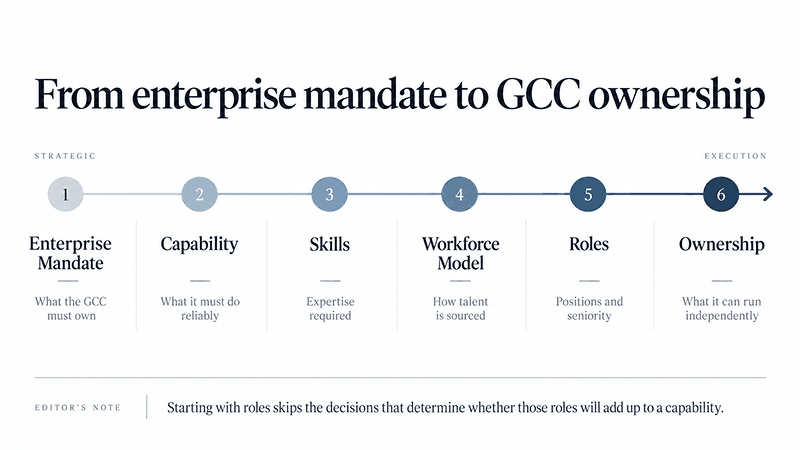
Once the GCC’s mandate is clear, leaders can work backwards from the work it needs to own. What expertise does that require? What already exists inside the organization? What needs to be hired, and where could a specialist partner fill a gap while the internal team builds the capability?
This is also why GCC design cannot separate talent from the operating model around it. The mandate, governance structure, decision rights, and talent model have to be designed together, an approach that informs Millipixels’ Global Capability Center services.
GCC hiring, seen this way, is one instrument within the operating model. It should not be mistaken for the operating model itself.
Workforce planning becomes more useful when it starts with the work
Most workforce plans are built to answer sensible administrative questions.
How many people will be required? At what level of seniority? In which location? By when?
A capability plan asks a different set of questions, and they tend to be closer to the concerns of the executives funding the center.
What should the GCC be able to do reliably a year from now? Which decisions should no longer need to travel elsewhere? Where does the organization currently depend too heavily on an individual, a vendor, or another geography? Which forms of knowledge would be expensive to rebuild if they disappeared?
Once those questions are asked, three types of workforce problems begin to separate from one another.
A capacity problem exists when there simply are not enough people to perform the work. A skill problem appears when the workforce lacks specific expertise. A capability problem is broader and usually more consequential, because the organization cannot yet perform or own an outcome reliably even when some of the necessary skills are already present.
That distinction gives GCC workforce planning and skill capabilities far more practical meaning.
A payments GCC, for example, may want to keep regulatory knowledge and senior platform architecture in-house because both are critical to the work it expects to own long term. A one-time migration may be better suited to external specialists. And when the center is building a new engineering capability, outside expertise can help it get started, with the internal team gradually taking on more of the work as its experience grows.
There is no single correct mix. There is, however, a better question than “How many people do we need?”
It is “What has to become true of this workforce before we can entrust it with the mandate?”
This way of thinking also connects naturally with a broader digital transformation capability framework. Technology capability rarely sits inside technology alone. Process maturity, workforce readiness, governance, and decision-making determine how much value an enterprise can actually extract from the tools it has bought.
How will the GCC close the skills gap as the work keeps changing?
A talent shortage invites an instinctive response. Recruit harder. That can work when the missing skill is clearly defined and available in sufficient numbers. It becomes far less reliable when demand is changing at the same time as the skill itself.
The World Economic Forum's Future of Jobs Report 2025 estimates that 39% of workers' existing skill sets will be transformed or become outdated by 2030, while skills gaps remain the most commonly cited barrier to organizational transformation.
GCC leaders are already adjusting. EY's 2025 GCC Pulse research found that 71% of centers were prioritizing reskilling, while 63% were focusing on niche-skill hiring. The combination is instructive. Organizations are beginning to accept that the workforce they will need cannot be sourced entirely from the external labor market. A sound GCC talent strategy therefore treats hiring, development, internal mobility, and specialist partnerships as different responses to different kinds of scarcity.
Senior expertise may need to be recruited when a capability is new, and there is nobody inside the organization able to set technical direction. Existing employees may be a better investment where adjacent skills are already present and their understanding of the business would take years to recreate externally. People elsewhere in the enterprise can sometimes be redeployed into the GCC, bringing valuable institutional knowledge with them. External specialists can accelerate the early stages of a capability, provided the engagement has been designed to leave the internal team stronger rather than permanently dependent.
The decision becomes one of architecture rather than ideology. Some knowledge is valuable precisely because it belongs inside the enterprise. Other expertise may be needed intensely for six months and very little thereafter. A mature GCC talent acquisition and management approach knows the difference.
Building a GCC around a strategic mandate?
Millipixels helps enterprises define the capability, operating structure, governance, and talent model before scale introduces unnecessary complexity.
Get a 90-day GCC setup roadmapThe talent model should change as the GCC matures
One reason generic hiring playbooks travel badly between GCCs is that a center's talent needs change with its mandate.
An early-stage GCC is often shaped disproportionately by a small number of people. Strong local leadership, senior technical anchors, and employees who understand the parent company's systems and business can prevent ambiguity from hardening into poor operating habits. At this stage, the quality of the foundation usually matters more than the speed with which every layer of the organization is filled.
As the GCC grows, knowledge can no longer depend on a few experienced people passing it on informally. Teams need consistent ways to share what they know, and managers need to make sure expertise spreads and doesn't remain concentrated among a few individuals. Career progression, succession planning, and retention also become more important as the center builds experience it cannot afford to keep replacing.
When the GCC begins to take ownership of portfolios or global functions, talent needs change again. Product leaders, architects, domain specialists, and senior operators need the experience and authority to make decisions close to the work. A sophisticated engineering center with weak local decision rights will eventually discover that its org chart promises more autonomy than its operating model permits.
This is where GCC operating models become inseparable from workforce strategy. A center cannot be staffed intelligently until the enterprise has decided where responsibility will live. Conversely, greater responsibility cannot move into the center unless the people there have the judgment and experience to carry it. The two have to mature together.
The recruitment dashboard ends too soon
Recruitment dashboards still have an important role. Time to fill, offer acceptance, cost per hire, and attrition can expose friction in the hiring engine and warn leaders when a workforce plan is becoming difficult to execute.
The limitation is that most of these measures become less informative at almost exactly the moment the person joins. For a GCC, that is when some of the more consequential questions begin.
How long does it take before a new engineer can work confidently within the architecture rather than merely understand the codebase? How quickly does a new product lead acquire enough commercial context to make trade-offs without constant escalation? Has the team developed enough depth that the loss of one specialist would be inconvenient rather than destabilizing? Is more important work being entrusted to the center as its experience accumulates?
Hiring metrics can therefore be supplemented with measures of what happens after someone joins. How long does it take before a new hire can contribute independently? Do critical areas have enough experienced people that one departure will not leave a serious gap? Are people within the GCC ready to take on more senior responsibility? And is the knowledge the team gains staying in the organization rather than being lost and rebuilt each time someone leaves?
These can be tracked through measures such as time to capability, critical capability coverage, leadership readiness, and knowledge continuity.
One measure sits above all of them because it brings talent back to the reason the GCC exists.
What can this center own today that the enterprise would not have entrusted to it a year ago?
A favorable answer tells leadership far more than a healthy hiring dashboard ever could.
What capability-first GCC design looks like in practice
Millipixels encountered this distinction while working with a leading UK digital media and publishing group that needed to accelerate product delivery without losing continuity, product context, or control over the work.
A conventional staffing response could have supplied additional engineers and designers. The business requirement called for something more durable.
The resulting MicroGCC combined UX, engineering, QA, and product operations inside a dedicated team that worked within the client's existing sprint rhythms and product structures. The team became operational in under six weeks and supported four product streams. Over an engagement spanning more than 18 months, Millipixels reports zero attrition and a twofold increase in delivery velocity.
The numbers are useful, but the more important result sits beneath them. Product knowledge stayed with the team long enough to deepen. People learned the client's systems, decisions, standards, and operating context together. The arrangement therefore became more valuable with time rather than returning to zero every time a project ended or a vendor team changed.
That is the point of the MicroGCC model and client case study. The team was designed as an enduring product capability rather than an accumulation of available resources.
For enterprises exploring the broader spectrum between external delivery teams and fully captive centers, Millipixels' outsourcing model provides useful context on how embedded teams, GCCs, and other operating structures can be matched to the amount of control, continuity, and scale the business actually needs.
Where GCC talent strategies tend to go wrong
Problems with GCC talent strategy often start before recruitment begins.
One is hiring against a mandate that has not been defined closely enough. Different leaders may have different expectations of what the GCC will eventually do, while recruitment has already started against today’s vacancies. Six or twelve months later, the center may have grown considerably without having the mix of skills needed for the work the business now wants it to own.
Senior hires can also come too late. There is sometimes a tendency to wait until the team reaches a certain size before bringing in experienced architects, engineering leaders, product owners, or domain specialists. But some of these people are most valuable early. They influence technical choices, establish ways of working, develop relationships with teams elsewhere in the business, and help determine what good looks like before habits become difficult to change.
Cost is another place where the original GCC business case can get in the way. Labor economics may be one reason for establishing the center, but hiring primarily against cost becomes harder to justify as the GCC takes on work that depends on experience, judgment, and business knowledge.
Then there is retention. Losing someone from a mature GCC can mean losing much more than the cost of replacing the role. It can mean losing knowledge of why a system was built a certain way, how a product evolved, who needs to be involved in a decision, or what has already been tried and rejected. Much of that context takes time to rebuild.
A GCC can therefore be doing well against its hiring plan while still falling behind on the capability it was meant to build. The pattern running through these failures is straightforward, that is, workforce activity has been mistaken for workforce progress.
Frequently Asked Questions
1) How should GCCs measure talent acquisition success?
The measurement should continue beyond recruitment. Alongside hiring speed, acceptance rates, retention, and cost, GCCs should examine time to capability, critical skill coverage, knowledge continuity, leadership readiness, internal mobility, and the amount of work the center can independently own. These measures connect talent investment to the actual mandate of the GCC.
2) What is the difference between GCC hiring and GCC talent acquisition?
GCC hiring usually addresses an immediate vacancy or workforce requirement. GCC talent acquisition takes a longer view, connecting recruitment with workforce planning, leadership pipelines, capability development, retention, and the future operating model of the center. The distinction becomes more important as the GCC moves from execution towards sustained ownership.
3) How can a GCC build talent for emerging technology skills?
Emerging capabilities are usually built through a combination of selective external hiring, reskilling, applied project experience, internal mobility, and specialist support. Training becomes far more valuable when employees can apply the skill to real work alongside experienced practitioners, particularly in fields such as AI, cloud, cybersecurity, and data engineering.
4) Should GCCs hire or develop talent for critical skills?
The decision depends on how urgently the skill is required, how scarce it is, whether adjacent expertise already exists internally, and how important institutional knowledge will be to the role. External hiring can establish expertise quickly, while development strengthens continuity and creates deeper organizational knowledge. Most mature workforce strategies use both deliberately.
5) How does the GCC operating model affect talent requirements?
A GCC's operating model establishes the work it owns, the decisions it can make, and its relationship with the wider enterprise. A delivery-focused center may require deep execution capability, while a portfolio or transformation hub needs stronger product leadership, architecture, domain expertise, and senior decision-making capacity. Talent architecture should follow those responsibilities.
6) What capabilities should a new GCC build first?
A new GCC should begin with the capabilities closest to its business mandate, supported by credible local leadership, senior technical or functional anchors, domain understanding, governance, and strong connections with the parent organization. Broader hiring becomes safer once these foundations can give a growing workforce direction and context.
The real asset takes time to accumulate
India's appeal as a GCC destination is already well established. The more interesting question now concerns what enterprises intend to build once they arrive.
A center that spends years learning a product, a market, an architecture, and the judgment behind thousands of small business decisions becomes something quite different from a lower-cost source of labor. Its value begins to reside in memory, relationships, technical fluency, and the ability to make decisions with less supervision than it required before. That is why GCC talent acquisition deserves to be treated as part of enterprise design.
The hiring numbers will always matter because organizations need enough people to do the work. They simply cannot tell the whole story. The real test is whether those people are becoming a capability the wider business can depend on, entrust with harder problems, and give more consequential work as their understanding deepens. Headcount records the center's growth, and capability reveals what that growth has made possible.
Build a GCC around the work it needs to own
Millipixels helps enterprises design, build, and scale GCC and MicroGCC models around defined business and technology capabilities, with the talent, governance, and operating structure required to support long-term ownership.
Speak to a GCC advisorWritten by

Taniya Adhikari
Taniya brings 7+ years of experience across technology, AI, UX, and consulting content, shaped by work with brands such as Tata Communications, Tanishq USA, Marico, and Kaya. This cross-industry exposure informs how she develops content at Millipixels, bringing clarity, context, and relevance to complex digital topics.
- Introduction
- The people are visible. The capability takes longer to see.
- Why GCC talent acquisition needs a better measure of progress
- GCC talent acquisition should begin before the first job description
- Workforce planning becomes more useful when it starts with the work
- How will the GCC close the skills gap as the work keeps changing?
- The talent model should change as the GCC matures
- The recruitment dashboard ends too soon
- What capability-first GCC design looks like in practice
- Where GCC talent strategies tend to go wrong
- Frequently Asked Questions
- The real asset takes time to accumulate