How to choose a generative AI integration partner for enterprise software in 2026 (CTO Checklist)
Learn how to choose generative AI integration services for enterprise software with insights on governance, LLM integration, & ROI.
June 09, 2026
Written by

Introduction
What happens when your enterprise AI system gives the wrong answer inside a real business workflow instead of a demo?
In 2026, enterprise demand for generative AI integration services has moved far beyond isolated copilots and experimental AI tools. Companies are now integrating AI directly into ERP systems, customer support platforms, ITSM workflows, and operational decision-making layers.
The problem is that most AI projects still fail after the pilot stage because enterprises choose vendors that understand prompts, but not enterprise infrastructure, governance, or workflow orchestration. The result is rising costs, unreliable outputs, security risks, and AI systems that cannot scale reliably.
This guide explores how CTOs can evaluate the right AI integration partner, avoid costly implementation mistakes, and identify what truly defines production-ready enterprise AI architecture in 2026.
Enterprise AI Has Entered a Different Era
Three years ago, enterprises evaluated AI based on output quality alone. In 2026, the real challenge is whether AI can operate reliably inside production infrastructure without disrupting workflows, exposing sensitive data, or creating operational instability.
This is why choosing providers for generative AI integration services for enterprise now requires evaluating systems engineering maturity, not just model capability.
Modern enterprise AI systems depend on:
- Workflow orchestration across business systems
- Permission-aware retrieval and governance controls
- Real-time integrations with ERP, CRM, and ITSM platforms
- Human escalation pathways for low-confidence outputs
- Continuous monitoring, cost optimization, and drift detection
Traditional software behaves deterministically. AI systems behave probabilistically. That changes how enterprises approach security, testing, compliance, deployment, and infrastructure planning.
A vendor that does not understand this difference will eventually create instability inside production environments.
The Real Cost of Choosing the Wrong AI Integration Partner
Many enterprises underestimate how expensive failed AI implementations become after deployment. Early pilots often appear successful because the environment is controlled. The workflow scope is limited, human oversight remains constant, and usage volume stays relatively low. This is one reason enterprise AI failure rates remain high when organizations move from pilots to production.
Production environments expose completely different problems.
| Enterprise AI Failure | Business Impact |
| Hallucinated workflow outputs | Operational errors and customer trust loss |
| Weak retrieval architecture | Incorrect decisions from incomplete context |
| Poor governance controls | Security and compliance risks |
| Token cost escalation | Unsustainable operating expenses |
| No observability systems | Inability to monitor or debug failures |
One of the biggest misconceptions in enterprise AI is that implementation success depends mainly on model selection. It does not.
The real complexity comes from:
- AI infrastructure integration across existing systems
- Workflow orchestration between tools and teams
- Governance and permission management
- Retrieval architecture for enterprise knowledge
- AI scalability solutions and reliability engineering
This is where most generic AI integration agencies struggle. Building a working demo is relatively easy. Building a stable AI system that can operate reliably across enterprise workflows at scale is an entirely different challenge.
Before You Hire a Custom Generative AI Integration Company, Audit Your Internal Readiness
Many enterprise AI projects fail before implementation even begins because the workflow itself was never suitable for AI automation in the first place. A process is not AI-ready simply because it is repetitive.
What Makes a Workflow Suitable for Enterprise AI?
- The most effective AI-driven workflows usually involve:
- High operational frequency
- Processing short-form AI visual content
- Large volumes of unstructured data
- Repetitive reasoning patterns
- Existing human review checkpoints
- Clear measurable KPIs
- Historical workflow data for evaluation
This matters more than most enterprises realize. According to McKinsey research, organizations applying generative AI effectively in customer operations have seen productivity improvements ranging from 30% to 45% of current function costs, but those gains depend heavily on workflow suitability and operational integration.
In contrast, highly sensitive financial approval systems with legal ambiguity and low workflow repetition are usually poor candidates for early-stage automation.
One of the biggest strategic mistakes enterprises make is trying to automate the most complex workflow first instead of the most measurable one.
At Millipixels, we often recommend starting with operationally constrained workflows before expanding AI orchestration into mission-critical systems. That approach reduces deployment risk significantly while creating clearer performance benchmarks for future AI scalability solutions.
Planning an Enterprise AI Initative? Start with the right Architure.
consult MillipixelsGenerative AI Integration Services Require a Different Engineering Stack
Many AI integration providers still focus almost entirely on model access. Enterprise deployments fail because models are only one layer of the system. Retrieval quality, workflow orchestration, governance controls, observability, and infrastructure scalability usually determine whether AI delivers business value at scale. These requirements make an enterprise AI governance model an important part of reliable AI architecture.
Core Components of Modern Enterprise AI Systems
| Layer | Purpose |
| LLM integration layer | Connects multiple AI models |
| Retrieval architecture | Pulls enterprise knowledge context |
| Agent orchestration layer | Manages multi-step workflows |
| Governance framework | Controls security and compliance |
| Observability stack | Tracks reliability and failures |
| AI FinOps layer | Optimizes cost and latency |
| Human review systems | Prevents unsafe automation |
This is why CTOs should evaluate whether a vendor truly provides:
- End-to-end AI integration services
- AI governance and compliance systems
- Enterprise orchestration capabilities
- AI infrastructure integration
- AI scalability solutions
Not just chatbot interfaces.
What to Evaluate in an Enterprise Generative AI Implementation Partner
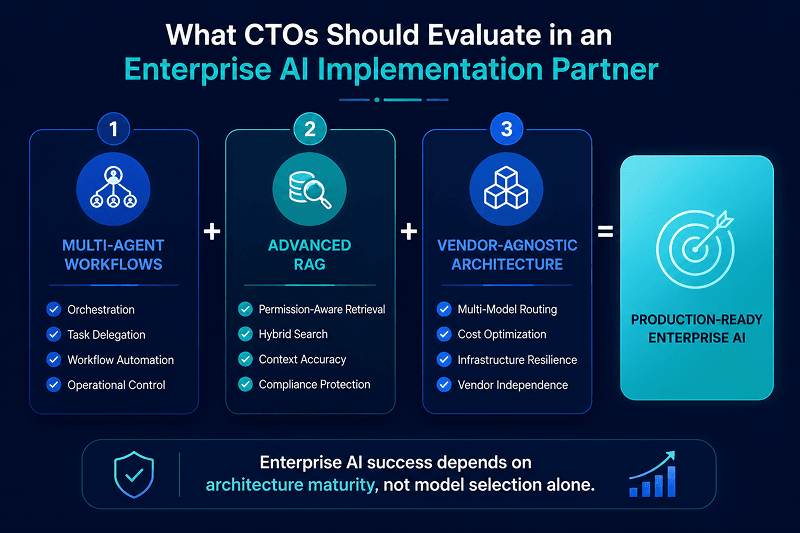
Enterprise AI success depends less on model quality and more on orchestration, retrieval reliability, governance maturity, and infrastructure adaptability under real-world operational load.
1. Multi-Agent Workflow Capability
Modern enterprise AI systems increasingly rely on coordinated multi-agent architectures instead of single-prompt interactions. In production environments, one agent may retrieve enterprise policy data, another may validate permissions, another may summarize findings, and another may trigger workflow execution within ERP or ITSM systems.
This separation of responsibilities significantly improves reliability, traceability, and operational control.
The same principles of orchestration, context management, and intelligent task routing are increasingly shaping how modern AI-powered SaaS products are designed. This is particularly true when applying structured AI product classification frameworks to support scalability, automation, and long-term growth.
A strong enterprise generative AI implementation partner should demonstrate experience with:
- CrewAI
- AutoGen
- LangGraph
- Model Context Protocol (MCP)
- Stateful workflow orchestration
If a vendor only demonstrates standalone chat interfaces without orchestration architecture, it is usually a sign that they are building AI wrappers rather than enterprise-grade systems.
2. Advanced Retrieval-Augmented Generation (RAG)
Basic vector search is no longer sufficient in enterprise environments, where permissions, contextual precision, and retrieval accuracy directly affect operational reliability.
Modern retrieval systems increasingly require:
- Hybrid semantic and keyword search
- Metadata-aware filtering
- Context pruning
- Semantic reranking
- Graph-RAG architectures
- Permission-aware retrieval pipelines
For example, a healthcare support employee should never retrieve HR-sensitive information simply because semantic similarity exists between documents.
This is where advanced generative AI software integration consulting becomes critical. Retrieval quality often determines whether enterprise AI systems become operational assets or compliance liabilities.
3. Vendor-Agnostic Model Architecture
One of the clearest patterns emerging across enterprise AI deployments is that long-term scalability depends on model flexibility, not model dependency.
The strongest AI systems now dynamically orchestrate multiple specialized models depending on workflow requirements.
For example:
- GPT-4o for complex reasoning tasks
- Smaller local models for low-latency execution
- Open-weight models for privacy-sensitive workflows
- Specialized domain models for industry-specific operations
This hybrid architecture improves:
- Cost efficiency
- Inference latency
- Infrastructure resilience
- Vendor independence
An experienced AI integration agency should already be designing systems around this multi-model operational reality rather than relying entirely on a single provider ecosystem.
AI Governance and Compliance Is Now a Procurement Requirement
In 2026, enterprise AI is increasingly evaluated through governance maturity, not model capability alone. Organizations handling sensitive data now expect governance and compliance controls to be built into AI systems from day one.
According to IBM's Cost of a Data Breach Report, the global average cost of a data breach reached $4.88 million, making security and governance a business priority. A reliable AI integration partner should be able to explain:
- Data protection and access controls
- Auditability and traceability
- Prompt injection risk mitigation
- Alignment with frameworks such as ISO 42001 and NIST AI RMF
One of the most common enterprise AI risks is unauthorized data exposure caused by weak retrieval architectures and permission controls rather than the model itself.
The Hidden Cost Layer Most Enterprises Ignore: AI FinOps
Most enterprises underestimate how quickly AI infrastructure costs compound at production scale. A single enterprise workflow can generate millions of inference requests monthly once AI becomes embedded across support systems, internal operations, SaaS platforms, and customer-facing applications.
Without optimization, even successful AI deployments can become financially unsustainable. Deloitte’s State of Generative AI in the Enterprise report highlights that organizations moving from AI pilots to production consistently face growing pressure around infrastructure scaling, governance, and operational cost management as deployment complexity increases.
This is why the best generative AI integration platform for B2B environments is not simply the most intelligent system. It is the system that can maintain performance, reliability, and scalability without creating uncontrolled infrastructure costs.
Modern enterprise AI systems now require dedicated AI FinOps strategies focused on balancing inference quality, latency requirements, GPU utilization, context efficiency, and long-term operating cost.
| AI FinOps Strategy | Operational Impact |
| Semantic caching | Reduces repeated inference costs |
| Prompt compression | Minimizes token consumption |
| Context-window optimization | Improves latency and response efficiency |
| Dynamic model routing | Balances cost with reasoning complexity |
| Local SLM deployment | Reduces dependency on cloud inference APIs |
A mature enterprise AI integration partner should proactively discuss cost-per-workflow benchmarks, GPU optimization strategies, latency thresholds for real-time systems, infrastructure scaling forecasts, model-routing efficiency, and long-term operational cost visibility.
If pricing conversations stop at API costs alone, the architecture is usually immature. In enterprise AI environments, infrastructure efficiency often determines whether a deployment scales successfully or becomes operationally expensive within months.
Why AI Value Depends on Workflow Integration
One of the most overlooked aspects of enterprise AI adoption is that model intelligence alone does not create business outcomes. Value emerges when AI capabilities are embedded into workflows that people can trust, understand, and use consistently.
Millipixels encountered this challenge while working with Distil, a customer intelligence platform designed to help marketers leverage AI and data science more effectively. The platform contained powerful capabilities, but turning it into business value required making complex insights accessible to non-technical users within their everyday workflows.
To address this, Millipixels developed a user experience strategy focused on self-service discovery, intuitive decision-making, and seamless integration into existing marketing processes. The result was a 46% increase in customer engagement within months of launch.
The lesson for enterprise AI initiatives is clear: success depends less on model sophistication and more on how effectively AI is integrated into workflows, systems, and operational decision-making.
How Workflow-Centric AI Design Increased Engagement by 46%
Download the Case StudyThe Enterprise AI Blind Spot Most Companies Discover Too Late
Many enterprise AI failures are not caused by the model itself. They happen because teams cannot trace why a particular output was generated inside a live workflow.
Unlike traditional software, AI systems operate across retrieval pipelines, prompts, models, and business systems. When something goes wrong, enterprises need visibility into what happened and why.
Production-grade AI systems require:
- Prompt and response tracing
- Retrieval visibility
- Latency monitoring
- Drift detection
- Continuous evaluation pipelines
At Millipixels, we believe observability is one of the most overlooked layers in enterprise AI architecture. Organizations often invest heavily in models and automation while underestimating the importance of understanding how AI decisions are generated, evaluated, and improved over time.
Strong observability frameworks also help enterprises identify and mitigate Shadow AI risks by providing visibility into how AI tools are used across workflows, reducing the likelihood that ungoverned systems will introduce security, compliance, or data exposure issues.
Build vs Buy vs Partner: The Strategic CTO Decision
 Most enterprise AI initiatives fail long before deployment because leadership makes the wrong operational decision at the beginning: build internally, buy SaaS tools, or partner with an enterprise AI integration firm.
The right choice depends less on budget and more on infrastructure maturity, workflow complexity, governance requirements, and execution speed.
Building Internally Gives Control but Slows Execution
Many enterprises assume AI implementation should be handled entirely in-house. While this approach offers maximum control and long-term flexibility, it also requires expertise across LLM integration, retrieval architecture, governance, workflow orchestration, observability, and infrastructure optimization.
The challenge is that enterprise AI evolves faster than most internal engineering cycles. Teams often spend months building foundational capabilities before delivering measurable business outcomes.
Internal development is typically best suited for organizations with mature engineering teams, dedicated AI expertise, long-term proprietary AI objectives, and the resources to support ongoing infrastructure investment.
Buying SaaS AI Tools Accelerates Adoption but Limits Flexibility
Buying AI SaaS integration tools is often the fastest path to deployment. Enterprises can quickly introduce copilots, workflow automation, and AI assistants without building infrastructure from scratch.
The tradeoff is architectural limitation. Most SaaS AI platforms are optimized for broad adoption, not deep enterprise customization. As workflow complexity increases, enterprises often encounter:
- Limited orchestration flexibility
- Weak governance customization
- Restricted retrieval control
- Vendor lock-in risks
- Limited infrastructure visibility
This becomes especially problematic for industries with strict compliance and operational requirements.
Why Hybrid Models Are Becoming the Enterprise Standard
For most organizations, the most sustainable approach is increasingly hybrid.
Internal teams retain strategic ownership over infrastructure, governance, and business logic while external specialists accelerate deployment, architecture maturity, and operational scaling.
This approach allows enterprises to:
- Reduce implementation timelines
- Avoid infrastructure missteps
- Build scalable AI-driven workflows
- Maintain long-term platform control
- Improve operational reliability faster
The strongest enterprise AI integration partners do not replace internal teams. They help enterprises avoid costly architectural mistakes while building systems capable of evolving alongside rapidly changing AI infrastructure.
How Millipixels Helps Enterprises Build AI Systems That Actually Scale
Access to AI models is no longer the challenge. The real challenge is integrating AI into business workflows, enterprise systems, and operational processes in a way that remains secure, reliable, and scalable over time.
That is where enterprise AI implementation becomes an engineering challenge, not just an AI initiative.
At Millipixels, we help organizations move beyond experiments and pilot projects by designing production-ready AI ecosystems built around orchestration, retrieval, governance, observability, and workflow integration. The focus is not simply on deploying AI faster. It is building systems that continue to deliver measurable business value as usage, complexity, and operational demands grow.
This becomes especially important when AI and automation are embedded directly into custom enterprise applications, where performance, governance, and workflow reliability must work together seamlessly at scale.

Conclusion: Choosing the Right Generative AI Integration Services Partner in 2026
The enterprises seeing real ROI from generative AI are not the ones chasing the most impressive demos. They are the ones building reliable operational systems with strong governance, scalable architecture, observability, and workflow-level control.
Before moving forward with enterprise AI adoption, ask two critical questions: Can your current infrastructure support AI reliably at scale? And is your AI strategy designed around measurable workflows or isolated experimentation?
If those answers are unclear, that is usually where implementation risk begins.
At Millipixels, we help enterprises design and deploy production-ready AI systems built around workflow orchestration, LLM integration, retrieval architecture, AI governance and compliance, observability, and scalable infrastructure planning.
Talk to our team of enterprise AI experts to evaluate your current AI readiness and build a scalable AI integration roadmap tailored to your goals.
Frequently Asked Questions
1.What are generative AI integration services?
Generative AI integration services involve embedding AI capabilities directly into enterprise software, workflows, applications, and operational systems. Instead of functioning as isolated chatbots or standalone AI tools, these systems become integrated into platforms such as CRMs, ERPs, customer support environments, ITSM systems, internal knowledge bases, and SaaS products.
In 2026, generative AI integration services for enterprise environments extend far beyond simple automation. They include LLM integration, contextual retrieval systems, workflow orchestration, AI governance and compliance frameworks, AI infrastructure integration, and long-term operational monitoring. The objective is not simply to generate responses, but to enable AI to act reliably within governed enterprise workflows.
2.How do generative AI integration services work
Generative AI integration services work by connecting AI models with enterprise infrastructure, business data, and operational workflows. The model itself is only one part of the larger architecture. Production-ready systems also require retrieval pipelines, orchestration layers, permission-aware access controls, observability systems, and workflow automation frameworks.
For example, a support workflow may use AI to retrieve information from internal documentation, analyze historical tickets, generate contextual responses, escalate uncertain outputs to human operators, and trigger actions inside enterprise platforms. This is where true end-to-end AI integration services differ from basic chatbot implementations.
Modern AI integration solutions also increasingly rely on hybrid model architectures. Different models are used for reasoning, low-latency execution, private deployments, or specialized operational tasks depending on cost, infrastructure, and workflow requirements.
3.How to choose generative AI service for workflow integration
Choosing the right provider requires evaluating whether the company understands enterprise operations as deeply as it understands AI technology. Many vendors can create impressive demonstrations, but far fewer can build production-ready systems capable of operating reliably at enterprise scale.
A strong enterprise generative AI implementation partner should demonstrate expertise in workflow orchestration, AI governance and compliance, observability systems, AI scalability solutions, infrastructure security, and retrieval architecture. Mature vendors also understand how enterprise workflows behave under real-world conditions where latency, permissions, infrastructure costs, and operational reliability become critical.
One important signal is how the vendor discusses AI systems. Less experienced providers often focus almost entirely on prompts and model outputs. More advanced providers focus on architecture, governance, orchestration, monitoring, and long-term operational sustainability. That distinction becomes extremely important once AI systems move into production environments.
4.Why do businesses need generative AI integration?
Businesses need to integrate generative AI because standalone AI tools rarely drive meaningful operational transformation. The real value appears when AI becomes embedded directly into existing systems and workflows that employees already use every day.
Enterprises are increasingly using GenAI to improve customer support, automate internal knowledge retrieval, accelerate documentation workflows, enhance SaaS platforms, and improve operational efficiency across departments. AI SaaS integration, for example, allows companies to build intelligent copilots, contextual search systems, and workflow automation directly into their software products.
5.How much do generative AI integration services cost?
The cost of generative AI integration services varies significantly depending on workflow complexity, infrastructure requirements, governance needs, and deployment scale. Smaller internal productivity integrations are typically less expensive than enterprise-wide AI infrastructure integration initiatives involving custom retrieval systems, private cloud deployments, observability layers, and advanced orchestration frameworks.
Pricing also changes based on whether the organization requires generative AI API integration for SaaS products, enterprise workflow automation, custom AI copilots, or long-term LLMOps support.
One of the most overlooked aspects of enterprise AI cost is infrastructure scaling. Inference costs, token usage, GPU utilization, retrieval complexity, and latency optimization can dramatically affect long-term operational expenses.
6.What industries benefit most from generative AI integration?
Industries with large volumes of repetitive, document-heavy, and knowledge-intensive workflows typically benefit the most from generative AI integration services. Healthcare organizations use AI systems for documentation assistance, knowledge retrieval, and operational workflow acceleration. Financial institutions increasingly deploy AI-driven workflows for compliance analysis, reporting, and customer operations.
SaaS companies invest heavily in integrating generative AI APIs into their products to improve onboarding, customer support, and platform usability.
Legal services, insurance, logistics, enterprise IT, telecommunications, and manufacturing are also seeing significant adoption because these sectors handle large volumes of unstructured data and operational complexity. AI integration solutions are especially valuable in environments where employees spend substantial time searching, reviewing, validating, or manually processing information.
7.How do I choose the right generative AI integration partner?
Choosing the right enterprise AI integration partner requires evaluating far more than just technical AI capabilities. The strongest vendors understand enterprise systems, operational workflows, governance frameworks, infrastructure reliability, and long-term scalability.
A mature AI integration agency should be able to explain how it handles security architecture, observability systems, permission-aware retrieval, cost optimization, drift monitoring, human review workflows, and deployment governance. The best generative AI integration company will typically approach enterprise AI as a systems engineering challenge rather than a simple software deployment project.
One of the clearest differentiators among top generative AI service providers is whether they build flexible vendor-agnostic architectures.
Written by

Parthsarathy Sharma
With 4+ years of experience across AI, UX, GCC/outsourcing, enterprise technology, and brand strategy, Parthsarathy brings a research-driven lens to digital experience content. His work focuses on turning emerging technology, customer experience, and business trends into clear, practical perspectives for readers.