Why Omnichannel Customer Experience Breaks (And the 5-Component Fix)
Most organizations optimize omnichannel customer experiences for channels, not connection. Discover why yours is broken and the 5-component framework that fixes it.
July 03, 2026
Written by
Reviewed by

Introduction
Most organisations get omnichannel wrong. They view it as a channel issue and, to counter it, add more touchpoints or integrate additional systems. What they're actually doing is optimizing for volume, when they should be optimizing for connection.
What happens when a customer discovers your brand on Instagram, researches your product on Google, adds it to their cart on mobile, and then has to start from scratch when they contact support?
In 2026, that single moment of friction can be the difference between a loyal customer and a lost opportunity. Customers expect brands to remember them, understand them, and deliver connected experiences at every touchpoint. Most businesses still don't.
The companies winning today are the ones creating the most connected omnichannel experiences. By combining unified customer data, AI-powered personalization, and a strategic approach to the omnichannel customer journey, they create a seamless customer experience that keeps customers engaged and coming back.
In this guide, you'll discover what separates leading brands from the rest, and why traditional multichannel strategies are no longer enough. Also, the practical frameworks, technologies, and tactics needed to build an omnichannel strategy that drives customer loyalty, engagement, and long-term revenue growth.
What Omnichannel Actually Is (And What It Isn't)
Omnichannel sounds like a consistent experience across channels, but consistency isn't the real goal, it is connection. In terms of customer experience, it can be understood as the practice of consistently delivering connected and personalized interactions across every touchpoint. Some of its key characteristics include:
- Unified customer data
- Consistent messaging
- Context-aware interactions
- Smooth transitions between channels
- Personalized engagement
Unlike isolated channel experiences, a successful omnichannel experience allows a customer to move from your website to your app to your support team to your physical store, without losing context. The system knows what they've done, what they're trying to accomplish, and where they're likely to go next.
Omnichannel vs. Multichannel: Why the difference matters
Many organizations still confuse multichannel and omnichannel strategies. While both involve engaging customers across multiple touchpoints, the customer experience they create is fundamentally different.
Let's take an example. A customer can reach you on email, chat, phone, or social media. That's multichannel. But here's a common scenario. The customer starts with a live chat and describes the issue in detail. Then they switch to email support, maybe because chat is slow or unavailable. The email support responds, and they need the issue description again. The customer has to explain the problem again. Same problem, different channel.
Omnichannel means that the context moves with the customer. A customer starts in live chat and reaches email support without having to repeat what they said in the chat. The team already knows. No repeats, no frustrations, and no lost history.
The difference may sound simple, but it makes all the difference when considering retention, lifetime value, and how often customers recommend you. In essence, channel presence increases visibility. Integration improves customer experience and business outcomes.
| Factor | Multichannel Customer Experience | Omnichannel Customer Experience |
| Strategy Focus | Maximizing channel presence | Creating a unified customer experience |
| Customer Data | Stored separately across systems | Unified into a single customer profile |
| Personalization | Limited to individual channels | Consistent across every touchpoint |
| Customer Context | Lost when switching channels | Preserved across interactions |
| Messaging | Can vary by channel or team | Consistent and coordinated |
| Customer Support | Separate conversations in each channel | Shared history across all channels |
| Technology Stack | Multiple disconnected tools | Integrated ecosystem of platforms |
| Customer Effort | Higher due to repetition and friction | Lower due to continuity and convenience |
| Analytics | Channel-specific reporting | End-to-end customer journey visibility |
| Business Outcome | Improved reach | Improved retention, loyalty, and lifetime value |
Why the focus on omnichannel customer experience in 2026
Five years ago, omnichannel was the differentiator, giving organizations that connected their channels an edge. Today, that's not the case. It is the baseline expectation.
Market shifts and evolving consumer expectations are at the root of it. Here's what shifted:
- Customer acquisition costs tripled. Losing customers to friction is no longer acceptable, or even a remote consideration.
- Buyers now move through multiple different channels before they buy anything. You can't afford to look like different companies at each touchpoint, so your channels should speak with one voice.
- Third-party data is becoming less relevant. In most cases, only first-party data is what's collected by your systems. That data will only matter if it actually connects across your touchpoints.
Omnichannel isn't a competitive advantage. It's survival. Brands that fail to connect customer interactions across channels risk becoming invisible in increasingly crowded markets.
Understanding the Customer Journey Across All Your Channels
An omnichannel customer journey maps how customers move across channels as they pursue a goal. It is rarely linear. It's more like bouncing between systems, trying to solve one problem.
For example, a customer may discover a product on social media, research it through search, compare options on a website, purchase it through a mobile app, and contact support via chat. In this journey, the customer may have called support once for some information, and after adding items to their cart, contacts support again after three days. The support agent has no information about the previous interactions and starts afresh. This is a disrupted journey, with a series of disconnected interactions.
The company that wins takes a different approach. They understand that journey matters because customers do not think in channels. They think in outcomes. They ask the right questions: What problem is this person solving? Where do they get stuck? Where do we ask them to repeat themselves? Where do we lose context?
That's the real journey.
Key Stages of the Omnichannel Customer Journey
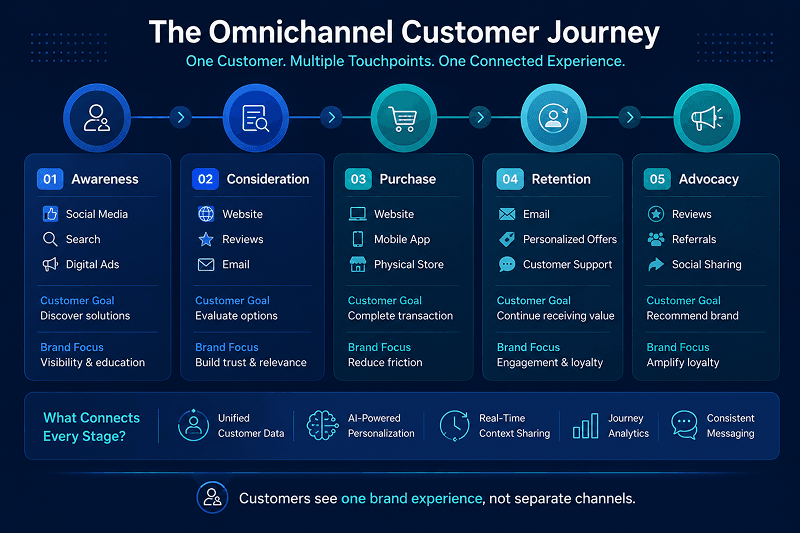
Common Customer Journey Pain Points
The most common barriers to a seamless customer experience include:
- Repeated information requests across chat, email, and phone support
- Inconsistent messaging between marketing, sales, and service channels
- Generic interactions, despite the availability of customer data, often indicate deeper issues with technology adoption, AI implementation, and organizational readiness.
- Slow issue resolution caused by disconnected systems and teams
These friction points increase customer effort, reduce conversions, and weaken retention.
The Core Components of Successful Omnichannel Experiences
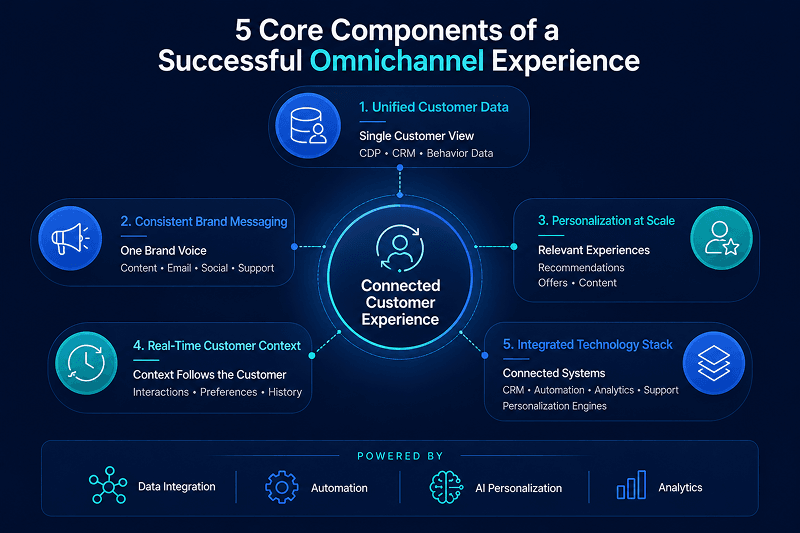
Unified Customer Data
A Customer Data Platform (CDP) connects your customer data across all systems and touchpoints, including websites, apps, CRM systems, support platforms, and marketing channels, to create a single customer view. With AI integrated, there is consistent personalization, accurate segmentation, and better decision-making.
Consistent Brand Messaging
Customers should receive the same core message, value proposition, and brand experience whether they interact through advertising, email, social media, sales conversations, or support channels. Consistency builds trust and reduces confusion.
Personalization at Scale
Modern personalization goes beyond using a customer's name. It involves delivering relevant content, recommendations, offers, and next-best actions based on real-time behavior, purchase history, and engagement patterns. With AI in the picture, this becomes automatic across thousands of customers. Effective personalization also depends on thoughtful user experience design that ensures these interactions feel helpful rather than intrusive.
Real-Time Customer Context
Customer context should follow users across touchpoints. If a customer abandons a cart, opens a support ticket, or engages with a campaign, that information should be available instantly across relevant systems and teams. The customer shouldn't have to repeat anything when switching channels.
Integrated Technology Stack
Successful omnichannel experiences rely on connected technologies that share data seamlessly across the customer lifecycle, including:
- CRM: Centralizes customer profiles, interactions, and sales activity.
- Marketing Automation: Automates campaigns, nurturing, and audience segmentation.
- Analytics Platforms: Tracks customer behavior, journey performance, and conversion metrics.
- Customer Service Systems: Provides agents with complete interaction history across channels.
- Personalization Engines: Delivers real-time recommendations, dynamic content, and tailored experiences based on customer intent.
Without integration between these systems, even the best customer experience strategy will struggle to deliver a truly connected experience.
Why Omnichannel Actually Moves the Needle
When an omnichannel strategy is well executed, it delivers more than just customer satisfaction or improved customer interactions. It directly impacts your bottom line. It changes these three things: how often your customers return, how much they spend, and whether they recommend you.
Here are the benefits of having a good omnichannel strategy:
- Reduced Effort, Improved Satisfaction: Customers can move between channels without losing progress or having to repeat themselves. When they can start their journey on a mobile and finish it on a desktop without having to find their place again or re-authenticate, their effort is reduced and time is saved. This converts directly to customer satisfaction.
- Retention & Loyalty: When a customer comes across the same brand voice, values, and level of support across all channels, they are more likely to trust you and return. This is where omnichannel becomes business-critical, not 'nice-to-have.'
- Revenue Impact: Connected customer data enables relevant recommendations, which in turn drive higher average order value and faster conversions. Informed personalization means customers see what's relevant to them, not generic suggestions. Ultimately, this compounds into significantly higher lifetime value.
- Operational Efficiency: Support teams spend less time gathering information and more time solving problems. They have the complete interaction history, resulting in a significant reduction in resolution times. That's improved capacity with the same team handling more volume.
- Consistency & Trust: Consistent experience reinforces reliability. With the same brand promise across the website, email, and support channels, they gain some stability, which translates into trust. In a crowded market, that's what separates you from your competitors.
The common pattern across all of this is that omnichannel isn't just about having more channels; it's about reducing friction for users. If the customer is frustrated with the experience, better pricing, better product, and better marketing won't matter. Organizations that connect their channels see growth because customers stay longer, come back for more, and they tell others.
How UX-Led Omnichannel Design Transformed a Large-Scale Education Platform
Stanfield, a large education ecosystem serving over 5,000 school districts, was struggling with a fragmented digital experience. They found that users faced inconsistent journeys across devices, making it difficult to complete key eCommerce actions smoothly.
Millipixels stepped in to reimagine the experience through a UX-driven omnichannel approach. We focused on understanding real user behavior, mapping broken journeys, and redesigning the platform. By aligning UX strategy with a scalable, cloud-native architecture, we unified interactions across mobile and web, ensuring continuity in the omnichannel customer journey from discovery to purchase.
The result was a more intuitive and connected experience that led to a 23% increase in conversions, a 30% reduction in support effort, and a 40% improvement in mobile engagement, showing how thoughtful UX and omnichannel design directly translate into measurable business impact.
Get the Complete Case Study on Omnichannel Experience Transformation
Read the Case StudyBuilding an Effective Content Strategy
Why Content Is the Foundation of Omnichannel Success
Content is what connects every stage of the customer journey, from initial discovery to post-purchase engagement. It ensures customers receive the right information, in the right format, at the right time, regardless of the channel they choose.
Content is also where messaging breaks. Marketing runs their campaign. Sales has their own narrative. Support tells customers something entirely different. The product team is talking about all different features. By the time the customer has moved through three channels, they have heard four different versions about what the company does.
This is not a content problem. It's an alignment problem. But on the surface, it's all content.
What works is one core narrative and all touchpoints reinforcing it. The same core value proposition, the same brand voice, and the same promises. The website, emails, chats, and all other touchpoints should reflect the same narrative.
Mapping Content to Customer Journey Stages
| Journey Stage | Content Type | Primary Channel |
| Awareness | Blogs, Videos | Search, Social |
| Consideration | Case Studies, Webinars | Website, Email |
| Purchase | Product Demos | Website, App |
| Retention | Tutorials, Knowledge Base | Email, Support |
Content Strategy in Practice
One blog should not become five identical posts. Repurpose with intent. Your detailed analysis works as search optimization piece on the website. It becomes a hook on a LinkedIn post. And a specific case study in an email to your leads. Same insight, different angles for where it is used.
Because search needs depth. LinkedIn needs a level of provocation. Email should show urgency. If you send the same thing everywhere, none of them convert well.
How to Engage Customers Across All Channels
Successful omnichannel customer engagement depends on delivering the right message through the right channel at the right moment.
Personalized Messaging Across Channels
Use customer behavior, purchase history, and engagement patterns to deliver relevant content, offers, and recommendations across touchpoints.
Proactive Customer Outreach
Identify potential issues, drop-off risks, or expansion opportunities and engage customers before they initiate contact.
AI-Powered Engagement
Leverage predictive analytics and AI models to anticipate customer intent, personalize interactions, and automate next-best actions.
Loyalty and Rewards Programs
Create a unified rewards experience where customers can earn and redeem benefits consistently across online and offline channels.
Conversational Marketing
Use live chat, messaging platforms, chatbots, and AI assistants to create real-time, two-way customer interactions throughout the journey.
Real-World Examples
| Industry | Omnichannel Engagement Example |
| Retail | Personalized product recommendations and promotions based on browsing and purchase history |
| Banking | Context-aware financial guidance delivered through mobile apps, email, and advisor interactions |
| Healthcare | Coordinated appointment reminders, follow-ups, and patient communications across channels |
| SaaS | Lifecycle-based onboarding, feature adoption campaigns, and customer success outreach based on product usage |
How Enterprise AI Is Solving the Omnichannel Problem At Scale
As customer journeys become more complex, AI is helping organizations move beyond reactive engagement toward predictive, personalized, and real-time experiences. Instead of managing channels independently, businesses can now orchestrate entire customer journeys based on behavior, intent, and context.
The Rise of Enterprise AI Omnichannel Marketing Platforms
Omnichannel without AI is expensive and manual. Teams duplicate work, channels are coordinated separately, and customers have to repeat themselves. With AI, this changes fundamentally, and these processes become intelligent and automatic.
An enterprise AI omnichannel marketing platform combines customer data, machine learning, automation, and analytics to coordinate interactions across channels. These platforms help businesses deliver more relevant experiences while reducing the manual effort required to manage customer journeys at scale.
Key AI Use Cases
- Predictive Analytics: When a customer shows signs of churn, AI detects it before they leave. When an existing customer stops engaging and hasn't opened your last three emails, AI notices this, reads into the pattern, and predicts churn risk. AI intervention here is not a generic "we miss you" email. It's very specific based on the knowledge of what moved the customer before and what they really care about. It can be a personal outreach from the account manager or a limited-time offer. With a retention workflow triggering automatically, you prevent churn and don't end up just reacting to it.
- Customer Intent Prediction: A customer abandons the cart after browsing the pricing three times and reading the comparison guide. They don't return to the website, but open your email. The next time they are on your website, AI knows they are not in purchase mode, but research mode. Here's when AI surfaces specific information they need, like case studies, educational content, and other comparisons. It doesn't push for a hard sell. This isn't guesswork, it's pattern identification.
- Automated Personalization: Once AI knows the intent, personalization is the next step in delivering the right experience. A healthcare provider would see case studies, testimonials, and pricing for their organization size. A SaaS buyer comparing solutions would see technical deep dives and comparison guides. For the same product, AI personalizes the experience based on who they are, what they're researching, and what they care about. Personalization is not just using someone's name. It's about showing them the version of your product or story that's relevant to them.
- Intelligent Chatbots: If a customer has a question at 2 AM on Sunday, they don't want to wait till Monday morning. AI-powered chat answers immediately, and with context. It knows their journey, purchase history, and feature preferences. Even when the issue is complex and it needs to be escalated to a human, it does so with all the context already shared. The customer doesn't have to repeat anything, and your team's capacity increases without hiring.
- Journey Orchestration: AI orchestrates across all of the customer's touchpoints, including when they abandon their cart, open an email, or browse social media. It then sends out a signal or a message when the user is most likely to engage. If that doesn't work, it moves to a different channel at their preferred time. It may then move to showing some social proof or handling their objections. Orchestration here means sending the right message, at the right time. This is pattern recognition at scale.
Challenges and Considerations
- Data Privacy Requirements: AI systems depend on customer data, making compliance and governance critical.
- Integration Complexity: AI delivers the most value when connected to CRM, marketing, analytics, and customer service systems.
- Ethical AI Governance: Organizations must ensure transparency, fairness, and responsible use of customer data and automation.
The most successful organizations are not using AI simply to automate tasks. They are using it to create smarter, more connected customer experiences that scale across the entire journey. The combination of omnichannel infrastructure and AI isn't just an added feature; it's multiplicative.
The Build vs. Buy Decision For Omnichannel Support Software
The best omnichannel customer support software should unify customer interactions, data, and workflows rather than simply add more support channels. The question every organization asks is whether to build custom omnichannel support software or buy a platform.
The answer for most is usually both. You need to decide which parts to buy off the shelf and which to build in-house to fit the business. Trying to build everything on your own will be a slow and expensive process.
When to Buy
Buy when you need speed to market and your workflows are standard across the industry. You have the budget, and you need something that works out of the box. You're operational in weeks, not months. The trade-off will be that you'll need to adapt some of your processes to the platform and some specific needs may not be met.
When to Build
Build when most of your processes are customized and unique to your business. You also have a strong engineering team and the budget to invest for 6-12 months upfront. The trade-off is higher engineering costs, longer time to build, and ongoing maintenance. But you don't compromise on your requirements.
The Hybrid Reality
This is what most organizations do. They buy the core platform (CRM, CDP, ticketing system) and build custom workflows, integrations, and specific features that matter to the business. While this requires strong technology leadership and a clear roadmap for what to build vs. what to buy, it delivers the market speed and customization. This is the most realistic and pragmatic approach.
Decision Criteria
Before you decide, ask these questions:
- How unique is your business?
- What are your engineering capabilities and capacity?
- How fast do you need to be operational?
- What's your tolerance and scope for compromise?
- What is the total cost of ownership, including implementation, integrations, training, and ongoing maintenance?
The companies that get this right don't go back on their decisions. They map their unique needs and assess their resources to pick the right path. The answer lies in understanding your reality before choosing between building, buying, and the hybrid approach.
Stop Buliding Channels. Start Fixing Connections.
Consult MillipixelsTop Omnichannel Marketing Trends for 2026
The biggest shift in 2026 is that omnichannel is no longer a differentiator. It is the expectation.
According to McKinsey's 2026 Global B2B Pulse Survey, buyers now use an average of 10 channels throughout the purchasing journey and expect seamless movement between them. Inconsistent information and disconnected experiences have become leading reasons customers switch providers.
AI-Powered Hyper-Personalization
Generic segmentation is being replaced by AI-driven personalization that adapts content, offers, and recommendations in real time. McKinsey reports that over 90% of organizations claim to personalize content across multiple channels and touchpoints.
Conversational Commerce
The traditional funnel is giving way to conversation-led buying experiences. Customers are discovering products, asking questions, and making purchasing decisions through messaging apps, AI assistants, and live chat. Not as a nice-to-have channel, but as a primary buying experience.
Unified Customer Data Platforms
Customer Data Platforms (CDPs) are becoming core infrastructure for omnichannel execution. By creating a single customer view, organizations can connect marketing, sales, support, and product interactions into one cohesive experience.
Real-Time Journey Orchestration
Leading brands are moving beyond scheduled campaigns. McKinsey report shows that they're adopting systems that respond instantly to customer behavior. AI-powered orchestration enables businesses to deliver personalized messages, recommendations, and support interactions based on live customer signals.
Voice and Messaging Channel Expansion
Voice assistants, WhatsApp, in-app messaging, and AI-powered chat experiences continue to gain importance as customers increasingly prefer conversational interactions over traditional web navigation. Businesses are adapting by treating every conversation channel as a potential conversion channel.
The common thread across these omnichannel marketing trends is clear: organizations are shifting from channel-centric marketing to customer-centric orchestration.
Measuring Omnichannel Customer Experience Success
An omnichannel strategy is only as effective as the outcomes it delivers. Tracking the right metrics helps organizations identify friction points, measure business impact, and continuously improve customer journeys.
Key Metrics to Track
- Customer Satisfaction (CSAT): Measures how satisfied customers are with specific interactions, purchases, or support experiences.
- Net Promoter Score (NPS): Evaluates customer loyalty and their likelihood of recommending your brand to others.
- Customer Retention Rate: Tracks the percentage of customers who continue doing business with your organization over time.
- Customer Lifetime Value (CLV): Measures the total revenue a customer generates throughout their relationship with your brand.
- Conversion Rate: Assesses how effectively customers move from one stage of the journey to the next, such as visitor-to-lead or lead-to-customer.
- Customer Effort Score (CES): Indicates how easy it is for customers to complete tasks, resolve issues, or achieve their goals.
Creating an Omnichannel Experience Dashboard
An effective dashboard should provide a unified view of customer, marketing, sales, and support performance. At a minimum, it should track:
- Channel-specific conversion rates
- Customer retention and churn trends
- CSAT, NPS, and CES scores
- Cross-channel engagement metrics
- Support response and resolution times
- Customer journey drop-off points
The goal is not to measure channels independently, but to understand how customers move across them and where friction occurs.
Continuous Optimization Framework
The most successful organizations follow a structured improvement cycle:
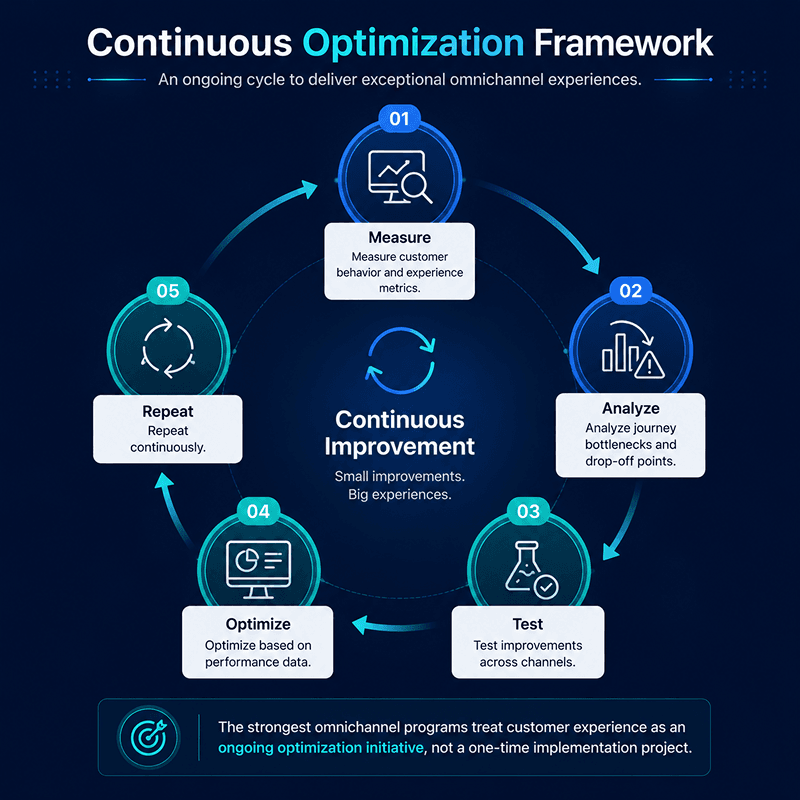
The strongest omnichannel programs treat customer experience as an ongoing optimization initiative, not a one-time implementation project. Continuous refinement is often what separates high-performing brands from those with merely functional omnichannel capabilities.
The Real Challenges Everyone Needs to Talk About
Data Silos
Customer data often lives across CRM platforms, marketing automation tools, e-commerce systems, analytics platforms, and support software. As a result, teams operate with incomplete customer information, making it difficult to deliver personalized experiences across the entire journey.
Legacy Systems
Many organizations still rely on legacy platforms that cannot exchange data in real time. This creates delays in customer updates, fragmented reporting, and inconsistent experiences across channels.
Inconsistent Customer Data
Duplicate customer records, missing attributes, and conflicting data sources can lead to inaccurate audience segmentation, irrelevant recommendations, and disconnected customer interactions.
Organizational Alignment Issues
Marketing may optimize for lead generation, sales for pipeline growth, and customer service for ticket resolution. Without shared customer experience objectives, customers often encounter disconnected messaging and handoffs throughout their journey.
Privacy and Compliance Requirements
As businesses collect more customer data to power personalization, they must also manage consent, data storage, access controls, and regulatory compliance requirements across multiple regions and platforms.
Many of these operational challenges ultimately surface as UX problems, where poor experience design leads to higher bounce rates and lower engagement.
How to Overcome These Challenges
Organizations that successfully scale omnichannel experiences typically:
- Establish a single source of truth for customer data.
- Prioritize API-driven integrations between critical systems.
- Create shared KPIs across marketing, sales, and customer service teams.
- Implement governance frameworks for data quality, privacy, and compliance.
- Continuously monitor customer journey performance to identify friction points before they impact revenue.
Future of Omnichannel Customer Experience
The next phase of omnichannel will be shaped by how effectively organizations combine customer data, AI, and automation to create increasingly intelligent customer journeys. But the real differentiator will not be autimation alone. It will be how well brands preserve context, respect customer data, and use AI to remove friction without making experiences feel automated, impersonal, or intrusive.
AI-Native Customer Journeys
Customer journeys will increasingly be orchestrated dynamically by AI. Instead of relying on predefined workflows, systems will continuously adapt messaging, content, and recommendations based on real-time customer behavior and intent signals.
Predictive Engagement Models
Organizations will increasingly identify churn risks, purchase opportunities, and support needs before customers take action. Engagement strategies will shift from reactive communication to proactive intervention.
Unified Commerce Experiences
Customers will expect a single commerce experience across websites, mobile apps, marketplaces, social commerce channels, and physical stores. Inventory, pricing, promotions, loyalty programs, and customer profiles will remain synchronized across every touchpoint.
Human + AI Collaboration
AI will automate routine support requests, audience segmentation, campaign optimization, and journey orchestration, allowing employees to focus on high-value customer interactions, relationship management, and strategic decision-making.
Hyper-Personalized Customer Interactions
Personalization will evolve beyond demographic segments and behavioral targeting. Future experiences will adapt in real time based on customer intent, historical interactions, lifecycle stage, location, device, and contextual signals.
Conclusion: Turning Omnichannel Strategy Into Measurable Growth
Delivering a connected omnichannel customer experience is now a business requirement. As customers move seamlessly between digital and physical touchpoints, brands must be able to unify data, preserve context, personalize interactions, and create consistency across the entire customer journey.
The challenge is that most organizations do not struggle because they lack channels. They struggle because their channels, systems, and teams operate independently. The result is fragmented customer journeys, inconsistent experiences, and missed growth opportunities.
If your customer experience still feels disconnected across marketing, sales, support, or digital channels, now is the time to evaluate your omnichannel maturity.
At Millipixels, we help organizations design and optimize omnichannel experiences that align customer needs with business goals. From customer journey mapping and UX strategy to digital experience optimization and AI-driven personalization, we help brands create connected experiences that drive measurable growth.
Ready to create a more connected customer experience? Schedule a consultation with our experts and discover where your biggest opportunities for improvement lie.
Frequently Asked Questions
What is omnichannel customer experience?
Omnichannel customer experience refers to a connected approach where customers receive consistent, personalized interactions across every touchpoint, including websites, mobile apps, social media, email, physical stores, and customer support channels. The goal is to create a unified experience rather than treating each channel separately.
Unlike disconnected interactions, successful omnichannel experiences ensure that customer data, preferences, and context move seamlessly between channels, creating a more convenient and engaging journey from discovery to post-purchase support.
How to improve omnichannel customer experience?
The most effective way to improve omnichannel customer experience is to eliminate friction between channels. Start by unifying customer data, integrating systems, and ensuring that customer conversations can continue across touchpoints without losing context.
Many brands focus on adding more channels when they should focus on creating a seamless customer experience. Personalization, real-time customer insights, and consistent messaging across channels are often the biggest drivers of measurable improvements.
What are the best strategies to improve omnichannel customer experience?
Some of the most effective 5 ways to improve omnichannel customer experience include:
- Centralizing customer data into a single profile
- Personalizing interactions using behavioral insights
- Enabling seamless channel switching
- Providing customer service teams with shared customer history
- Continuously measuring and optimizing customer journeys
What is an omnichannel customer experience platform?
An omnichannel customer experience platform is a technology ecosystem that connects customer data, communication channels, analytics, and service tools to deliver consistent interactions across the entire customer lifecycle.
Many organizations use an enterprise AI omnichannel marketing platform to unify customer insights, automate personalization, and orchestrate customer journeys at scale.
What is the difference between customer journey and customer experience?
The omnichannel customer journey refers to the path a customer takes while interacting with a brand across different stages such as awareness, consideration, purchase, and retention.
Customer experience is the overall perception a customer forms during those interactions. In simple terms, the journey is what customers do, while the experience is how they feel about it.
What is the role of AI in omnichannel customer engagement?
AI plays a critical role in omnichannel customer engagement by helping businesses analyze behavior, predict intent, automate personalization, and deliver relevant interactions in real time. It enables brands to create more contextual and timely experiences across channels.
AI also powers intelligent recommendations, predictive analytics, chatbots, and journey orchestration, helping organizations deliver a stronger cross channel customer experience while improving efficiency and customer satisfaction.
What are the benefits of omnichannel customer service?
The key benefits of omnichannel customer service include faster resolution times, reduced customer effort, improved service consistency, better agent productivity, and increased customer trust.
Businesses that invest in omnichannel customer support software can provide connected support experiences where customers do not need to repeat information when switching channels.
How can businesses improve omnichannel customer experience?
Businesses can improve omnichannel customer experience by developing a strong omnichannel content strategy, unifying customer data, integrating technology systems, and aligning teams around customer needs.
They should also monitor emerging omnichannel marketing trends, continuously optimize customer journeys, and use AI-driven insights to create more personalized and consistent interactions across every touchpoint.
Written by

Parthsarathy Sharma
With 4+ years of experience across AI, UX, GCC/outsourcing, enterprise technology, and brand strategy, Parthsarathy brings a research-driven lens to digital experience content. His work focuses on turning emerging technology, customer experience, and business trends into clear, practical perspectives for readers.
Reviewed by

Anukriti Tuli
With 6 years of experience across product and experience design, Anukriti brings a practical UX lens to the team. At Millipixels Interactive, she works across research, usability testing, visual design, and product launches, helping ensure digital experiences stay clear, functional, and user-centered.
- Introduction
- What Omnichannel Actually Is (And What It Isn't)
- Omnichannel vs. Multichannel: Why the difference matters
- Why the focus on omnichannel customer experience in 2026
- Understanding the Customer Journey Across All Your Channels
- Common Customer Journey Pain Points
- The Core Components of Successful Omnichannel Experiences
- Why Omnichannel Actually Moves the Needle
- How UX-Led Omnichannel Design Transformed a Large-Scale Education Platform
- Building an Effective Content Strategy
- How to Engage Customers Across All Channels
- How Enterprise AI Is Solving the Omnichannel Problem At Scale
- The Build vs. Buy Decision For Omnichannel Support Software
- Top Omnichannel Marketing Trends for 2026
- Measuring Omnichannel Customer Experience Success
- The Real Challenges Everyone Needs to Talk About
- Future of Omnichannel Customer Experience
- Conclusion: Turning Omnichannel Strategy Into Measurable Growth
- Frequently Asked Questions