SaaS UX Design Agency vs In-House Team: Which Is Right for Your Product?
Choosing between a SaaS UX design agency and an in-house team? Compare costs, expertise, & proven decision frameworks to find the right fit.
August 06, 2026
Written by

Introduction
Building a SaaS product is rarely just about shipping features. As your product grows, user expectations grow with it. Workflows become more complex, onboarding starts affecting conversions, and small usability issues begin influencing retention and customer satisfaction.
At some point, every product leader faces the same question: Should we partner with a SaaS UX design agency or start building an in-house design team?
It sounds like a straightforward comparison, but it rarely is. The right choice depends on far more than cost. It depends on where your product is today, how quickly you're growing, the type of design work you need, and whether you're building a long-term capability or solving an immediate challenge.
After years of collaborating with industry leaders, Millipixels has seen some organizations spend months building internal teams when what they really needed was momentum. At the same time, others relied on external support long after design had become a core part of their product strategy. Both decisions can slow progress if they don't align with business needs.
This guide takes a different approach. We'll look at how this decision changes as your product matures, what reliable data tells us about investing in design, and how to determine which model fits your team today.
If you're evaluating a SaaS UX design agency, considering whether to outsource UX design, or debating the merits of an in-house UX team vs design agency, this is for you.
Most Agency vs In-House Comparisons Start with a Bias. Let's Start with Transparency.
When it's time to invest in UX, most teams start with the same question: Should we hire an in-house team or partner with a SaaS UX design agency?
It seems like a straightforward choice, but that's rarely how it plays out in practice.
We've worked with companies that hired too early and struggled to keep a design team fully utilized. We've also seen businesses wait too long to invest in dedicated UX, only to find that usability issues had started affecting adoption, customer satisfaction, and product growth.
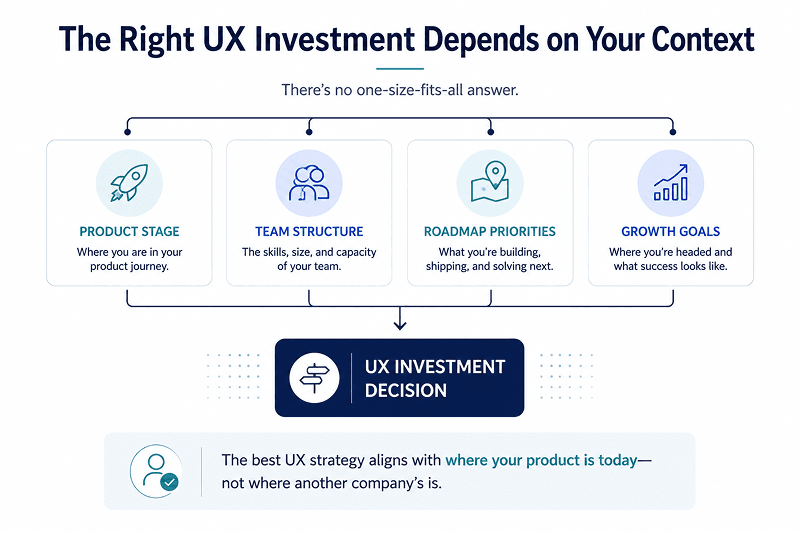
The reason is simple. This isn't a question of which model is better. It's a question of which model is better for your product today.
Your product stage, roadmap, team structure, and growth plans all influence the right decision. An early-stage SaaS company validating product-market fit has very different design needs from a mature platform supporting thousands of users.
That's why this guide doesn't take sides. Instead, we'll look at the situations where an agency creates the most value, where an in-house team becomes the smarter investment, and why many growing SaaS companies eventually combine both. The goal is to help you evaluate your options with confidence and choose the approach that best supports the next stage of growth for your product.
You Are Not Choosing Designers. You Are Choosing Design Capability.
One of the biggest mistakes companies make is treating this as a hiring decision. It isn't.
You're deciding how your organization will build design capability over the next several years. A designer is one part of that equation. Design capability is much broader. It includes the systems, processes, expertise, and collaboration needed to continuously improve your product experience, reduce user friction, and keep visitors engaged.
As products evolve, that capability usually expands to include:
- User research and customer interviews
- Information architecture
- UX and interaction design
- Visual design and branding
- Design systems
- Usability testing
- Cross-functional collaboration with engineering and product teams
The mix changes over time. An early-stage SaaS company might only need help validating user flows before launching new features. A growth-stage company may need design integrated into every sprint. A mature platform might require specialists for accessibility, research, enterprise workflows, or large-scale design system management.
This is why comparing an agency and an internal hire as though they solve the same problem often leads to the wrong conclusion. Before evaluating cost, team structure, or timelines, define the capability your business actually needs. Once you're clear on that, the hiring decision becomes much easier.
Build a Team That Matches Your Product's Next Growth
Scale your UX capabilities with experienced SaaS designers who integrate seamlessly with your team. Get the expertise you need without the time and cost of building it in-house.
Talk to Our UX ExpertsThe Real Question Is: What Stage Is Your Product In?
Choosing between an agency and an in-house team is a decision that evolves as your product, customers, and business grow.
A company validating product-market fit has very different priorities from one managing multiple product teams or serving enterprise customers. The design capability that helps you move faster today may not be the same capability you'll need a year from now.
That's why the first step isn't comparing costs or team structures. It's understanding where your product is today.
Once you're clear on your current stage, it becomes much easier to determine the type of design support that will create the most value. It also helps you avoid common UX mistakes that can slow adoption and create friction for your users.
| Product Stage | What Design Looks Like | Most Common Need |
| Early Stage | Design is handled by founders, engineers, or freelancers. UX decisions are often reactive. | Build foundational UX capability without committing to a permanent team. |
| Growth Stage | Product development accelerates and design becomes part of regular delivery cycles. | Create consistent product experiences while supporting faster releases. |
| Mature Stage | UX becomes a competitive advantage across multiple products or customer segments. | Scale design strategically through internal ownership and specialist expertise. |
Your stage doesn't automatically determine whether you should outsource a UX team or hire internally. It does determine the questions you should be asking.
A company validating product-market fit has very different priorities from one managing multiple product squads. Treating both situations the same often leads to unnecessary hiring costs or stretched internal teams. Understanding where you are today provides the context for every decision that follows.
Do You Need to Hire Anyone Yet?
Not every product challenge requires another hire. This is especially true for founders and early-stage SaaS teams.
We've seen companies begin recruiting because they felt they "needed a designer," when the real issue was much narrower. Their onboarding flow confused users. A key feature needed usability testing. Navigation had become inconsistent after several product releases.
Those are important problems, but they don't always justify building a permanent function. Ask yourself a few practical questions:
- Is design work becoming continuous rather than occasional?
- Are UX decisions delaying product releases?
- Does your team regularly need research, testing, or interaction design?
- Are usability issues affecting adoption, retention, or customer satisfaction?
If the answer to most of these questions is "not yet," your priority may be solving immediate user experience challenges rather than expanding your team.
Remember, the goal is to invest in design when it becomes a repeatable business capability instead of an occasional project.
Now let's see what reliable research says about the business value of design and what building that capability actually costs.
What the Data Actually Says About Investing in UX
Choosing between an in-house team and a SaaS UX design agency is a significant investment. You're not just deciding where to allocate budget. You're deciding how your product will evolve, how quickly your team can move, and how effectively you can solve user problems.
Before making that decision, it's helpful to understand what research tells us about the business impact of design, the true cost of building an internal team, and the factors that influence long-term success.
Let's start with why investing in UX matters in the first place.
Strong Design Is a Business Investment, Not Just a Product Decision
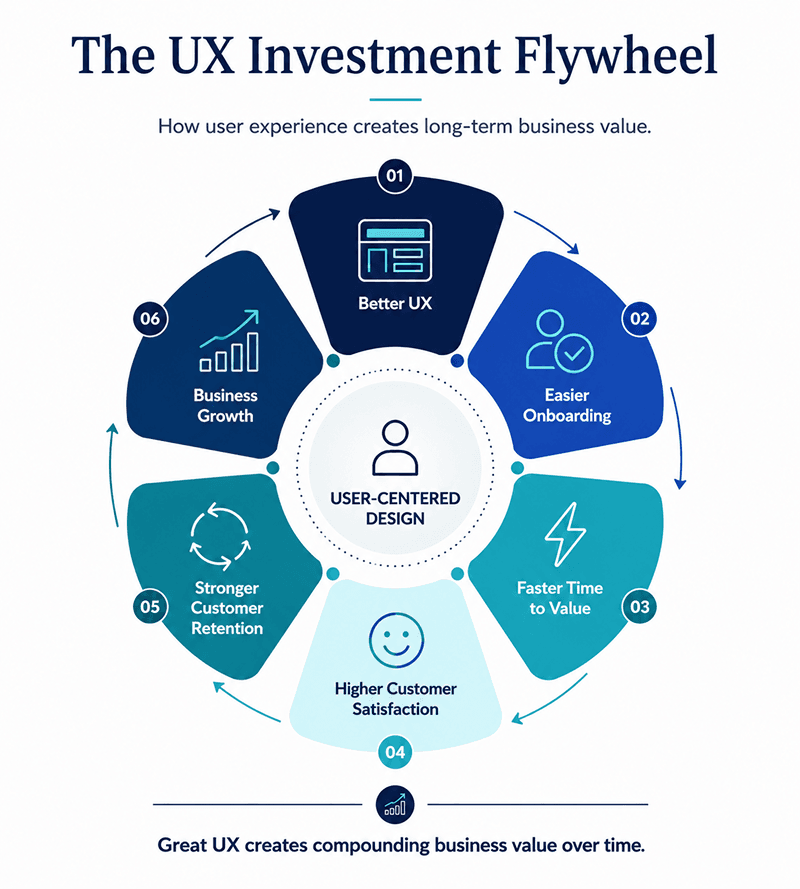
When organizations invest in UX, the goal isn't simply to create a more attractive interface. It's to make products easier to adopt, simpler to navigate, and of more value to the people using them.
That has measurable business implications.
McKinsey's The Business Value of Design studied 300 publicly listed companies over five years across multiple industries. The research found that organizations in the top quartile of design performance achieved 32 percentage points higher revenue growth and 56 percentage points higher total returns to shareholders than their industry peers.
There is no denying that every business is different. But the study reinforces an important point that applies to most businesses: organizations that consistently prioritize user-centered design are better positioned to deliver experiences that customers value. Over time, that can contribute to stronger adoption, greater customer satisfaction, and sustained business growth.
For SaaS companies, the takeaway is clear. Investing in UX isn't just about improving the interface. It's about removing friction, helping users reach value faster, and creating experiences that encourage long-term engagement.
Looking Beyond Salary: What an In-House UX Team Really Costs
When comparing an agency with an internal team, salary is usually the first number people look at.
It shouldn't be the only one.
According to the U.S. Bureau of Labor Statistics, the median annual wage for web and digital interface designers was $98,090. That provides a credible benchmark because it comes from an independent government source rather than self-reported salary platforms.
However, salary represents only one part of the investment.
| Cost Area | What It Includes |
| Salary | Base annual compensation |
| Benefits | Healthcare, retirement contributions, taxes, paid leave |
| Hiring | Recruiter fees, interviews, onboarding, equipment |
| Software | Design, prototyping, collaboration, and testing tools |
| Ramp-up Time | Time needed before a new hire reaches full productivity |
| Management | Mentoring, reviews, and collaboration with product and engineering teams |
Salary platforms such as Glassdoor and Payscale often report higher or lower figures depending on geography, company size, and experience level. These estimates are useful for understanding market ranges, but they should be treated as directional rather than definitive.
The more important question is not, "How much does a designer cost?" It's, "What level of design capability does this investment create?"
One experienced product designer may be exactly what your team needs. In another organization, the requirement might span user research, design systems, accessibility, and interaction design, making a UI UX design agency for SaaS a more practical choice in the short term.
Cost Is Only One Side of the Equation
One mistake we often see is comparing monthly agency fees with annual salaries as though they're equivalent. They aren't.
An internal hire is a long-term investment that builds institutional knowledge and becomes deeply embedded in your product. An agency is typically an investment in speed, specialist expertise, or additional capacity. Neither option is inherently cheaper.
The better question is which investment delivers the value your business needs right now.
For example, if your roadmap includes a major redesign, onboarding optimization, and user research over the next four months, hiring one designer may not provide enough capacity or specialist expertise.
On the other hand, if your product team needs someone participating in daily sprint planning, design reviews, and engineering discussions for years to come, building an internal team often creates stronger long-term value.
The Real Trade-Offs Start Long Before Cost
Once the numbers are on the table, it's tempting to reduce the decision to a financial comparison.
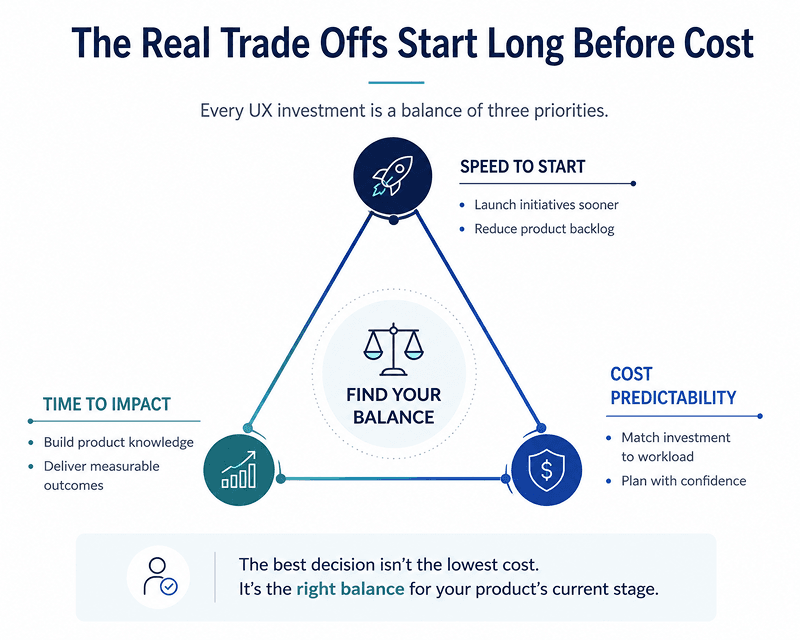
In practice, the most important trade-offs usually have nothing to do with salary or agency fees. They're about how quickly you need to move, how closely design needs to integrate with product development, and how your team works every day.
Speed to Start
If your team needs design support immediately, an agency almost always has the advantage.
Recruiting, interviewing, onboarding, and integrating a new hire can take weeks or even months. During that time, product work often continues to pile up.
An experienced agency already has designers, researchers, and established workflows in place, allowing projects to begin much sooner.
Remember, if your priority is launching faster or clearing a growing product backlog, partnering with an agency can reduce the time between identifying a problem and solving it.
Cost Predictability
At first glance, an internal hire may seem like the more predictable investment because you're paying a fixed salary. But predictability also depends on workload.
If design work is continuous throughout the year, an internal team often provides strong long-term value. If demand fluctuates with product launches, redesigns, or periodic research, paying for specialist support only when it's needed can be more efficient.
Instead of asking which option is cheaper, ask which one better matches the rhythm of your product development.
Time to Impact
Hiring doesn't end when someone accepts the offer. New team members need time to understand the product, customers, processes, and engineering culture before they reach full effectiveness.
An agency also requires onboarding, but experienced teams often arrive with proven frameworks, established collaboration models, and specialist expertise that shorten the path to meaningful outcomes.
When evaluating agency vs in-house SaaS web design models, don't compare only annual costs. Also consider how you'll measure the impact of that investment over time.
The Real Trade-Offs Continue Beyond Hiring
The first part of the decision is usually straightforward. How quickly can you get started? What will it cost? Who will own the work?
The harder questions appear as your product grows.
Will your team have access to the right expertise? Can you continue improving the experience as customer expectations evolve? Will your designers challenge existing assumptions or simply reinforce them?
These are the trade-offs that often determine whether design becomes a competitive advantage or just another delivery function.
Breadth of Specialist Expertise
Hiring your first UX designer doesn't automatically give your organization every design capability it needs. Modern SaaS products often require expertise across multiple disciplines, including:
- User research
- Information architecture
- Interaction design
- Design systems
- Accessibility
- UX writing
- Visual design
- Usability testing
Finding all of those skills in one person is uncommon. This is one reason many companies choose to outsource UX design during periods of rapid growth. Rather than hiring multiple specialists, they gain access to a multidisciplinary team that can scale based on project needs.
That doesn't mean agencies are always the better option. As products mature, some of these capabilities become strategic enough to build internally. The decision depends on whether the work is ongoing or occasional.
Simply put, if your product requires specialist expertise across several areas, partnering with a multidisciplinary team may be more effective than expecting one designer to wear every hat.
Fresh Perspective Helps Teams See What They've Stopped Noticing
One challenge that rarely appears on hiring spreadsheets is familiarity. The longer teams work on the same product, the easier it becomes to overlook usability issues because they already know how everything works.
The Nielsen Norman Group has long discussed this concept as "insider blindness." Product teams naturally develop assumptions that new users simply don't have.
We've seen this happen repeatedly. A workflow feels obvious because the team built it. Navigation appears logical because everyone uses it every day. Terminology makes sense because it's become part of the company's vocabulary. Customers don't share that context.
An external UX team often asks different questions because they approach the product without those assumptions. That fresh perspective can uncover friction that internal teams no longer notice.
This isn't an argument against internal designers.
It's a reminder that every team benefits from periodic outside perspectives, especially before major product launches or redesigns.
The Cost of Waiting Is Easy to Miss
Budget discussions often focus on the cost of hiring. A more useful question is:
What is the cost of doing nothing?
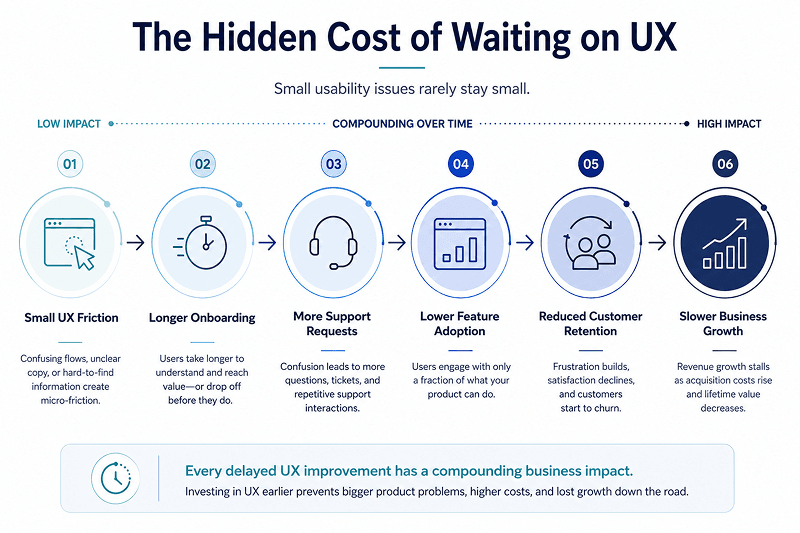
Delaying UX improvements has consequences that don't always appear in quarterly budgets. For example:
- Customers abandon onboarding before reaching value.
- Support tickets increase because workflows are confusing.
- Engineers repeatedly redesign features that could have been validated earlier.
- Sales teams struggle to demonstrate product value because the interface creates unnecessary friction.
- Users adopt only a fraction of available functionality.
None of these problems happen overnight. They accumulate gradually until growth slows or customer satisfaction begins to decline. When evaluating an in-house UX team vs design agency, don't compare only the cost of each option. Compare that investment against the cost of unresolved user experience issues. In many cases, improving UX earlier prevents significantly larger product and business problems later.
The Approach Many SaaS Companies Eventually Adopt: The Hybrid Model
Discussions around agency vs in-house UX design often assume you have to choose one approach forever. In practice, many successful SaaS companies don't.
As products grow, they combine internal ownership with external expertise. The internal team provides continuity. The external team provides flexibility. This balance allows organizations to respond to changing business needs without constantly expanding permanent headcount.
| Product Stage | Typical Team Structure | Why It Works |
| Early Stage | Founder, product manager, and agency support | Access specialist UX skills without building a full design department. |
| Growth Stage | Internal product designer with agency specialists | Combines daily product ownership with additional capacity during periods of rapid delivery. |
| Mature Stage | Dedicated internal design team with agency partnerships | Internal team owns strategy while agencies contribute specialist expertise, research, or large transformation projects. |
There isn't a single "correct" structure. The right model depends on how often design work occurs, the complexity of your product, and the capabilities your team already has.
From our experience at Millipixels, the strongest product teams rarely ask whether they should build internally or externally.
They ask a better question:
Which capabilities should we own, and which capabilities are more effective to bring in when needed?
That shift in thinking usually leads to better long-term decisions.
What Happens When You Find the Right UX Partner?
If your product has grown faster than its user experience, you're not alone. Many organizations reach a point where adding new features isn't enough. People need to find what they're looking for faster, complete tasks with less effort, and have a consistent experience across every device.
That's exactly where one education organization serving more than 5,000 school districts found itself.
The organization partnered with Millipixels to rethink the experience from the user's perspective. Before making design decisions, our team conducted UX audits, user research, and journey mapping to understand where educators were experiencing friction. Those insights shaped a simpler, mobile-first experience that made it easier to discover and purchase educational resources.
The impact was felt quickly. Within the first month of launch, conversions increased by 23%, mobile engagement improved by more than 40%, and the more intuitive experience contributed to an estimated 30% reduction in support intervention.
Every product has different challenges, but the lesson remains the same. When you invest in understanding your users first and build the right UX capability around their needs, better business outcomes naturally follow. That's the approach we bring to every engagement at Millipixels.
Choosing the Right Model Starts with the Right Questions
Before making a hiring decision, take a step back and evaluate your current situation. The table below isn't designed to give you a definitive answer. Instead, it helps identify which model naturally aligns with your immediate priorities.
| If this sounds like your situation... | Agency | In-House | Hybrid |
| You need UX support within the next few weeks | ✓ | ||
| Design is part of every sprint | ✓ | ✓ | |
| You need user research, accessibility, and design systems expertise | ✓ | ✓ | |
| You already have design leadership but need additional delivery capacity | ✓ | ||
| Product knowledge and long-term ownership are critical | ✓ | ✓ | |
| Your workload changes significantly throughout the year | ✓ | ✓ |
A Simple Self-Assessment Before You Decide
By now, it's probably clear that there isn't a universal answer to the agency versus in-house debate.
The better question is whether your current design capability matches your product's needs.
Before making a decision, use this checklist with your leadership team.
- Is design work becoming a continuous part of product development rather than an occasional project?
- Do product and engineering teams need a designer involved in daily decisions?
- Is your biggest challenge speed, specialist expertise, or long-term ownership?
- Are usability issues affecting customer adoption, retention, or support costs?
- Do you need capabilities such as user research, accessibility, or design systems that go beyond a single generalist designer?
- Has your team become so familiar with the product that it's difficult to spot usability issues objectively?
The more "yes" answers you have, the easier it becomes to identify whether you should build internally, partner externally, or combine both approaches.
Conclusion: Choose the Right Capability, Not Just the Right Team
Choosing between a SaaS UX design agency and an in-house team isn't about finding a permanent winner. It's about investing in the design capability your product needs today while building a foundation for where you want it to go next.
Every SaaS company reaches this decision at a different stage, and the right answer depends on your product, your team, and your growth goals. The best approach is the one that helps you deliver better experiences for your users while supporting your business in the long run.
If you're still weighing your options, don't start by asking which model is better. Start by understanding the capability your product needs most.
At Millipixels, we help SaaS teams evaluate their design maturity, identify capability gaps, and determine whether an in-house team, external partnership, or hybrid approach makes the most strategic sense. Book a UX strategy consultation with our team to get a practical recommendation tailored to your product, roadmap, and growth stage.
Frequently Asked Questions
1. Agency vs in-house UX: Which is better for SaaS?
There isn't a single answer because the right choice depends on your product's stage, the complexity of your design needs, and how your team operates.
A SaaS UX design agency is often the better fit when you need to move quickly, require specialist expertise, or have project-based work such as onboarding redesigns, usability testing, or launching new products. Agencies also give you access to researchers, interaction designers, and design system specialists without hiring multiple full-time employees.
An in-house UX team becomes more valuable when design is part of your day-to-day product development. Designers working alongside product managers and engineers build deep product knowledge, participate in every sprint, and continuously improve the user experience based on customer feedback.
2. What are the advantages of an in-house UX team?
An in-house UX team offers several long-term advantages:
- Deep understanding of your product, customers, and business goals.
- Daily collaboration with engineering and product teams.
- Faster design decisions during development sprints.
- Strong ownership of design systems and product consistency.
- Continuous improvement based on user feedback rather than project timelines.
If UX has become a core part of your product strategy, building an internal team often creates lasting value.
3. How do I choose between an in-house team and an agency?
Instead of comparing job titles, compare business needs. Ask yourself:
- Is design work continuous or project-based?
- Do you need support immediately or can you invest in hiring?
- Does your product require specialist skills like UX research, accessibility, or design systems?
- Will designers need to work closely with engineering every day?
- Is your priority long-term ownership or faster execution?
If you need speed, specialist expertise, or temporary capacity, partnering with a UI UX design agency for SaaS is often the practical choice. If design influences every product decision, building an internal team usually delivers greater long-term value.
4. How do I find a reliable UX design agency?
Don't choose an agency based solely on its portfolio. Instead, evaluate whether it understands SaaS products and product strategy.
Look for an agency that:
- Has experience with SaaS product design rather than only marketing websites.
- Can explain its UX research and design process.
- Shares measurable outcomes instead of focusing only on visuals.
- Understands product metrics such as activation, retention, and user adoption.
- Works collaboratively with internal product and engineering teams.
The best design agencies for SaaS companies act as strategic partners. They ask thoughtful questions, challenge assumptions, and make recommendations based on user needs rather than design trends.
5. What is SaaS product design?
SaaS product design is the process of designing digital software products that are intuitive, scalable, and easy to use throughout the customer journey.
It goes beyond creating attractive interfaces. It includes user research, information architecture, interaction design, onboarding, usability testing, accessibility, and continuous improvements based on user behavior.
The goal is to help users accomplish tasks efficiently while improving product adoption, engagement, and retention.
6. How does UX design impact SaaS conversions?
UX design influences every stage of the customer journey, from the first product interaction to long-term retention.
A well-designed SaaS experience helps users understand your product faster, complete key actions with less effort, and reach value sooner. Better onboarding reduces drop-offs during sign-up, intuitive workflows increase feature adoption, and clear navigation minimizes frustration that often leads users to abandon a product.
Good UX also improves business metrics beyond conversions. It can lower support requests, shorten onboarding time, increase customer satisfaction, and improve retention because users are more likely to continue using software that feels intuitive and reliable.
For SaaS businesses, conversions are rarely driven by marketing alone. They are heavily influenced by how easily users can experience the value your product promises. A thoughtful UX strategy ensures that every interaction moves users closer to that outcome.
Written by

Parthsarathy Sharma
With 4+ years of experience across AI, UX, GCC/outsourcing, enterprise technology, and brand strategy, Parthsarathy brings a research-driven lens to digital experience content. His work focuses on turning emerging technology, customer experience, and business trends into clear, practical perspectives for readers.
Reviewed by

Ashley Alemao
Ashley is a UX Designer focused on complex enterprise systems, with 4 years of experience across cybersecurity and energy logistics. His work blends research, strategy, interaction design, accessibility, and UX writing to make compliance-heavy products clearer and easier to use.
- Introduction
- Most Agency vs In-House Comparisons Start with a Bias. Let's Start with Transparency.
- You Are Not Choosing Designers. You Are Choosing Design Capability.
- The Real Question Is: What Stage Is Your Product In?
- Do You Need to Hire Anyone Yet?
- What the Data Actually Says About Investing in UX
- The Real Trade-Offs Start Long Before Cost
- The Real Trade-Offs Continue Beyond Hiring
- The Approach Many SaaS Companies Eventually Adopt: The Hybrid Model
- What Happens When You Find the Right UX Partner?
- Choosing the Right Model Starts with the Right Questions
- A Simple Self-Assessment Before You Decide
- Conclusion: Choose the Right Capability, Not Just the Right Team
- Frequently Asked Questions